Alcohol and Recovery Data: What Your Wearable Sees
Two glasses of wine at dinner. Nothing dramatic. The next morning your Garmin says Body Battery 32, HRV is 15 percent below your rolling average, and resting heart rate is up 4 bpm. The instinct is to blame the sensor. The sensor is right.
What your watch or ring picked up is alcohol metabolism printing itself onto your autonomic nervous system. This guide explains what is actually happening, how long the signal lasts, why the common workaround (taking Saturday easy, hammering Sunday) often backfires, and how a coach reading that data should adjust the next 48 hours of training.
The honest angle first: the wearable data on alcohol is more reliable than most people want to admit, and the popular framing of "a couple of drinks won't hurt" undersells the autonomic cost by roughly a full day.
What the Data Actually Shows
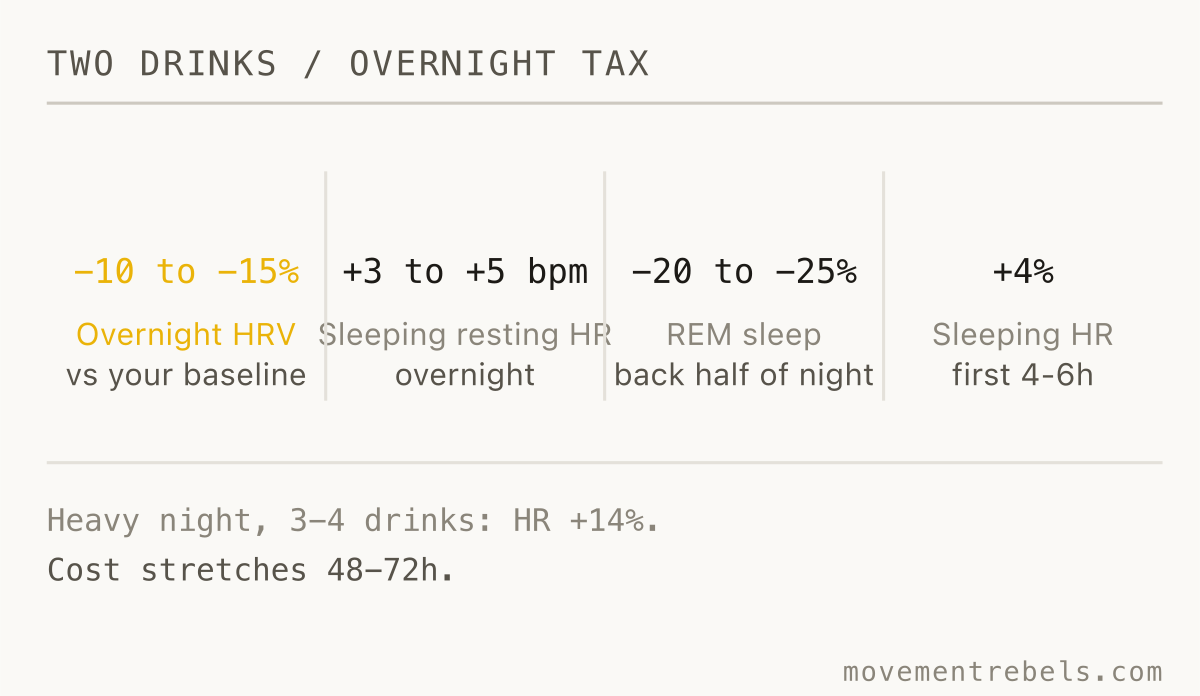
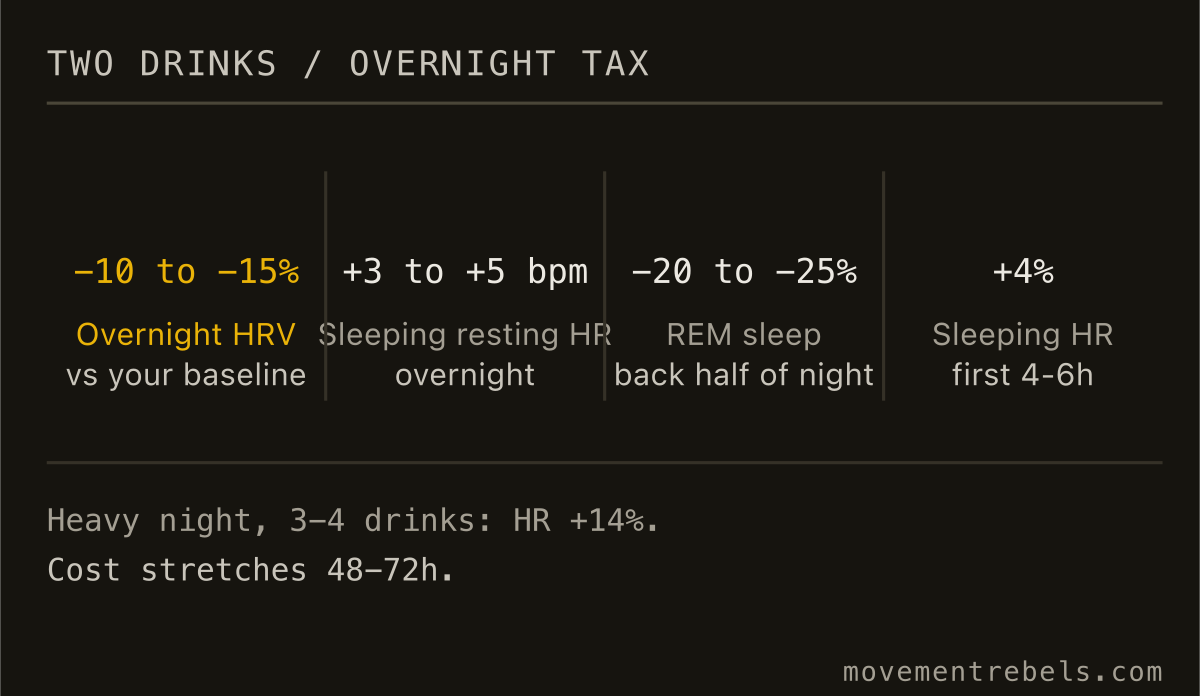
A controlled dose-response laboratory investigation published in the journal Sleep found that two drinks are the threshold where cardiac autonomic disruption becomes measurable: heart rate during the first four to six hours of sleep runs roughly 4 percent faster than placebo; total HRV and high-frequency vagal HRV (RMSSD, the metric your wearable reports) are both suppressed through much of the night, with higher doses producing effects that extend closer to morning. Three to four drinks pushed HR roughly 14 percent faster than normal for most of the first six hours of sleep.
A Finnish real-world study using employer wellness data confirmed the same pattern in free-living conditions. Across drinking nights versus non-drinking nights within the same individuals, researchers found dose-dependent suppression of a proprietary HRV-derived recovery score and elevated sleeping HR, with larger doses producing larger effects.
In practical wearable terms, that translates to:
- HRV drops 10 to 15 percent below your personal baseline the night of drinking. Heavy sessions can push the drop past 30 percent. Your device reports your rolling average for a reason; a single absolute number is not the signal, the deviation from your own trend is.
- Resting heart rate rises 3 to 5 bpm overnight, sometimes more. Sleeping RHR is the cleanest indicator here because daytime readings absorb caffeine, stress, and movement noise.
- REM sleep is suppressed. Alcohol promotes sleep onset (the sedative effect is real) while fragmenting the back half of the night through rebound sympathetic arousal. You feel "asleep but not rested" because the architecture is wrong, not because of weak mindset.
- Respiratory rate ticks up as the liver clears acetaldehyde. Devices that track this metric catch it reliably.
The mechanism is not mysterious. Alcohol is a sympathetic stressor at a time the body is supposed to be parasympathetic-dominant. Acetaldehyde, the first metabolite, is mildly toxic and pulls metabolic resources to clear it. Add mild dehydration and disrupted thermoregulation and you get an autonomic profile closer to mild illness than true rest. That is not an exaggeration. It is what the autonomic nervous system looks like on those nights.
Why the Dip Lasts Longer Than a Hangover
Most recreational athletes assume the data normalises once the headache fades. It does not.
Sleep debt accrued on night one means night two tends to run with elevated sympathetic activity, even when alcohol is gone and you feel fine. The research broadly supports the picture that full autonomic recovery from a moderate drinking session takes longer than a single morning, and heavier sessions extend that window further. If the dose was three to four drinks, a perfectly normal Saturday night of sleep may not fully restore HRV by Monday morning.
This is the part the "I'll just take it easy the next day" approach misses. Drink Friday, take Saturday easy, feel fine by Sunday morning, go long. The watch tells a different story: HRV still below baseline, Saturday sleep fragmented by autonomic rebound, resting HR still 2 to 3 bpm elevated. Sunday's long run feels harder than the pace suggests, and the recovery cost rolls into the next training week. The compounding is subtle and consistent enough that it shows up clearly on a 30-day HRV chart once you start logging drink nights.
The Protein Synthesis Problem
Sleep quality is half the story. The other half is what alcohol does to the structural repair that should happen the night after a training session.
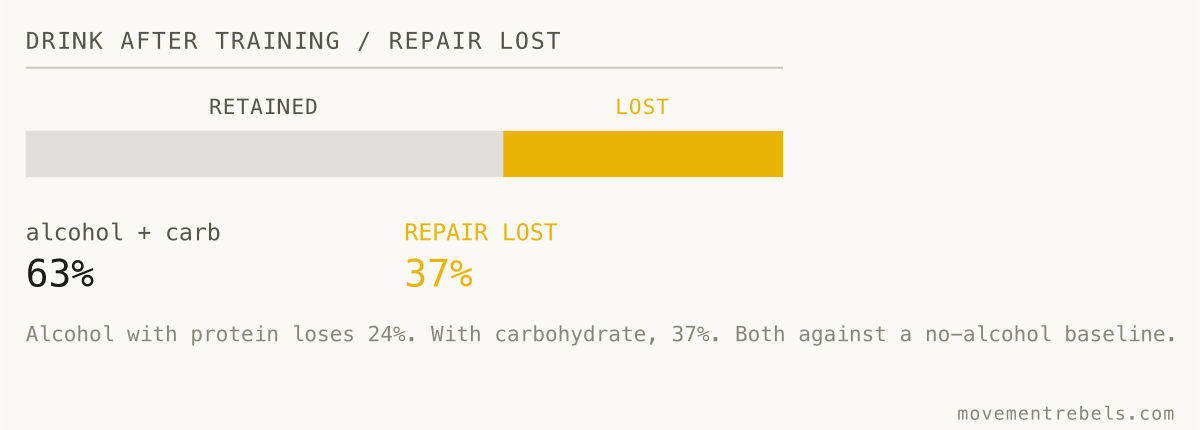
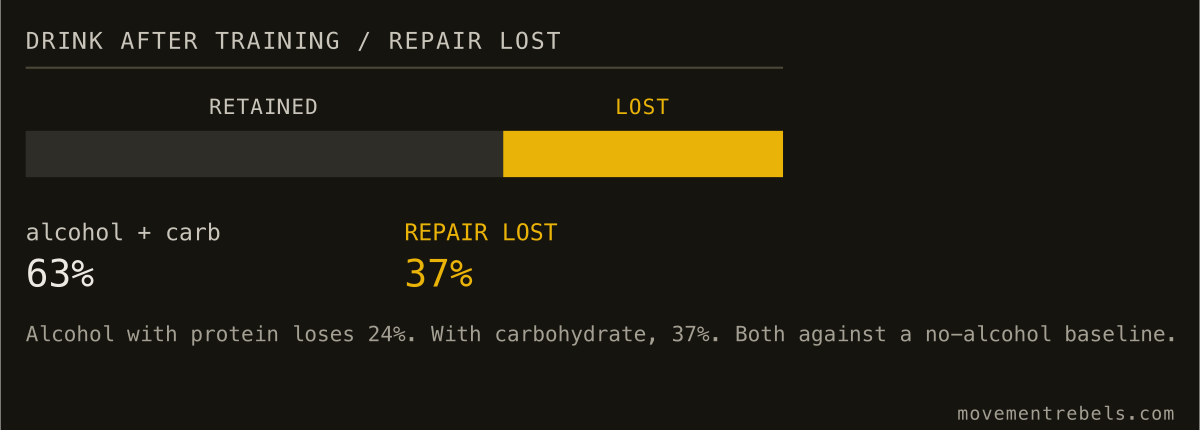
A peer-reviewed PLOS One study found that alcohol co-ingested with protein after concurrent exercise impaired maximal rates of myofibrillar protein synthesis by up to 24 percent, and by 37 percent when co-ingested with carbohydrate instead of protein. The mTOR pathway, which governs translation initiation in muscle repair, was suppressed even when nutrition was otherwise adequate.
That means the night you drink after a hard training day is precisely when the cost lands hardest. You are not just sleeping worse. You are blunting the adaptation the session was supposed to produce.
What Your Wearable Is Telling You
The metric to trust most is overnight HRV trend versus your personal rolling baseline, not a single reading. One 12 percent dip that recovers cleanly in 48 hours is a manageable cost. The same dip stretched across three nights is a meaningful signal that something is being suppressed past normal noise.
Cross-check three indicators when alcohol is in the picture:
- Sleeping RHR versus your 14-day average. A persistent 3-plus bpm elevation is your clearest "still recovering" signal.
- HRV trend, not absolute number. Day-to-day HRV is noisy. The seven-day rolling line is the one to watch.
- Sleep stage distribution, specifically REM percentage. A meaningful drop in REM share is a sign sympathetic drive is still elevated.
If you log drinks alongside a readiness check, patterns emerge quickly. Two drinks twice a week looks much worse on a 30-day HRV chart than one social Saturday. Most people find that surprising until they see it.
The HRV-guided training guide covers how to read your personal baseline and act on deviations without overreacting to single data points. That context matters here because a one-night alcohol dip and a one-night overtraining dip look similar in isolation. History and context separate them.
How a Coach Should Adjust the Next 48 Hours
This is where data turns into smarter training rather than guilt or a rest day taken without understanding why.
When the morning data shows a 12 percent HRV dip and a 4 bpm RHR rise, the appropriate response is load adjustment, not cancellation:
- Threshold or VO2max work scheduled for that day gets demoted to Zone 2. Sympathetic systems are already taxed. Hammering them further is how a one-night dip becomes a one-week suppression. The when to deload guide covers the threshold between "adjust the day" and "adjust the week."
- Strength sessions stay on the calendar with a volume trim. Neural drive is intact but eccentric recovery is blunted by the protein synthesis impairment. Pull one or two top sets, keep the movement.
- Fuel aggressively. People underfuel the day after drinking because appetite is suppressed and "I'll just be clean today" kicks in. Under-eating that day impairs the recovery you are already behind on. The fueling around long sessions guide is worth reading alongside this one. If you are 600 kcal under target by late afternoon, you are compromising the next day as well.
- Hydration is rate-limiting. Autonomic recovery runs slower when fluid status is off. The compounding of alcohol-induced dehydration and under-fueling is where mild "one night" damage turns into a three-day hole. You can estimate your daily water intake to offset alcohol dehydration and see hydration tracking for athletes for practical targets.
- NSDR (non-sleep deep rest) in the afternoon is one of the few interventions with a plausible mechanism for nudging HRV upward acutely by shifting the nervous system toward parasympathetic tone. Twenty minutes is enough.
Two days later, when HRV is back inside the normal band, harder work resumes. No drama, no punishment session, no "making up" for Friday.
The overtraining signs guide is useful context here: the autonomic signature of a moderate drinking night overlaps considerably with early non-functional overreaching, which is why the same conservative response applies.
A Practical Honest Framing
The skeptic position on wearables is worth naming: consumer HRV is noisy, algorithms differ between devices, and the absolute numbers are not directly comparable to lab-grade measurements. That is true. The accuracy claim worth accepting is narrower and more robust: your device's deviation from your own rolling baseline is a reliable signal of autonomic state change, even if the absolute RMSSD number is not a clinical grade measurement.
The economist angle is also worth naming: sleep tracker companies, alcohol wellness products, and recovery supplement brands all have incentives to tell you either "a glass of wine is fine, relax" or "even one drink is devastating you, buy this HRV monitor." The honest dose-response evidence lands between both. Two drinks produce a real and measurable autonomic cost that persists well past the morning after. Heavy drinking extends that window further. Zero drinks overnight produces better sleep quality on average. That is what the data shows.
For endurance athletes, the resting heart rate trends guide provides the 28-day trend context you need to distinguish alcohol-related RHR elevation from fitness-driven downward trends. Both show up on the same chart.
How Movement Rebels Handles This
Most apps ignore alcohol entirely or treat every dip as a crisis. Movement Rebels reads Garmin data natively and reads Apple Health through the native iOS app. That is how data from Oura (which exports sleep, HRV, and resting HR to Apple Health) reaches the coaching layer. WHOOP does not export its recovery or strain scores to Apple Health, so WHOOP scores themselves are not available to the coach. But any heart rate, sleep, or activity data your device pushes to Apple Health gets read.
When the morning data shows the autonomic dip, the coach adjusts the next two days of planned training automatically. The plan you open Monday morning is not the same plan if Friday night happened, and you do not need to remember to dial it back manually. After a strength session or long run, the coach writes a session summary back to your Strava activity. One app reads the wearable, plans the week, logs the strength session, tracks macros, and connects to the tools you already use, instead of adding another dashboard to check.
Pricing
Movement Rebels is one app for the full picture: strength, endurance, hybrid, planning, coaching, fueling, recovery, tracking. A 7-day free trial covers the entire surface. After the trial, Pro+ is $20/month for unlimited coaching. No card on the trial.
One app instead of five.
Strength, endurance, recovery, fueling, planning, and your AI coach. All under a 7-day free trial. No card.
Start 7-day trialHRV-Guided Training: Read the Signal, Skip the Noise
One low HRV night tells you almost nothing. The 7-day-vs-28-day trend tells you nearly everything. Here is what the evidence actua
Sleep and Training Performance: The Lever Nobody Respects
Sleep outperforms every supplement, wearable, and recovery tool you own. Here's the honest evidence, what actually trashes it, and
When to Deload: Reading the Signals Right
The 4-week deload rule is a template, not a law. Here are the actual physiological signals that tell you when your body is asking
Resting Heart Rate Trends: The 28-Day Line
One morning's RHR is mostly noise. Your wearable's sensor can swing 5 bpm on a good night. The 28-day rolling mean is where the si