Building Your Aerobic Base: The Long, Slow Training Phase Everyone Skips
Every athlete who races eventually hits a wall. The fast workouts get faster, but race performance flatlines or declines. The problem is not the workouts, it's the foundation underneath them. Base building is the phase where you build that foundation, and it's also the phase almost everyone skips because it feels too slow and too long. It takes 8-16 weeks to build a real aerobic base, and most athletes give it 3-4 weeks before wanting to race.
What aerobic base is
Your aerobic system is your fat-burning engine. It includes mitochondrial density (the power plants inside your muscle cells), capillary development (the tiny blood vessels that feed those cells), and the ability to burn fat at high speeds. When your aerobic base is weak, you must burn carbs to go hard, and carbs run out in 60-90 minutes. When your aerobic base is strong, you can sustain high speeds on fat for hours, which means your carbs are preserved for the final race effort.
Elite endurance athletes reflect this in their training distribution. A systematic review of elite training distributions found that cross-country skiers spend approximately 84-95% of preparation-phase training at zone 1 intensity, with rowing ranging from 70-95% and cycling from 77-88% depending on sport and season phase. That is not an accident. It is the only way to build a sustainable engine.
The other benefit is durability. A weak aerobic base forces you to accumulate training stress at high intensities, which wears out your central nervous system and raises injury risk. A strong base lets you build hard sessions on top of an enormous volume of low-stress training.
How long does base building take
The duration depends on your starting point and how much aerobic fitness you retained from the prior season.
- Coming back after time off (3+ months): 12-16 weeks. You are rebuilding from nearly zero.
- After a short off-season (1-2 months): 8-12 weeks. Your aerobic enzymes did not fully downregulate.
- Maintaining from a prior block: 4-6 weeks. You are topping up what is already there.
The minimum threshold for real change is 4 weeks at consistent low intensity. A research study tracking Zone 2 training over 4 weeks found that athletes training at 3 hours per week demonstrated measurable improvements in aerobic base despite "low training volume and minimal intervention time". Lower volumes produced mixed or negative results. But 4 weeks is the floor. Meaningful adaptations require at least 8 weeks, and the deepest gains happen between weeks 8-16.
Plan for base building after your race season ends, before you start training for your next objective. It is a distinct phase, not something you layer on top of hard training.
The 80/20 rule: why base is 80% of your training
The 80/20 training principle states that approximately 80% of training volume should occur at low intensity, with only 20% at moderate to high intensity. This distribution was documented by Stephen Seiler in studies of elite endurance athletes and confirmed in a 2015 systematic review of elite training distributions. It appears across elite cross-country skiers, marathon runners, and professional cyclists, without any deliberate copying between disciplines. For athletes training under eight hours a week, the gains from pyramidal and polarized distributions are similar; the 80/20 split is most pronounced at elite training volumes of 15 or more hours per week.
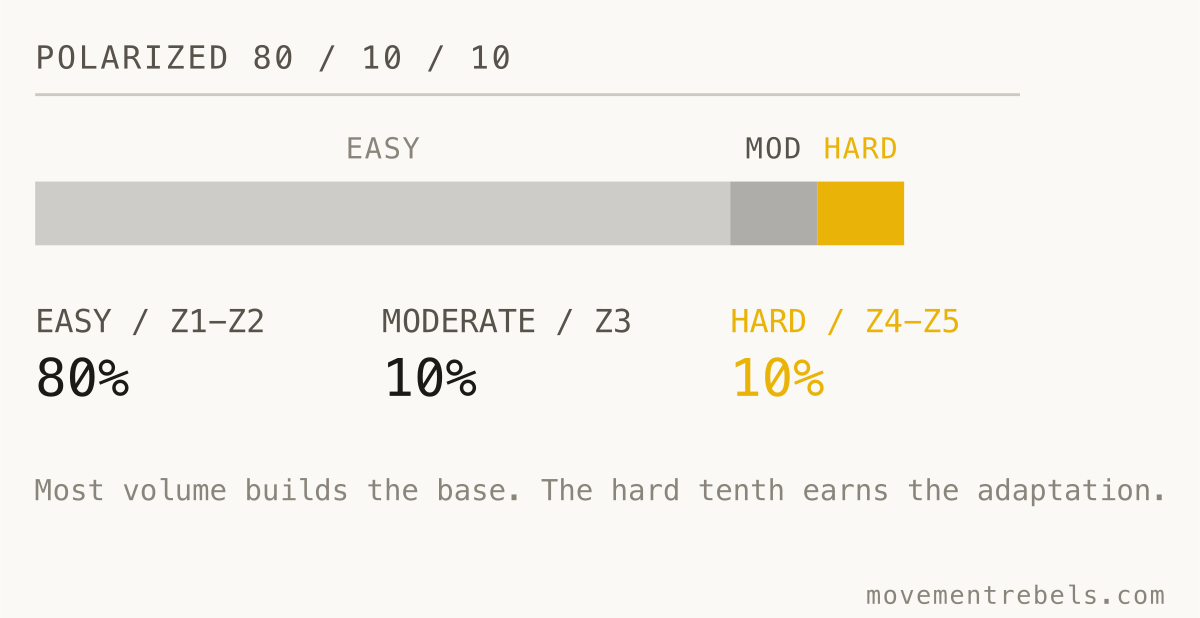
During a pure base-building block, your distribution is even more skewed. You are doing 85-95% at zone 1-2, with maybe one Zone 3 (threshold) session per week or none at all. The point is accumulating low-intensity volume without the fatigue that would suppress aerobic adaptations.
Most of the evidence on intensity distribution points the same way: athletes who hold close to the 80/20 split improve more than athletes who sneak in extra hard sessions trying to get faster. The extra intensity backfires because fatigue suppresses the aerobic adaptations they were chasing.
Zone 2 intensity: where the work happens
If you want a full breakdown of Zone 2 mechanics, heart-rate targets, and the conversation-pace test, see the companion guide on Zone 2 training. The summary relevant to base building is here.
Zone 2 sits at approximately 60-70% of your maximum heart rate, or the intensity where you can hold a conversation but cannot sing. This is not random. Research defines the upper boundary of Zone 2 as the first ventilatory threshold (VT1), the metabolic point where fat oxidation is optimized, with peak fat burning (FatMax) occurring at an intensity somewhat below VT1.
The practical signal is easier than the physiology. You should be able to talk in full sentences without breathing hard. If you cannot, you are too fast. If you are barely breathing, you are too slow. For a number to check the talk test against, a VDOT calculator sets your easy pace band from a recent race. Runners training on feel alone tend to drift fast on the days their legs feel good, which is how a base block quietly turns into a tempo block.
During base building, you will spend the majority of your time here. A sample week might look like:
- Monday: 45-60 minutes Zone 2
- Tuesday: Complete rest or 20 minutes easy jog
- Wednesday: 60-90 minutes Zone 2
- Thursday: Complete rest or cross-training at Zone 1 (yoga, strength)
- Friday: 45-60 minutes Zone 2, or one 20-minute Zone 3 threshold effort if you have a race coming
- Saturday: 90-180 minutes Zone 2 (your long session)
- Sunday: Rest or 20-30 minutes Zone 1 easy walking
The total is high volume, but at minimal intensity. Your legs feel fresh, your heart rate never spikes, and you recover completely between sessions.

What happens in your body during base building
Three key adaptations happen during this phase.
Mitochondrial growth. Low-intensity, long-duration training triggers the production of new mitochondria in your muscle cells. These are your cellular power plants, and more of them means more capacity to produce energy from fat without relying on carbohydrate. Research consistently shows that sustained low-intensity endurance work is a potent stimulus for mitochondrial biogenesis, and studies comparing training intensities find that aerobic capacity improvements from low-intensity training are similar to moderate-intensity training when total energy expenditure is equal.
Capillary density. Your body builds new capillaries to feed those mitochondria. This network development takes time. Eight weeks of consistent low-intensity work creates visible improvements in how efficiently oxygen reaches your muscles.
Fat oxidation capacity. You train your body to extract more energy from fat stores at higher speeds. In early base building, you might burn fat efficiently up to around 65% of max heart rate. After a full 12-week base block, that ceiling tends to shift upward in well-documented but highly individual ways. This is the change that carries forward into your hard training: you preserve carbs for the final effort because the base workload runs on fat.
The signal is increased power or speed at the same heart rate. In week 4, a 150 BPM effort in Zone 2 might hold 180W on the bike or a 6:15 minute per km pace while running. By week 12, the same 150 BPM might hold 195W or a 6:00 pace. You are faster without training faster.
Base building is boring, and that is the point
The mental challenge of base building is that it feels slow. You will see athletes running at 10:00 mile pace in your running group, and they will feel leisurely. But a 10:00 mile at 155 BPM is the right intensity for base building, and holding it for 90 minutes is the work, not the pace.
The other mental barrier is comparison. Harder workouts produce faster times and feel more "productive" than a long, slow run. But the hard workouts will not improve race performance without the base underneath them. A 6 by 3-minute VO2max session feels like training. An 80-minute Zone 2 run at conversational pace feels like an easy day. The Zone 2 work is the training.
Commit to the slow. Use the time for focused effort at a controlled intensity. Use a training app that tracks your data in real time, like Movement Rebels, which reads your Garmin or Apple Health data and adjusts your training based on how your recovery is tracking day to day. The app sees your zone distribution and can warn you if you are drifting into higher intensities when you should be building base. Build the monotony. The speed comes after.
When base building is done and how to transition out
Three signals tell you the base phase is complete and you are ready to move into threshold and race-prep work.
Pace drift at the same heart rate. If your Zone 2 pace has improved by 30-60 seconds per kilometer (or 15-25W on the bike) at the same heart rate over 8-12 weeks, the aerobic adaptations have taken hold. The engine is bigger.
Recovery is fast. After a 90-120 minute Zone 2 session, you feel recovered the next morning with no heavy-leg fatigue. That is a sign your aerobic system is running on fat, not burning through glycogen and leaving yourself in deficit.
Resting heart rate has dropped. If you are tracking resting heart rate via Garmin or Apple Health, a 3-7 BPM drop from baseline over the block is a reliable signal of improved cardiac efficiency.
When these signals appear, begin transitioning intensity over 2-3 weeks. Do not cut Zone 2 volume in half overnight. Shift one session per week toward threshold, hold the long Zone 2 session, and reduce the shorter Zone 2 sessions. By week 3 of the transition, you should be at 70/30 low-to-high before entering a full build phase. Cutting base abruptly forfeits the aerobic capacity you spent weeks building.
Common mistakes in base building
Mixing in too much intensity. One threshold session a week is fine if you have a race coming and want to maintain some sharpness. Adding multiple Zone 3-5 sessions during base building suppresses the aerobic adaptations you are trying to build. Hard sessions trigger a different set of adaptations (anaerobic capacity, power), and doing both at once is worse than doing one at a time.
Stopping too early. Four weeks of Zone 2 is a start, not a base. Eight weeks is better. Twelve weeks is where elite athletes see the biggest returns. Cutting it short means your capillaries, mitochondrial density, and fat-oxidation capacity do not fully develop. Then, when you move into your hard phase, you do not have the engine to support it.
Not varying your zone 2 duration. Your long run or long ride should be 75-180 minutes depending on your sport and goal. Your short sessions should be 30-45 minutes. Doing only 45-60 minute Zone 2 sessions means you miss the capillary stimulus of longer efforts and the intensity-distribution signal of shorter sessions. Vary the long sessions from week to week, and the weekly variation will drive more complete adaptations.
Assuming low intensity means no effort. Low-intensity is not zero-intensity. You are teaching your body to work at a sustained level for hours. The effort is metabolic, not neurological. You are learning to consume fat and hold a steady output, not crushing yourself.
Skipping strength. Aerobic base building pairs well with 1-2 strength sessions per week, kept separate from your long endurance sessions. Strength does not compete with base building. It builds resilience and complements the aerobic work. See strength training for endurance athletes for a framework that fits into base.
How Movement Rebels fits
The challenge in base building is doing the right intensity at the right time without the monitoring and feedback that keeps it honest. The Movement Rebels coach reads your Garmin or Apple Health data in real time and sees your training intensity distribution across the week. It knows when you are drifting into Zone 3 during sessions meant for Zone 2. It knows how much recovery you have left after a long session and whether you should extend the next day's work or dial it back. It also reads your strength logs and meal data from Snap Meal, so it knows whether you have the capacity to extend a long session or if your glycogen deficit is too deep.
During base building, the coach uses this data to make sure your easy days stay easy, your long days land on a day when recovery is available, and your rare hard sessions land on days when you have already accumulated some fatigue but not so much that form breaks down. Over 12 weeks, this coherence turns a block of slow training into a foundation that carries you through every hard phase that follows.
Start your base phase now. Schedule 8-12 weeks before your next race objective and hold the intensity down until the pace at the same heart rate improves.
One app instead of five.
Strength, endurance, recovery, fueling, planning, and your AI coach. All under a 7-day free trial. No card.
Start 7-day trialTissue Capacity: The Training Quality Runners Never Measure
Your tendons and bones adapt far slower than your aerobic engine. Here is how to build tissue capacity so a fitness peak does not
Heat Acclimation When You Train in a Cold Climate
Preparing for a hot race when you live somewhere cold. Sauna protocols, hot baths, overdressing, and the plasma-volume adaptation
Zone 2 Training: When It Works, When It's a Waste
Zone 2 is real, old, and oversold. Here's the honest version: when low-intensity volume is your highest-leverage work, when it isn
Zone 2 Heart Rate: Find Your Real Z2
Your watch zone is probably wrong. 220-age misses individual max HR by 10-15 bpm. Here's how to find your actual LT1 ceiling with