Zone 2 Heart Rate: Find Your Real Z2

The number your watch calls Zone 2 is probably not your Zone 2. It is a population formula applied to your individual physiology, and the error is large enough to matter. Getting it right changes nothing about the theory and everything about the result.
Here is the honest version: the 220-age formula was never a training prescription. It was a rough epidemiological estimate from a 1971 review by Fox, Naughton, and Haskell that was never derived from original research. Fox drew a line on a graph, got a tidy number, and the fitness industry ran with it for fifty years. The standard deviation is 10-12 bpm. That means if your watch says your Zone 2 ceiling is 145, your real ceiling could be anywhere from 130 to 160 and the formula would have no way to know. At that error range, you are not tuning training zones. You are guessing.
This guide is about closing that gap without a $250 lactate test.
What the formula is actually doing wrong
There are two layers of error, and both compound.
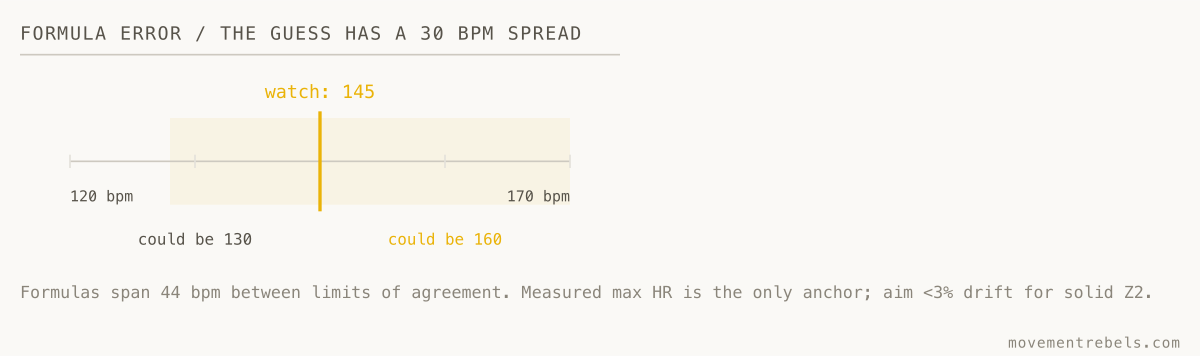
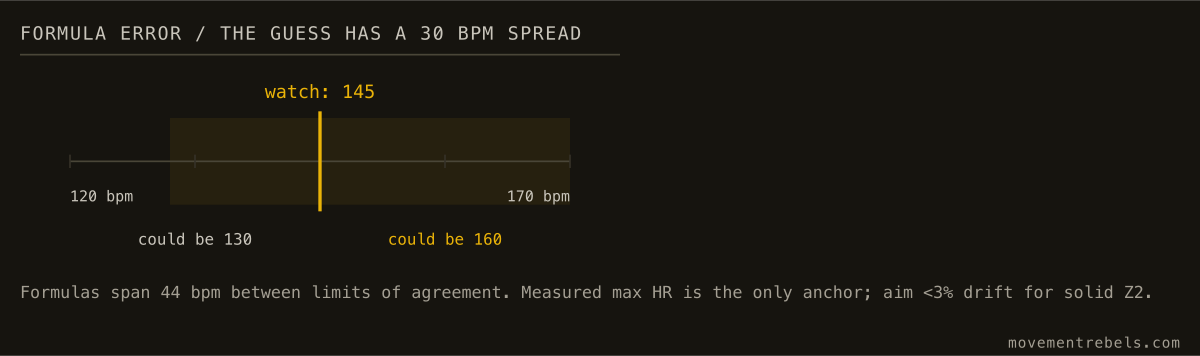
The first is max HR. Tanaka's 2001 meta-analysis of 351 studies (492 subject groups, 18,712 subjects) produced the cleaner formula (208 minus 0.7 times age), but it still carries a standard deviation near 10 bpm. Research comparing age-predicted formulas against graded exercise tests consistently finds that the limits of agreement between predicted and measured max HR can span 40 bpm or more at the individual level. No formula works well individually. Measured max HR from an actual test is the only reliable anchor.
The second layer is how watches chain off that broken max. Garmin's default five-zone model, Apple Fitness zones, every generic plan from every generic app, all anchor on the predicted max, then apply fixed percentages (50-60%, 60-70%, etc.) to carve out zones. But LT1, the physiological event that defines Zone 2, does not fall at a fixed percentage of max HR. Trained athletes tend to hit LT1 higher relative to their max. Untrained adults hit it lower. Masters athletes hit it at a different spot than their age-matched peers. Individual variation in heart rates at LT1 and LT2 is large enough to make percentage-based zones unreliable for zone training at the individual level.
None of this means zones are useless. It means you need to calibrate to yourself, not to a default.
What Z2 actually is
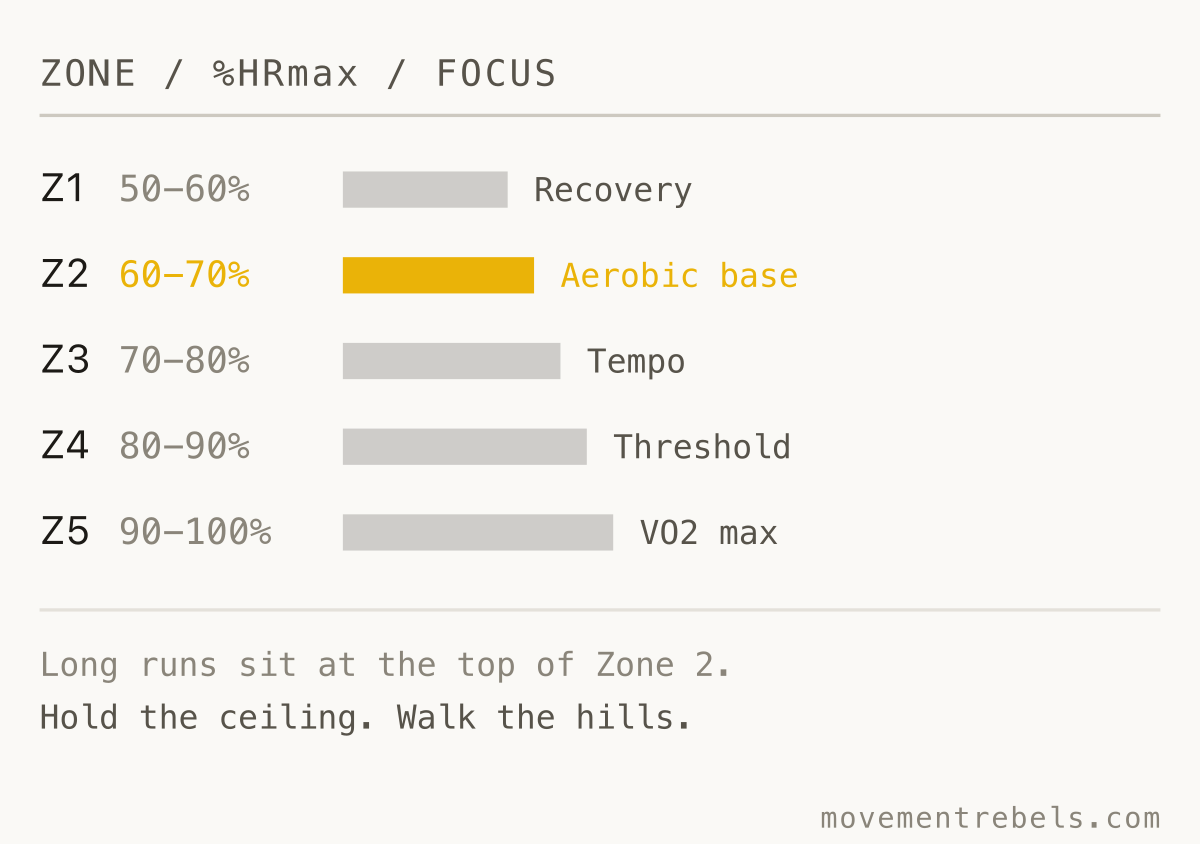
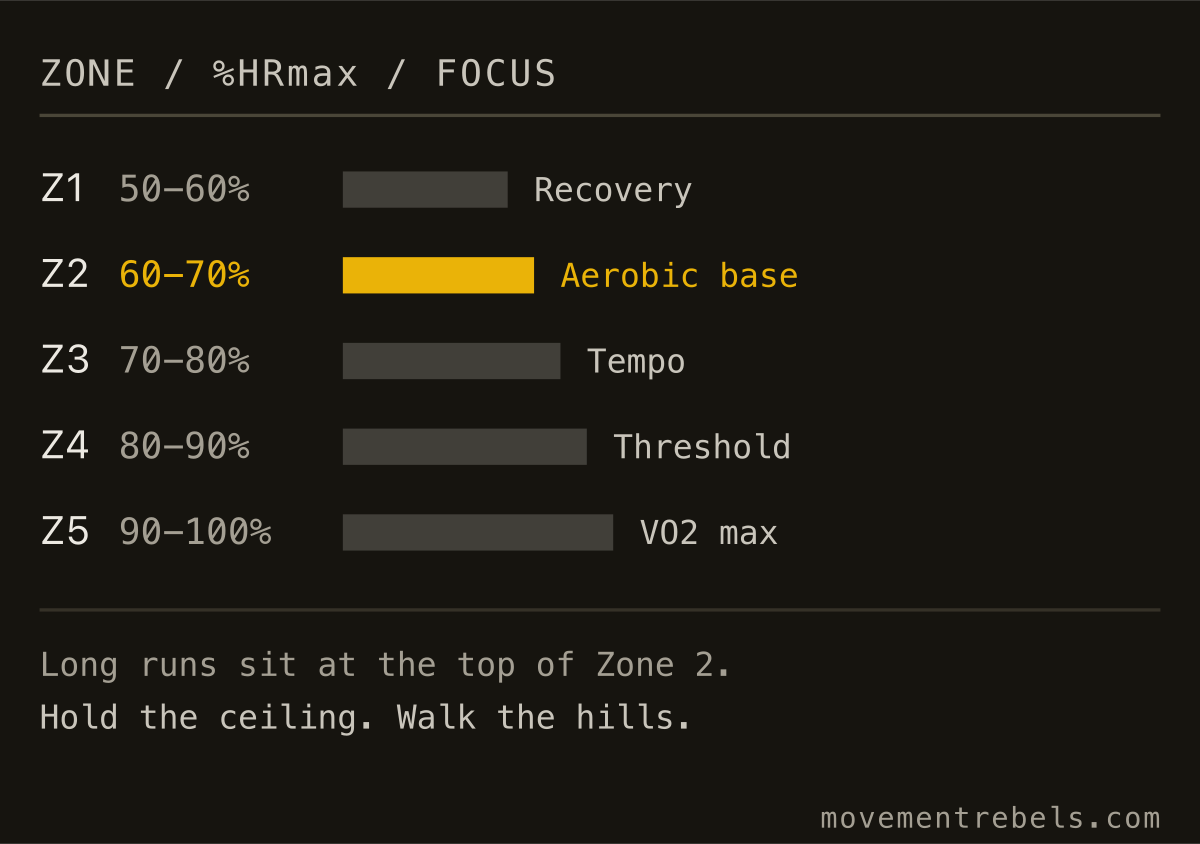
Zone 2 is the highest intensity at which your lactate stays at or near resting baseline, roughly 2 mmol/L, because your slow-twitch fibers and mitochondria are clearing lactate as fast as they produce it. In exercise physiology this is the first lactate threshold, LT1. Below it you are burning predominantly fat, mitochondrial density is the primary adaptation, and you can hold the intensity for hours if you stay fueled. Above it, lactate accumulates, glycolytic fiber recruitment increases, and the recovery cost climbs.
The practical version: it is the pace where you can hold a conversation and breathe entirely through your nose. It feels almost embarrassingly easy if you have any fitness at all. That discomfort is how you know it is working.
There is also a myth worth killing early. Zone 2 is real, but the claim that it is the only intensity that drives mitochondrial adaptation is an overstatement. High-intensity intervals hit the same pathway by a different route. Zone 2's actual edge is volume: you can accumulate hours at LT1 without digging a recovery hole, week after week. Take volume out of the equation and the advantage shrinks. Read the companion piece on Zone 2 training for the full honest filter on when it is your highest-leverage work and when it is not.
Four ways to find your real Z2 ceiling
1. Lab lactate test
A step-protocol test on a treadmill or bike, with finger-prick blood draws at each stage, is the gold standard. LT1 is the inflection point where lactate first rises 0.3-0.5 mmol/L above baseline. Cost: $150-300. Accuracy: within 2-3 bpm. Worth it once a year if you are training seriously toward a race goal. For everyone else, the methods below are close enough.
2. Talk test
Research supports the talk test as a valid proxy for the first ventilatory threshold, which tracks closely with LT1. A 2022 systematic review found that the last comfortable speech stage shows workload, oxygen uptake, and heart rate "not different from the same parameters related to the first ventilatory threshold," with criterion validity rated as very good.
In practice: at your Z2 ceiling you can speak a full sentence, six to eight words, without gasping mid-phrase. The moment you start chunking into three-word bursts, you have crossed LT1. Note that HR at this point, run a few sessions using it as the ceiling, and watch whether it holds across terrain and temperature.
Crude but calibrated to your body, and it recalibrates automatically as you get fitter.
3. Nose-only breathing check
A simpler real-time signal: close your mouth and breathe only through your nose. The intensity at which you cannot sustain nasal breathing for five or more minutes is roughly LT1, give or take. Use it as a ceiling check mid-session rather than a zone-setting protocol.
4. Heart rate drift test
Fifty minutes at a steady effort you believe is Zone 2. Compare average HR in the first 25 minutes to average HR in the second 25 minutes. If HR drifted more than 5% (not 5 bpm, 5 percent of the first-half average) at constant pace and conditions, you were above LT1. Drop 5 bpm and repeat the test. Less than 3% drift indicates solid aerobic base work at or below the ceiling. Between 3-5% is borderline.
This method does double duty: it finds your ceiling and confirms whether you are hitting it on subsequent sessions. It also catches the two confounders that ruin easy days, heat and under-fueling. A 90-minute Z2 run in the sun will drift 8-10 bpm even at the right intensity. That is dehydration and thermoregulation, not zone error. Cross-reference conditions when reading drift.
Starting point: heart rate reserve
Before running any of the above, seed a working estimate. Take your resting HR (measured lying down before you get up, averaged over three mornings), your best estimate of true max HR from an actual hard effort, then apply: Z2 ceiling = resting HR + 0.65 times (max HR minus resting HR). This will land you in the right neighborhood. Validate it with one of the four methods above. Treat it as a hypothesis, not an answer.
The smartwatch problem
A 2025 study comparing Garmin, Huawei, and COROS smartwatch-derived lactate threshold estimates against graded exercise testing found mean absolute errors of approximately 9-12 bpm at the individual level, even when group averages looked acceptable: COROS 8.9 bpm, Huawei 10.7 bpm, Garmin 11.4 bpm. Garmin's test succeeded on only 65% of attempts. The study recommended complementing device estimates with subjective indicators: "rather than depending exclusively on smartwatch thresholds."
The practical read: your watch's auto-detected LT1 or Zone 2 cap is a starting point, the same as 220-age is a starting point. It is not the answer. The talk test and drift method cost nothing and give you a tighter calibration within two or three sessions.

Common Z2 execution mistakes
Defending pace on hills. Heart rate is the zone boundary, not pace. Zone 2 on a climb is a shuffle. If you defend pace, you blow out of Z2 within a minute.
Skipping fuel. Z2 trains fat oxidation, but fat oxidation runs on a glycogen background. Train three consecutive days 600 kcal under target and your next Z2 run turns into a glycolytic slog. The adaptation you are chasing requires fuel. See the guide on fueling around long sessions.
Treating the zone as fixed year-round. As aerobic fitness improves, your LT1 shifts upward. The absolute heart rate ceiling changes. Re-run the drift test every four to six weeks if you are in a consistent training block. If your Z2 runs feel easier at the same HR, that is a signal to test whether the ceiling has risen.
Using heat days to validate zones. A humid 28-degree afternoon will push HR 8-15 bpm above cool-day values at identical effort. Set zones in controlled conditions and note the modifier for hot days.
Running Z2 too long, too soon. The two-hour Z2 ride is an advanced stimulus. Start at 30-45 minutes and build. Sitting in Z2 for too long before the aerobic base is there to support it just adds fatigue without extra adaptation.
How HRV interacts with your Z2 day
Your target HR ceiling for any given session is not fixed. Your resting autonomic state is. On days where HRV is suppressed and resting HR is elevated (common after poor sleep, high stress, or a hard training block), your perceived Z2 effort will push HR higher than your calibrated ceiling. You have two sensible options: run by feel with the talk test as your guide, or accept that today's Z2 is at a lower absolute ceiling. Either is fine. What is not fine is defending the HR number while your body is already paying a recovery tax. The guide on HRV-guided training covers how to read that signal and when to dial back before digging a hole.
The same logic applies to the relationship between resting HR trends and Z2 execution. A rising resting HR over two to three weeks is an early warning sign. See resting heart rate trends for how to use that 28-day line as a training modifier rather than a panic signal.
How Movement Rebels handles this
You do not need to set zones manually. When you sync your first real workout through Garmin (native OAuth connection, the coach reads completed activities and pushes structured sessions back to your watch) or through Apple Health on the iOS app (reads HRV, sleep, resting HR, and workouts from HealthKit), Movement Rebels seeds a working Zone 2 ceiling from your HR reserve, then narrows it across the first month using the drift pattern in your actual data.
If your "Z2" sessions consistently drift more than 5% over 50 minutes, the coach tightens the prescribed ceiling for the next session. If they drift under 3%, it tests a slightly higher ceiling. Over four to six weeks the prescribed range converges on your real LT1 without a lab visit.
The coach also reads context the drift number alone cannot see. If your Apple Health data shows a short sleep the night before, your prescribed ceiling for the next session adjusts before the session starts, not after you blow past it. If a Garmin-synced activity shows you running the entire second half 12 bpm above the cap on a day that was hotter than average, the coach notes that separately rather than treating it as a zone miscalibration. If you use Strava, the coach writes a structured session summary back to the activity description after each workout, so your debrief lives in the same place the activity does.
A well-calibrated Zone 2 is also the foundation for everything harder. If you are building toward a marathon with heart rate data or following a periodized plan, the LT1 ceiling you set now is the baseline the coach references when prescribing tempo work, threshold intervals, and race-pace sessions. To turn a recent race result into matching paces, a VDOT calculator for your easy and threshold paces gives you the targets that sit on top of that floor. Getting the floor right is what makes the ceiling meaningful.
Pricing
Movement Rebels is one app for strength, endurance, hybrid, coaching, fueling, recovery, and tracking. A 7-day free trial covers the full surface. After the trial, Pro+ is $20/month for unlimited coaching. No card on the trial.
Heart Rate Zone Calculator
Find your five training zones, including Zone 2.
One app instead of five.
Strength, endurance, recovery, fueling, planning, and your AI coach. All under a 7-day free trial. No card.
Start 7-day trialZone 2 Training: When It Works, When It's a Waste
Zone 2 is real, old, and oversold. Here's the honest version: when low-intensity volume is your highest-leverage work, when it isn
HRV-Guided Training: Read the Signal, Skip the Noise
One low HRV night tells you almost nothing. The 7-day-vs-28-day trend tells you nearly everything. Here is what the evidence actua
Marathon Training With Heart Rate Data: The Honest Playbook
HR-based marathon training is powerful and misunderstood. The honest version: what cardiac drift means for race day, when pace bea
Periodization for Recreational Athletes: Which Model, and How Much You Need
Linear, block, undulating: the honest evidence on which periodization model recreational athletes actually need, and what the rese