Half Marathon Training Plan: A 10-12 Week Build That Works
The half marathon punishes the runner who trains it like a 10K and the runner who trains it like a marathon. It sits in an awkward middle: long enough that aerobic endurance decides your second half, fast enough that your threshold pace is close to what you hold for much of the race. Get those two engines built in the right proportion over 10 to 12 weeks and you run an even, controlled 21.1 km instead of fading from kilometer 15.
This guide lays out what the distance demands, how to structure the weeks, the two sessions that carry the build, how to fuel a 90 to 120 minute effort, how to taper, and how to pace the race so you finish strong.
What the half marathon demands
For most recreational runners the half takes 1:30 to 2:45, with the majority of finishers landing somewhere around 2:00 to 2:15. That means you are racing for roughly 90 to 165 minutes. Two physiological qualities decide the outcome:
- Threshold pace. The fastest pace you can hold without lactate piling up faster than you clear it. How close your half marathon pace sits to this depends heavily on your finishing time. Faster runners, finishing under roughly 1:45, race at or very near their threshold for the duration. Slower runners, finishing in 2:00 or more, race significantly below their threshold: their threshold is closer to 10K pace, not half marathon pace. Either way, raising your threshold raises everything. A VDOT calculator gives you that threshold pace from one race result, along with the easy and interval paces that sit either side of it.
- Aerobic endurance. The base that lets you hold a strong pace deep into the race without your form, breathing, and pace falling apart. This is built by volume at easy intensity, not by going hard.
The build is mostly easy running with two quality sessions a week. If you race the half well, you have a high threshold pace sitting on top of a deep aerobic base. Skip the base and your threshold work has nothing to stand on. Skip the threshold work and you can run forever but never fast.
Most easy running should sit in Zone 2, conversational, around 65-75% of max heart rate. If you are not sure where that line is, read Zone 2 heart rate and set it properly before week one.
Weekly structure across a 10-12 week build
Four to five runs a week works for most people targeting a competitive time. Three runs a week works if you are also lifting or short on time, but expect a more modest result. The non-negotiable shape:
- 2 quality sessions per week (one threshold, one long run with pace work)
- 2 to 3 easy runs in Zone 2 to build the base
- 1 full rest day minimum, two if you lift hard
A representative midweek for a runner aiming around 1:50:
- Monday: rest or 30 min easy
- Tuesday: threshold session (the tempo day)
- Wednesday: 40-50 min easy, Zone 2
- Thursday: rest or 30 min easy
- Friday: 30-40 min easy
- Saturday: long run, 90-120 min, with HM-pace segments later in the block
- Sunday: rest
Volume should climb gradually. A common rule: increase weekly distance by no more than about 10% week over week, then every third or fourth week cut volume by 25-30% to absorb the work. That down week is not optional. It is when the training you did becomes fitness. For how to phase these blocks across the full 12 weeks, periodization for recreational athletes covers the structure in depth, and when to deload covers the signals that you need the cut week early.
The arc across the block: weeks 1-4 build base volume and introduce threshold work, weeks 5-9 sharpen with longer threshold reps and HM-pace in the long run, weeks 10-12 taper into the race.
The long run: your most important session
The long run builds the aerobic engine and teaches your legs to hold form when tired. Two mistakes ruin it.
The first is making it too short. Work toward a long run of 90 to 120 minutes, or 16 to 20 km, by mid-block. You do not need to run the full race distance in training. Time on feet matters more than hitting 21 km in practice.
The second mistake is running it too fast. This is the most common error in half marathon training. Most of your long run should be easy, Zone 2, a pace you could hold a conversation at. If it leaves you wrecked for two days, it was too hard and you stole from the rest of your week.
Once you have a base, start adding race-pace work inside the long run. This is where the long run becomes specific to the half:
- Weeks 5-7: finish the last 15-20 minutes at HM goal pace
- Weeks 8-9: run the middle or final 6-8 km at HM goal pace inside an otherwise easy run
- A sample week-8 long run: 8 km easy, 6 km at HM pace, 3 km easy to finish
Practicing goal pace on tired legs teaches you what race pace feels like when it is hard, which is the only time it matters.
Threshold work: the session that raises your ceiling
The threshold session is your second quality day and the one that lifts your sustainable pace. Run at a "comfortably hard" effort, the pace you could hold for about an hour in a race, roughly 83-88% of max heart rate. You should be able to say a few words at a time, not hold a conversation.
Two formats, alternate them across the block:
- Continuous tempo: 20-30 minutes at threshold after a 15 min warm-up, then 10 min easy to finish
- Threshold intervals: 4 to 6 reps of 5-6 minutes at threshold with 90 sec easy jog between. Easier to hold the right intensity, slightly more total volume at pace
Effort matters more than chasing a number on the watch. If your threshold pace is 4:50/km and you find yourself at 4:30 because you feel good, you are no longer doing threshold work, you are doing a race you will pay for on Thursday. Stay disciplined. For the full breakdown of pacing, duration, and the difference between tempo and threshold, the tempo run guide goes deeper than there is room for here. If you train by heart rate, marathon training heart rate explains how to set your zones and why pace alone lies on hilly or hot days.

Fueling for 90 to 120 minutes
A sub-90-minute half can be run on a good breakfast and water. Past 90 minutes, and for anyone targeting 2 hours or more, fueling during the race changes your last 5 km.
The target during the race:
- 30-60 g of carbohydrate per hour for efforts up to about 2 hours
- For most half marathoners, that means one gel around the 45-50 minute mark, a second around 80-85 minutes if you are running longer than 1:45
- Take gels with a few sips of water, not a sports drink, to avoid doubling up on sugar concentration and upsetting your stomach
A race nutrition planner for 90 to 120 minutes sets the carb, fluid, and sodium numbers for exactly that effort length so you can rehearse them in your long runs.
The rule that saves races: nothing new on race day. Whatever gel, drink, or timing you plan to use, practice it in your long runs from week 5 onward. Your gut has to be trained to absorb carbs while you run, and a stomach that handles a gel fine on the couch can rebel at HM pace. Fueling around long sessions covers pre-run meals, during-run carbs, and recovery timing in detail, and gut training for carb tolerance is worth reading if gels have ever sent you looking for a portable toilet.
The morning of the race: a familiar breakfast 2 to 3 hours out, mostly carbs, low fat, low fiber. Sip water up to start. Do not arrive at the line dehydrated and do not overdrink either.
The taper: do less, arrive fresh
The taper is the two to three weeks before race day where you cut volume while keeping enough intensity to stay sharp. Done right, you arrive rested with the fitness intact. Done wrong, you either show up tired or flat.
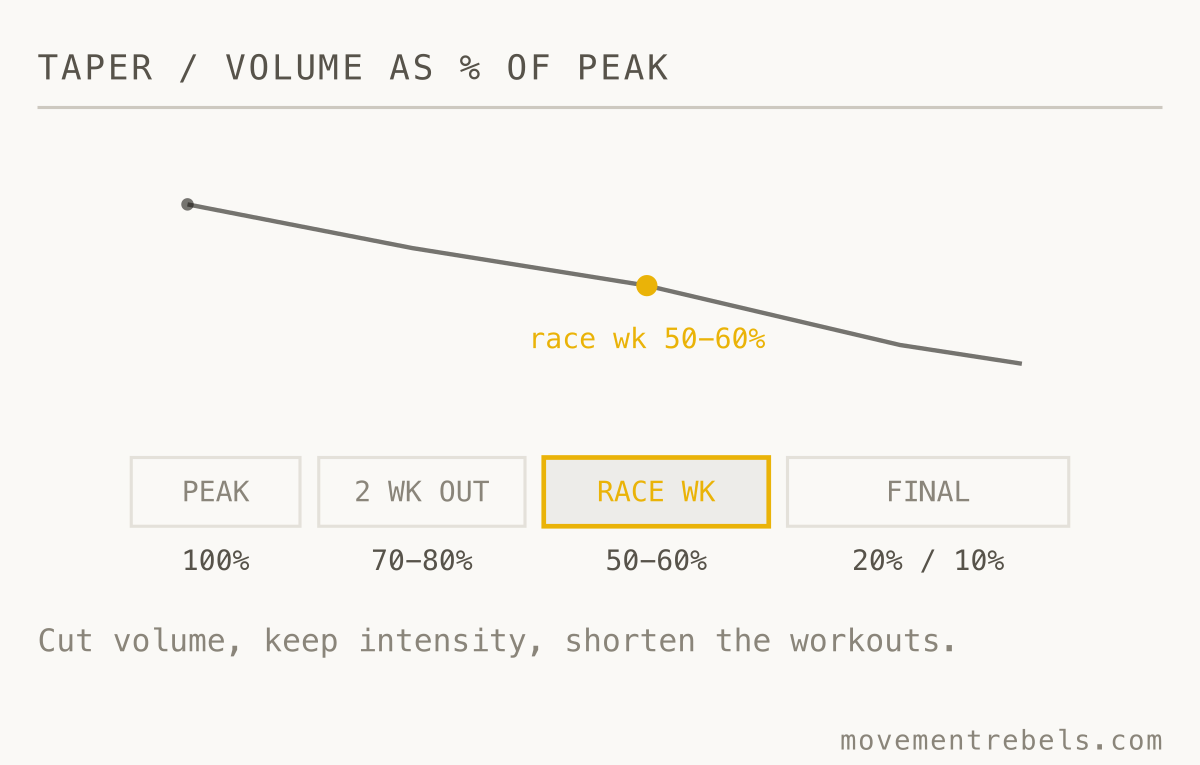
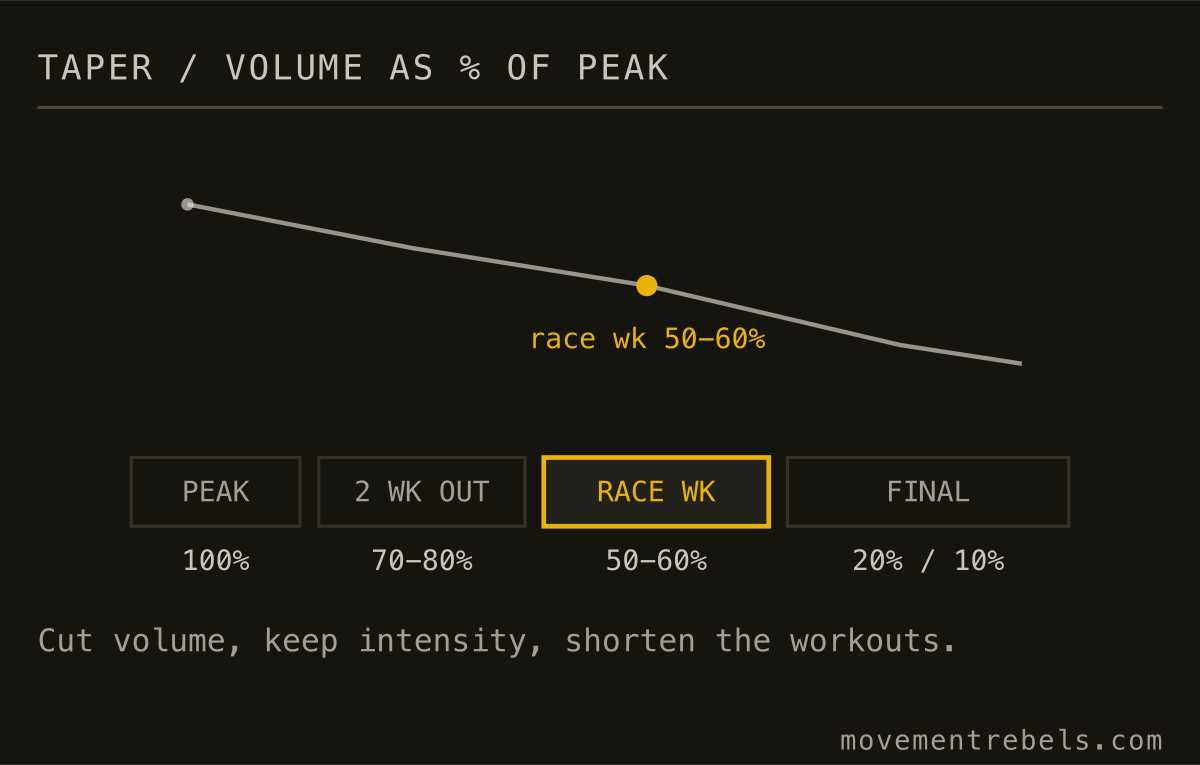
The principle: cut volume, keep intensity, shorten the workouts.
- Two weeks out: drop total volume to about 70-80% of peak. Keep one threshold session but shorten it. Last long run of 80-90 minutes max
- Race week: volume around 50-60% of peak. A short, sharp session early in the week (3-4 reps of 3 min at HM pace) to keep the legs awake. Easy short runs after that
- Two days before: rest or 20 min gentle. The day before, rest or a 15 min shakeout with a couple of 30 sec pickups at race pace
A taper calculator for the final weeks builds the week-by-week volume cut from your peak so you arrive fresh without guessing the numbers.
Resist the urge to cram. No workout in the final 10 days will make you fitter. It can only make you tired. Trust the work you already did.
Race pacing: keep it controlled
The single biggest avoidable mistake is going out too hard. Adrenaline, fresh legs, and the crowd push most runners faster than goal pace in the opening kilometers. The problem is you will not feel the cost at kilometer 3. You will feel it at kilometer 16, and it will cost you far more time than you gained early on.
The evidence broadly supports aiming for even pacing or a very slight negative split, meaning the second half slightly faster than the first. Some large-scale race analyses show that the best recreational performances tend to involve very slight positive splits rather than negative ones, which suggests that avoiding dramatic variation, not running the second half dramatically faster, is the real goal. What the evidence consistently agrees on: going out more than a few seconds per kilometer faster than goal pace in the opening 3 km tends to result in a significantly slower finish. A conservative buffer of 3-5 seconds per kilometer slower than goal pace in the first few kilometers is a reasonable target.
Practically:
- First 3 km: hold goal pace or a touch slower. Let it feel easy. It should
- Km 3 to 15: lock into goal pace. This is where discipline pays
- Km 15 to 19: hold the pace as it starts to hurt. This is the race
- Final 2 km: if there is anything left, spend it
To estimate goal pace honestly, base it on a recent threshold session or a tune-up race, not on what you wish you could run. A recent shorter race fed into a race time predictor for your half marathon goal gives you a grounded target, and a race pace band calculator for even splits turns that target into per-kilometre markers you can carry on race day. A realistic goal you execute beats an ambitious one that blows up at km 14 every time.
How Movement Rebels fits
The Movement Rebels AI coach reads your Garmin and Apple Health data, sees your real easy runs, threshold sessions, long runs, heart rate, and recovery, and builds each week around what you did rather than a generic template. If a long run leaves your HRV flat or you miss a session, the plan adjusts the next week instead of pushing you into a hole. You get the structure of a real build with the weekly judgment a static PDF can never make.
Build the base, run the long runs easy, keep the threshold work honest, practice your fueling, taper properly, and pace the first 3 km with discipline. That is the whole plan. The hard part is having the patience to run easy when you feel good and the nerve to hold back when the gun goes off.
One app instead of five.
Strength, endurance, recovery, fueling, planning, and your AI coach. All under a 7-day free trial. No card.
Start 7-day trialHow to Fuel a Marathon: Race-Day Nutrition From Start Line to Finish
Marathon fueling that holds up past 30K: carb loading numbers, race morning timing, carbs per hour, drinking to thirst, caffeine d
Tempo Runs: Threshold Done Right
Tempo run physiology, honest pacing ranges, three session variants, and why the popular HR zone is wider than coaches admit. Build
Marathon Training With Heart Rate Data: The Honest Playbook
HR-based marathon training is powerful and misunderstood. The honest version: what cardiac drift means for race day, when pace bea
Carbohydrate Timing for Athletes: Fueling Around Long Sessions
How many grams of carbohydrate and when: 1 to 4 g/kg before training, 30 to 90 g per hour through long sessions, and the 4 hour re