WHOOP vs Oura vs Garmin: Which One Earns Its Place?
Accuracy is the wrong question. Each of these three measures something different and sells a different story to a different athlete, which is why the argument never resolves: the people having it are not buying the same thing. Buy the wrong one and you spend twelve months staring at a metric that does not answer your question.
Short version. Garmin wins for active training, GPS, and long-term value. Oura wins on sleep staging and recovery signal, in the smallest footprint of the three. WHOOP wins for cardiovascular strain tracking, no screen, subscription only. None of them program your training. That takes more than a sensor.
The core tradeoff each brand made
WHOOP dropped the display on purpose. No watch face, no notifications, nothing to tap. The pitch: you stop checking the strap and start acting on its recovery score. Hardware ships with a subscription, and there are three tiers right now, $199/yr (One), $239/yr (Peak) and $359/yr (Life), with the strap included at each. Strain is the most coherent daily cardiovascular load metric of the three, because it reads what a hard session cost you in cardiovascular terms rather than in minutes.
Oura made a ring, and the form factor is the accuracy story: a ring sits against a finger artery with no motion noise from arm swing, which is why its photoplethysmography signal comes through cleaner than any wrist sensor. Sleep staging is the flagship. You can wear the Gen 4 for weeks and forget it is there. The tradeoffs are real: no real-time workout heart rate you would pace intervals with, no GPS, and $5.99/month once the first free year runs out. New ring purchases include 12 months of membership at no cost.
Garmin has been building the same ecosystem for 30 years. A Forerunner, Fenix, Epix or Venu gives you GPS, optical heart rate, running power, paired cycling power, overnight HRV, body battery, training load, a VO2 max estimate and multi-day recovery readouts. Sanity-check that headline VO2 max number with a VO2 max calculator, which computes it from a field test so you can compare. You pay once. Connect keeps core features off the subscription paywall. Optical HRV accuracy trails Oura's ring placement (more on this below) and the daily strain framing is less elegant than WHOOP's, but the watch shows you the workout while you are inside it: real splits, pace targets, structured interval cues on the wrist. Different product.
Sleep and HRV: what the evidence actually says
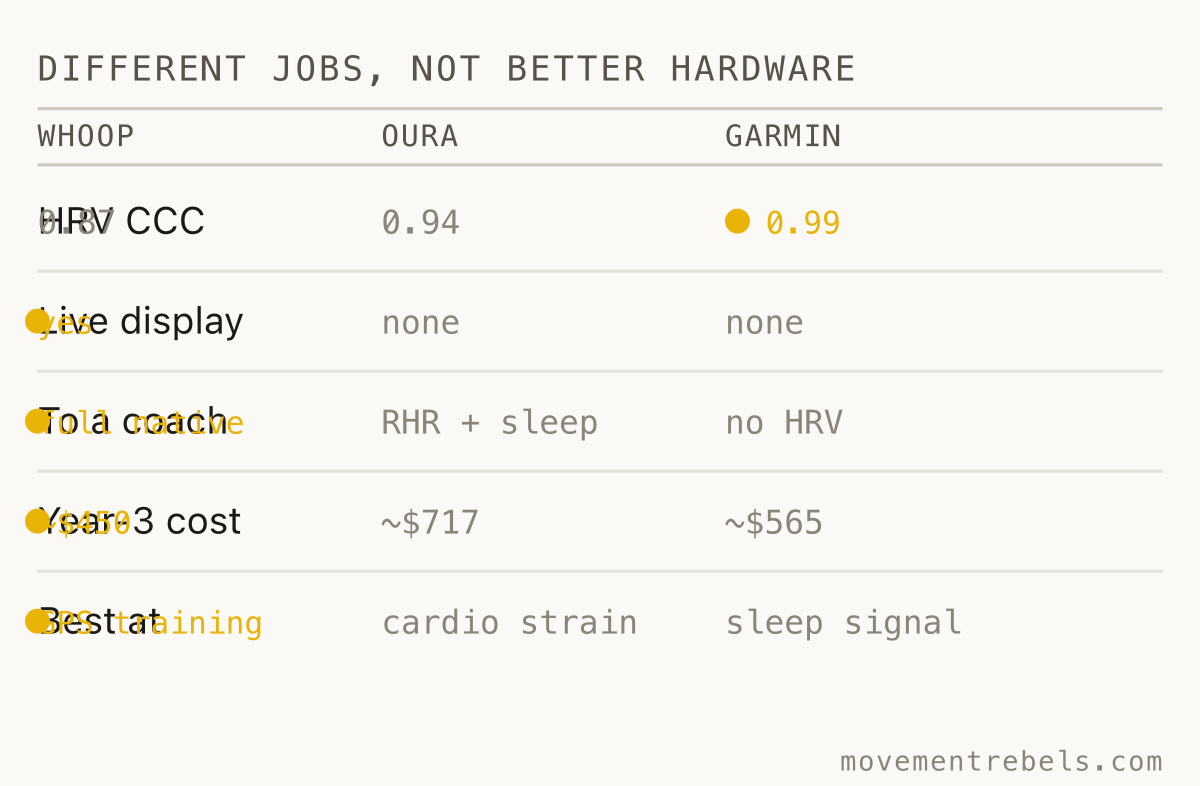
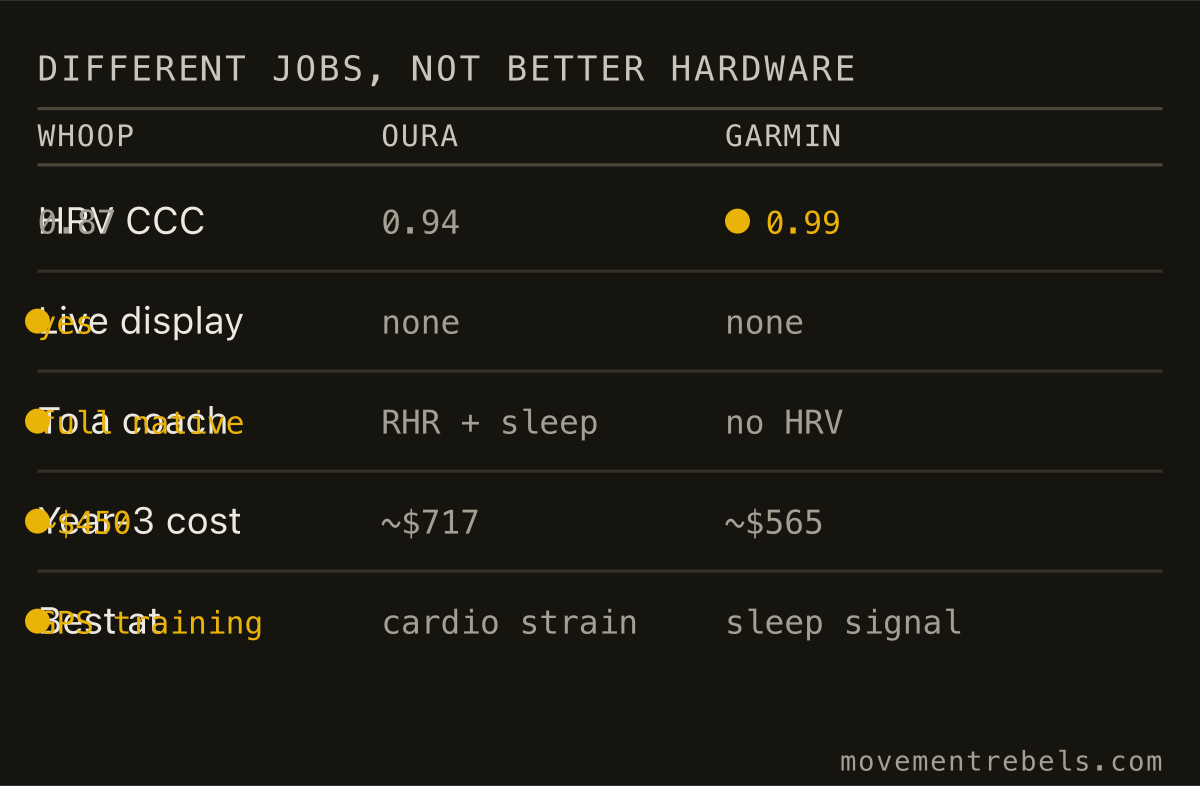
536 nights. That is the size of the 2025 validation study published in Physiological Reports, which put nocturnal HRV and resting heart rate from five wearables up against an ECG reference. Resting heart rate is the steadier of those two signals to act on, and reading resting heart rate as a 28-day trend shows how to use it instead of reacting to one morning number. Oura Gen 4 took the highest concordance for HRV (CCC = 0.99, MAPE 5.96%). WHOOP landed in the middle at acceptable accuracy (CCC = 0.94, MAPE 8.17%). Garmin Fenix 6 came in notably lower (CCC = 0.87, MAPE 10.52%). The authors concluded that ring-based photoplethysmography has a structural advantage for nocturnal metrics.
A sleep staging validation study (PMID 38382312, Sleep Medicine 2024) put Oura Gen 3 at 75.5-90.6% accuracy across sleep stages against polysomnography, over 96 participants and 421,045 epochs. Oura Health Oy funded it. Worth holding in mind while you read the conclusions, and the methodology has drawn published criticism since. The figures still sit among the stronger consumer-wearable results in the literature, and the broader evidence on ring-based sleep staging supports Oura's advantage over wrist devices. Accurate staging only earns its price if you act on it. The guide on what sleep tracking does for your training covers how those numbers should shift a session.
So: if the question you wake up with is "did I recover well enough to train hard today," Oura answers it most accurately, and it answers it best for HRV trends once you have two weeks of baseline behind you. WHOOP is a credible second on recovery signal. Garmin's overnight HRV status has improved across firmware generations and is adequate for most recreational athletes who already own the watch. Buying a device to track HRV and sleep quality specifically? Ring beats wrist.
For turning HRV into a training input instead of a number you stare at, see HRV-guided training.
Strain, load, and workouts: Garmin and WHOOP
For active training the picture flips. WHOOP's strain metric is well-calibrated for daily cardiovascular load across modalities: a long zone 2 ride, a tempo run and a heavy barbell session all register in a way that tracks genuine systemic stress, and the recovery ceiling framing ("your strain is approaching your recovery capacity") is easy to act on without a statistics degree.
Garmin reads training load too: acute load, training status, multisport load focus, and now multi-day recovery readouts. Difference is when you see it. Structured intervals, pace targets, power zones, current heart rate zone and route all sit on your wrist mid-effort, which counts for nothing until the zones themselves are right, so run a heart rate zone calculator and get the five bands the watch displays against. WHOOP cannot. No screen. Take a 70.3 triathlon, a marathon with pacing demands, or a cycling session with power targets: the real-time display stops being optional. The guide on pushing workouts to your Garmin watch shows that loop in practice.
Oura is the weakest of the three here. It detects workouts and estimates calories, and that is where it stops: you would not pace intervals by it, and you would not run a structured threshold session off its outputs. Its value sits before and after the session. That scope is deliberate.
The data-pipeline problem nobody advertises clearly
Here is where most comparisons duck. The metric your device measures and the metric your coaching app receives are not always the same thing.
WHOOP exports to Apple Health. It writes resting heart rate, workouts annotated with strain values, sleep sessions, blood oxygen and respiratory rate. What it does NOT export: recovery scores as a standard HealthKit data type that third-party apps can query, plus HRV values, where the unit incompatibility between WHOOP's SDNN and Apple Health's rMSSD format makes the sync technically unreliable. Recovery and strain live inside WHOOP's own ecosystem. You see them in the WHOOP app. Piping them to a coach outside that ecosystem is not reliable.
Oura exports to Apple Health as well. Sleep data with staging, heart rate at one-minute intervals, respiratory rate, steps, workout data. HRV is missing from that official export list per Oura's own support documentation, so the ring's HRV stays inside the Oura app or comes out through Oura's own API.
Garmin is the exception. It has a native API that third-party apps connect to over OAuth, and the full activity file, heart rate trace, HRV overnight status, body battery, sleep and stress data all flow through that pipe cleanly.
That distinction is the whole game for the data-driven athlete who wants their wearable feeding a coaching layer. Coach reads Apple Health? WHOOP hands it resting heart rate, sleep duration and workout times, Oura hands it sleep staging and heart rate intervals, and neither hands over the scores those two brands are known for. Connect Garmin natively and you get the full picture.
Pricing and the subscription math
Year-one costs, rounded. WHOOP starts at $199/yr (One tier) with the strap included, mid-tier Peak runs $239/yr, Life $359/yr. Oura Gen 4 ring, $349, first year of membership included free. Garmin Forerunner 265, around $450 one-time, no subscription, realistic lifespan three to five years.
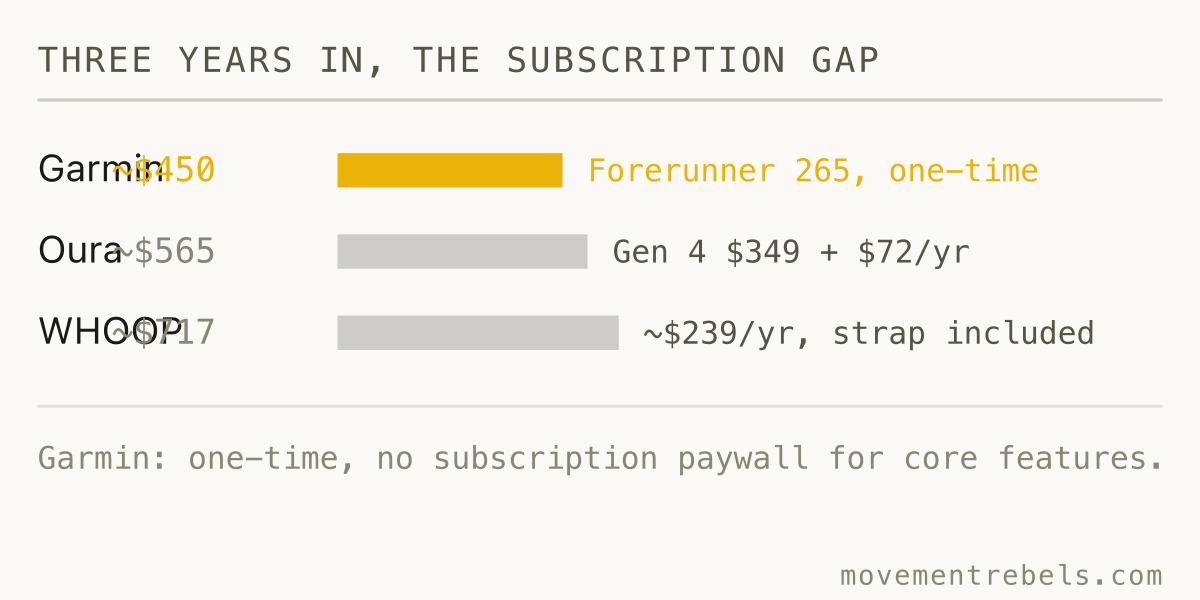
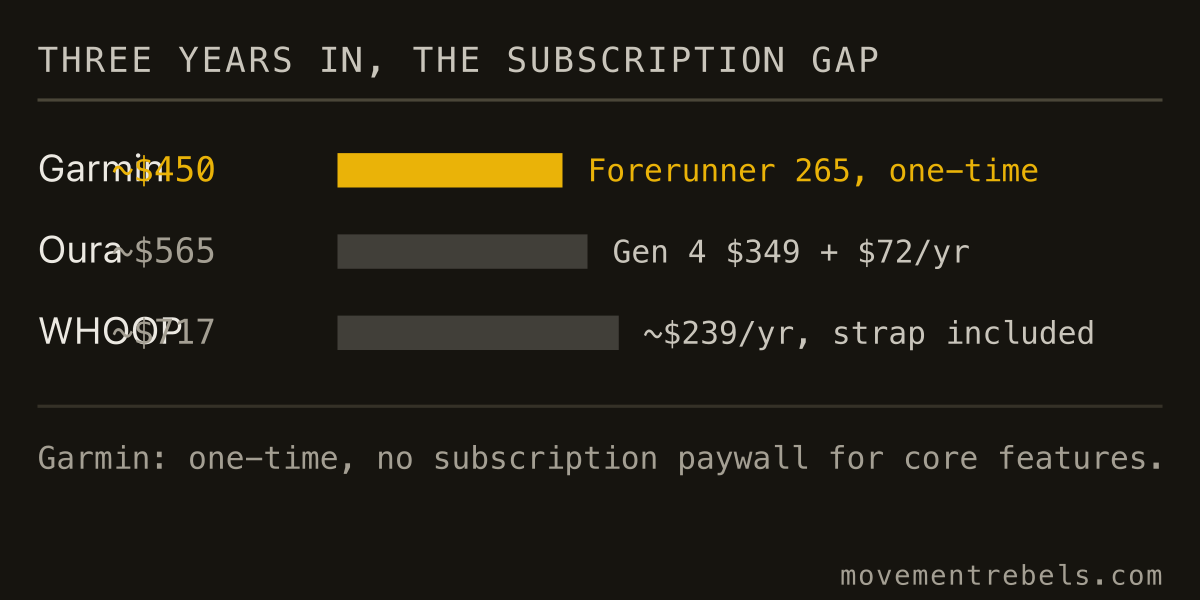
Year three cumulative. WHOOP on the Peak tier: around $717. Oura: around $493, the ring plus two years of subscription at $72/yr. Garmin: still $450, and a firmware update has likely added features for free by then.
The subscription brands do push hardware upgrades. WHOOP 5.0 shipped free to active members with twelve months or more remaining on their subscription, and Oura Gen updates came with member discounts, so if staying on current hardware matters to you there is logic behind paying monthly. Want to spend the least over five years, with GPS and workout execution as the thing you care about? Garmin, by a wide margin.
Fighting information overload rather than information shortage? Read fitness data overwhelm before you add another subscription.
How Movement Rebels connects each device
Garmin connects natively over OAuth. Completed activities land within seconds, and resting heart rate, overnight HRV status, body battery, sleep, stress and steps flow in behind them. The coach calibrates the plan off that: a 12ms HRV drop against your 14-day baseline might swap a threshold run for an easy 40-minute aerobic effort. Planned sessions push back to the watch as structured workouts you execute interval by interval, and the Garmin AI coach integration guide covers the full round-trip. Highest-fidelity setup available.
WHOOP and Oura reach us through Apple Health on the native iOS app. For a WHOOP user that means resting heart rate, sleep duration and stages, workout records. What it cannot mean: WHOOP's recovery scores or strain scores, which are proprietary and never written as queryable HealthKit metrics. For an Oura user: sleep staging, overnight heart rate, respiratory rate. HRV is not in the Apple Health export from Oura's official integration, so if you want the coach weighing your Oura HRV trend, bring that context into the chat yourself.
The Oura ring coaching and WHOOP AI coach guides go deeper on working each device inside those constraints.
Whichever device you own, it is one input. Movement Rebels reads the wearable alongside your strength log, your food and macro log, your breathwork and recovery tool history, and your body tracking, which is the cross-domain read a single-device app cannot do. Three days at 600kcal under target, plus a 15ms HRV drop? The coach connects those dots and moves Saturday's long run before you have to ask.
Strava connects natively too. Activities sync in, and the coach writes a session summary back to your Strava activity description: a read-and-write loop for the social side of training, not an AI data pipeline.
How Movement Rebels handles this
One app instead of five. Strength, endurance, hybrid, planning, coach chat, nutrition logging, recovery tools, body comp tracking and your wearable feed, same place. Garmin native today, over a live OAuth connection. Apple Health native on iOS, which is how WHOOP, Oura, Polar and COROS data reaches the coach, within what Apple Health carries from each device. Strava native, read and write. Honest caveat: there are crews, a feed, follows and high fives here, but no segments and a much smaller network than Strava. Keep Strava for the reach. Movement Rebels runs the training.
Pricing
A 7-day free trial covers the full surface. No card. After the trial, Pro+ is $20/month for unlimited coaching.
One app instead of five.
Strength, endurance, recovery, fueling, planning, and your AI coach. All under a 7-day free trial. No card.
Start 7-day trialGarmin Watches Ranked by Sport, Not Price
Find the right Garmin for your sport. Ranking running, cycling, triathlon, and trail watches by specs, battery life, and performan
WHOOP AI Coach: What the Scores Tell a Coach, and What They Don't
WHOOP measures well but cannot write a plan. Here is what data actually crosses into Apple Health, what a real coach layer does wi
Oura Ring AI Coaching: Great at Recovery, Blind to the Barbell
Oura Ring is the best sleep and HRV tracker you can wear. It cannot program a week of training. The honest picture: what the ring
Garmin AI Coach: What Your Watch Knows vs. What a Coach Needs to Know
Garmin's built-in coaching balances run and ride load using its own metrics. An AI coach reading the same data programs everything