Strava AI Coach: Read Activities, Write Back Summaries
Strava built a decent descriptive AI. Upload a ride, and Athlete Intelligence summarizes what happened: pace, heart rate zones, elevation, Relative Effort, a few trends from the past 30 days. It is a good summary of the past. It does not tell you what to do next.
That is the gap. Strava is a social log with analytics. It was never designed to be a coach. Movement Rebels connects to Strava in both directions: it reads your completed activities and writes a structured session debrief back to your activity description. The planning, adaptation, and prescription happen in Movement Rebels. The social feed stays in Strava. Both do what they are actually good at.
What the integration does: two directions, both native
No middleware, no Zapier, no CSV exports.
Read. Every completed Strava activity, ride, run, swim, hike, virtual, indoor, lands in your Movement Rebels timeline within seconds of upload. Duration, distance, pace splits, heart-rate distribution, elevation. This keeps your Movement Rebels activity log complete without manual re-entry. The coach itself plans and adapts from richer device data: Garmin files and Apple Health metrics feed the AI prompt directly; Strava activity records are display-only in the Movement Rebels timeline (Strava's API terms bar third-party AI use of their data).
Write. When the coach finishes its analysis of a Garmin or Apple Health session, it can push a structured summary back to the matching Strava activity description. Default is on. So instead of "Morning Ride" sitting empty, your activity reads something like: "Zone 2 endurance, 2h12m. Aerobic decoupling 4.2 percent, clean. 198 TSS. Tomorrow is a tempo block: eat 80g carbs in the next two hours." Your followers see real training context. If you want to work out that load figure yourself, a Training Stress Score calculator for your logged sessions gives you the number for any ride or run. Your future self has a searchable, structured log. The coach has, in effect, published its notes in public.
You can turn the write-back off per activity or globally. Some people want their Strava feed to stay pure social. That is a one-tap setting.
The distinction Strava Athlete Intelligence blurs
Strava's Athlete Intelligence (available on paid Strava subscriptions) does something real: it explains your completed workout in plain language, tags performance milestones, and surfaces 30-day trends. It is descriptive. It runs after the fact, and it stays that way.
What it does not do: build a plan, adapt the week when you miss a session, tell you whether Tuesday's threshold block should go ahead given Sunday's overshoot and Monday's sleep data, or integrate what you ate and how much you lifted. It has no visibility outside the Strava ecosystem.
That distinction matters because an AI coach's value is mostly in the prescriptive layer: not what happened, but what to do next and why. A summary of last week's rides is useful. A coach that reshapes next week's training based on those rides is what actually moves the needle. To set the goal those rides are building toward, a race time predictor from a recent result gives you a realistic target across 5K to marathon.
Movement Rebels is the prescriptive layer. Strava is where you log socially. The write-back makes those two things work together instead of in parallel.
What the adaptive plan does with Strava data
The weekly plan is not a static template. It rebuilds on what you actually did and how you actually recovered.
If your Garmin shows a 4-hour ride at 240W normalized when you were prescribed 3 hours at 210W, the coach sees the overshoot. Tomorrow's threshold block might drop to tempo. Wednesday's strength session might lose a set. The recovery rating adjusts. The matching Strava activity gets a write-back that reflects those conclusions.
Same logic on the downside. You cancelled Saturday's long run. The plan does not slide it to Sunday and hope for the best. It looks at your fatigue from Garmin and Apple Health data for the week, your HRV trend, your sleep, and decides whether Sunday gets the full session, a shortened version, or a recovery day with the long run pushed to next week.
For multisport athletes, this is where the Strava integration earns its keep most clearly. Endurance sessions, strength work, and recovery all sit in the same timeline. See the AI triathlon coach guide for how cross-discipline adaptation works across a full training week, and the adaptive training plan guide for the mechanics behind load management.
Pairing Strava with Garmin and Apple Health
Most cyclists and runners have data spread across more than one source. Movement Rebels handles all three natively: Garmin directly via OAuth, Apple Health through HealthKit in the native iOS app, and Strava directly via Strava's API.
The coach de-duplicates. If your Garmin pushes an activity to Strava and both sync to Movement Rebels, you will not see the ride counted twice.
The deeper data layer lives in Garmin and Apple Health. Garmin sends per-session power, cadence, and GPS files along with daily resting metrics. Apple Health sends HRV, sleep, and resting heart rate picked up by the iOS app natively. Some devices export sleep and HRV to Apple Health, so Movement Rebels picks those up through that channel. Strava handles the social side of the equation: the upload, the feed, the kudos. The coach uses whichever source has the richest signal for each metric.
If you want to understand exactly what data flows in through Apple Health versus Garmin versus Strava, the Apple Health AI coach guide and the Garmin AI coach guide cover those integrations in detail.
The fueling and recovery layer Strava cannot see
This is where the "one app instead of five" case is clearest.
A Strava-only view sees the bike file. Movement Rebels sees the bike file, plus the squat session you logged in the strength logger Tuesday, plus the meals you photographed with Snap Meal, plus your HRV trend from the morning readiness check, plus the breathwork session you ran after your nap.
Concrete example. You upload a 90-minute Zone 2 ride. The coach reads it. It also notices you have been 500 kcal under your training target for three days. The write-back that goes to your Strava description calls the ride clean. The push notification fifteen minutes later is more direct: "You are underfueled. Eat 80g of carbs and 30g of protein in the next hour or tomorrow's threshold session gets downgraded automatically."
The evidence broadly agrees that subjective self-report outperforms objective device files alone when capturing training quality. Watts and pace tell you what happened. How you slept and how you felt tell you why. The coach reads both.
The same pattern runs on recovery. A hard weekend brick triggers the coach to schedule NSDR Monday morning, push you toward the breathwork timer, and reduce Tuesday's strength volume by one working set. For athletes managing concurrent strength and endurance load, the hybrid athlete training guide covers how the coach balances those adaptations without overreaching into either modality.
What Movement Rebels does not replace
This needs saying directly.
Movement Rebels has its own social layer: a feed, crews, follows, high fives and comments. What it does not have is segments, course records, or Strava's network size, and that network is the point. Strava is good at the social motivation layer, and research on fitness app adherence suggests peer comparison and social features do increase training frequency for many people. Keep using Strava for that. The integration is designed so both tools run simultaneously, not in competition.
What Movement Rebels replaces is the coaching layer Strava was never built to provide: planning the week ahead, adapting when life or recovery shifts, prescribing the next session with specifics, integrating strength and nutrition into the same plan. The data-driven athlete guide covers what that integration actually looks like in practice across sources and metrics.
A note on Strava's 2026 API changes
Strava updated its developer API agreement with several restrictions effective through 2026. The key restriction for users: third-party apps can only show your Strava data back to you, not to other users of the third-party app. This matches what Movement Rebels already does. The write-back to activity descriptions (the activity:write scope) is a separate API capability that Strava permits for third-party apps that have been granted that access by the athlete. Our integration uses a direct, native OAuth connection, not an intermediary platform, which aligns with Strava's updated developer terms.
For athletes, the practical consequence of the 2026 changes is that some third-party Strava tools are narrowing or disappearing. A native, direct integration is worth more now than it was before.
How Movement Rebels works with Strava
Connect in under two minutes via OAuth inside the app. Once connected:
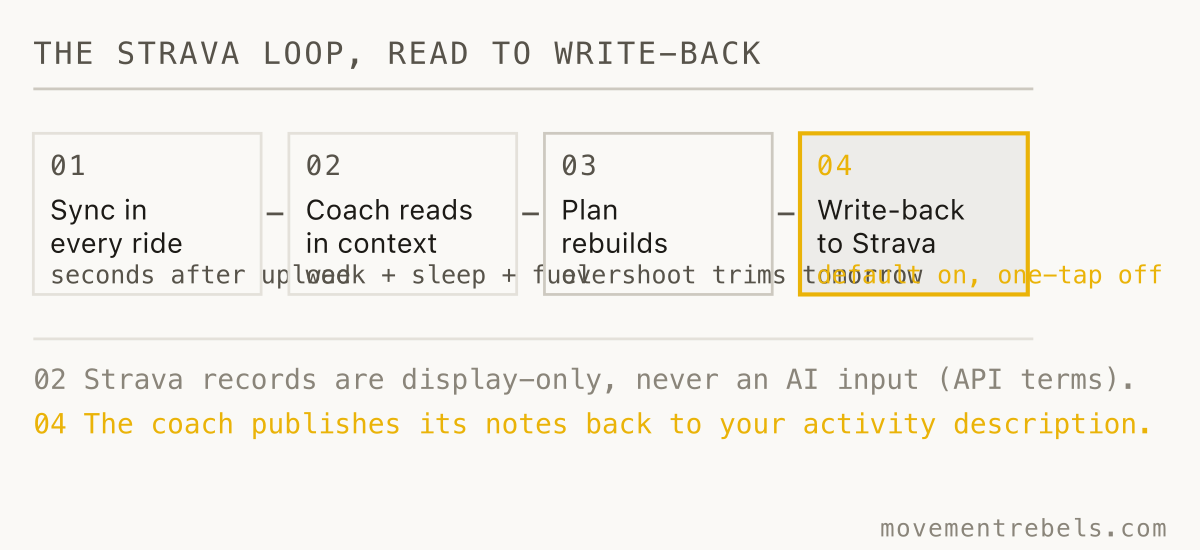
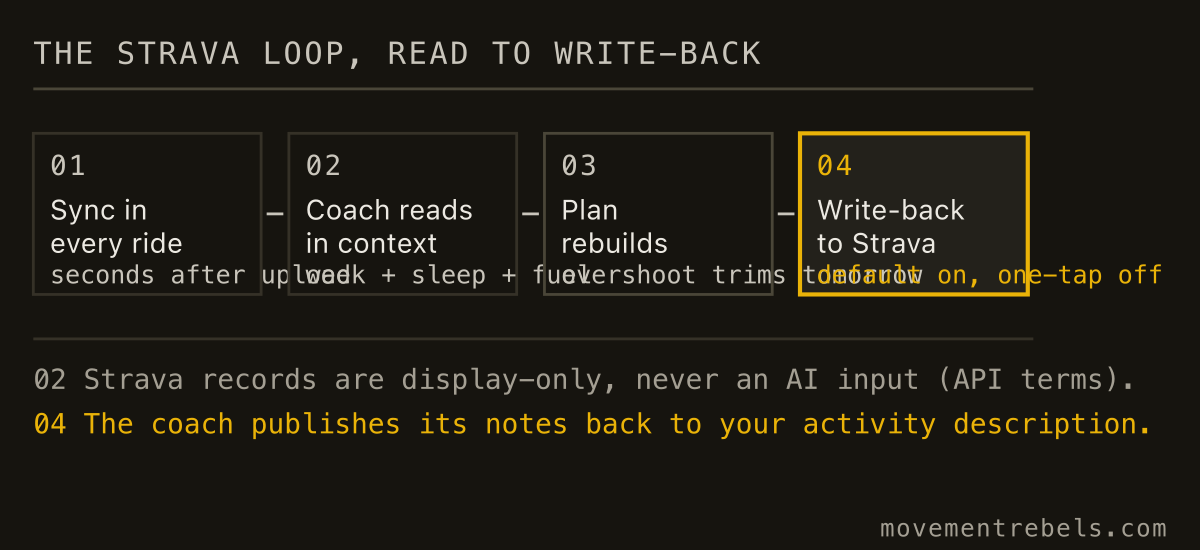
- Every new Strava activity syncs automatically to your Movement Rebels timeline.
- The coach reads the session in context with your full week: strength log, sleep, nutrition, readiness.
- A structured summary is written back to the activity description (unless you turn it off).
- The adaptive plan rebuilds for the rest of the week based on what the session showed.
The write-back pulls in training context that makes your Strava log useful over time. A structured, consistent training log is better for self-monitoring than blank activity descriptions, and most coaches agree that written notes compound over a season in ways that raw files alone do not.
Pricing
Free 7-day trial of the full coach. No card required. After the trial, Pro+ is $20 a month: unlimited coach chat, unlimited adaptive plans, every recovery tool, Rebel Fuel, native Strava, Garmin, and Apple Health integration, and the full workout library.
One app instead of five.
Strength, endurance, recovery, fueling, planning, and your AI coach. All under a 7-day free trial. No card.
Start 7-day trialGarmin AI Coach: What Your Watch Knows vs. What a Coach Needs to Know
Garmin's built-in coaching balances run and ride load using its own metrics. An AI coach reading the same data programs everything
Apple Health as an AI Coach Data Layer: What It Passes Through
Movement Rebels reads Apple Health natively on iOS. But WHOOP doesn't export HRV, Oura's readiness score stays locked, and the coa
AI Triathlon Coach: Three Sports, One Load
Most triathlon apps optimize three separate plans. An AI triathlon coach treats them as one load budget, detects your real limiter
Adaptive Training Plans: How the Plan Adjusts to You
Adaptive training is real science with honest limitations. What peer-reviewed research says about autoregulation and HRV-guided pl