Garmin Coach vs AI Coach: What the Watch Knows and What It Ignores
Here is the thing nobody says clearly: Garmin Coach adapts to your pace, not to your body. If your HRV has been dropping for four days, your sleep score is 51, and your Training Readiness is in the orange, the plan still serves Tuesday's intervals. The watch knows you had a bad night. The coach ignores it.
That is not a bug Garmin accidentally shipped. It is a structural limit of what a template-based system can do, and understanding it tells you exactly when Garmin Coach is the right call and when it will quietly cost you.
What Garmin Coach actually does
Garmin Coach is three coaches with three methodologies baked into a fixed plan library: Greg McMillan, Amy Parkerson-Mitchell, and Jeff Galloway. You pick a race distance, set a goal time, and the system slots sessions into your week from a preset pool of easy runs, tempos, intervals, and long runs.
The adaptation that happens is pace-based. After each run you rate difficulty, the plan reads your tracked pace and adjusts effort targets accordingly. That is useful. If you want to set those targets yourself, a VDOT calculator for your training paces turns one race result into easy, threshold, and interval paces. It is also the ceiling. Garmin's own HRV Status feature flags when your autonomic nervous system is under stress. That signal sits in a separate corner of Garmin Connect. Garmin Coach does not read it.
What Garmin Coach supports, in full:
- Running: 5K, 10K, and half marathon with the three named coaches. Garmin added a marathon plan in late 2024 under the Garmin Run Coach brand, without a named human coach attached to it.
- One sport at a time. No multisport logic, no brick sessions, no triathlon.
- No strength integration. A 2025 update added optional strength workouts to run and cycling coach plans, but there is no logic for how a heavy squat day should change tomorrow's interval session.
- No conversation. You cannot ask why a session changed or request a trade. The plan speaks, you listen.
For a first 5K or 10K on a clean schedule, that is enough. For everyone else, the ceiling shows up fast.
The gap the research actually measured
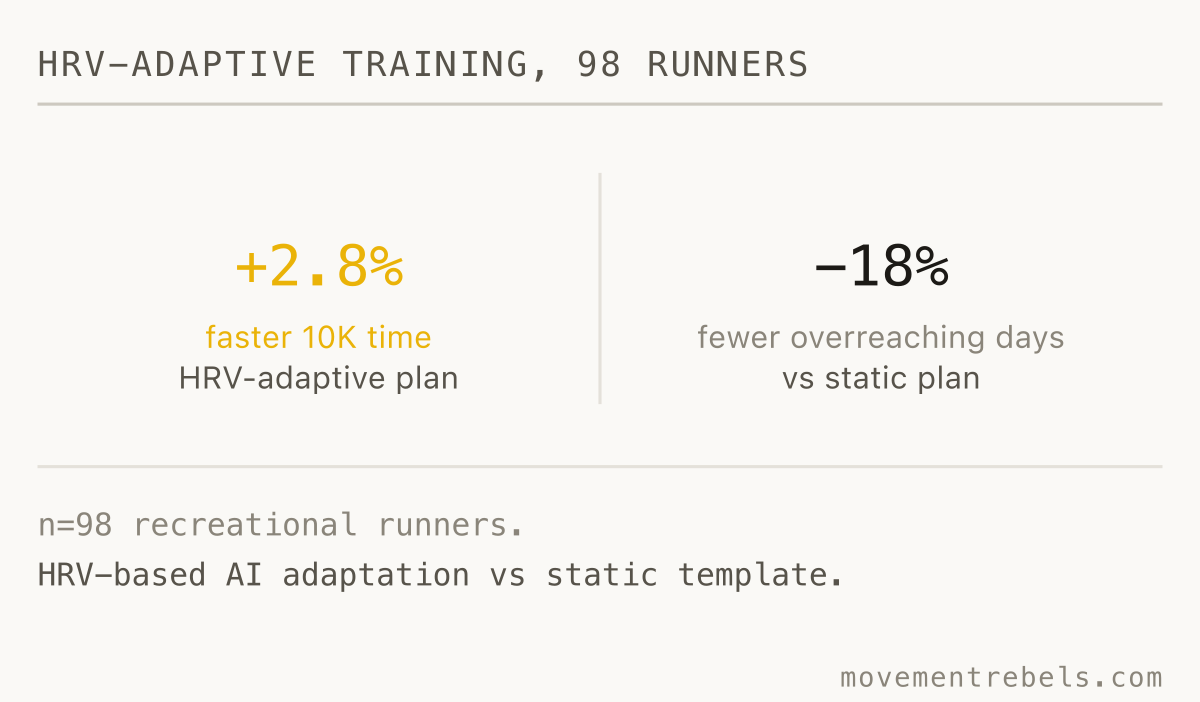
A 2023 preprint from Swedish School of Sport and Health Sciences tested AI-driven daily adaptivity against static plans for runners, using a Garmin watch for training data and a daily readiness questionnaire app. The adaptive group's sessions were scaled up when they were ahead of plan and trimmed when they were behind or showing signs of overreaching. The static group ran the template.
The finding that matters here is not the performance delta. It is the mechanism: adaptation that reads multiple physiological signals daily outperforms adaptation that reads one signal weekly. Garmin Coach reads pace performance over time. It does not have a daily readiness read.
Research on HRV monitoring and training load broadly shows that integrating HRV with subjective wellness creates a stronger signal for readiness than any single metric. The evidence generally points to athletes training more consistently at the right intensity when they use daily readiness information, rather than following a fixed schedule regardless of how they feel. The honest translation: Garmin has the data. The coach does not use it.
Where Garmin Coach wins outright
Be direct about this. Garmin Coach is free. The plans are written by real coaches with real credentials. For a single-sport beginner targeting one race on a clean schedule, it does the job without friction. The workout is on your wrist the night before. You do not need another app.
It also wins on simplicity of scope. If you want someone or something to make a decision and stop asking questions, a three-option avatar selection followed by a date picker is very hard to argue with. The plan shows up. You run.
The limitation is not that Garmin Coach is bad. It is that the watch already contains better information than the coach ever sees.
Where it fails the most common user
Look at who actually owns a Garmin. The majority are not pure runners. They lift two or three times a week, run some days, ride others, and want the whole thing to compound rather than fight itself. Hybrid training is not a niche: it is how most athletes spend most of their time.
Garmin Coach has no concept of this. A heavy deadlift session on Thursday does not move Friday's threshold run. A hard bike ride on Saturday does not blunt Sunday's long run. The plan assumes the rest of your life is quiet. For most people's schedules, that assumption fails every week.
The second failure is recovery blindness. Most recreational athletes already drift too hard on easy days and not hard enough on hard days. Adding a plan that ignores their HRV, sleep, and resting heart rate trends does not fix that drift. It schedules hard sessions into it. Pinning the bands so easy stays easy starts with the numbers, and you can find your real heart rate training zones from your max or resting HR. Knowing when a planned hard session should become an easy day is where injury prevention lives, and Garmin Coach does not go there.
The third failure is single-variable adaptation. If you eat poorly the week before a goal race, Garmin Coach does not know. If you are traveling, jet-lagged, stressed at work, or in the second half of your cycle, the plan runs as written. These are not edge cases. They are the average training week for most people.
What an AI coach changes, honestly
The realistic case for an AI coach is not magic. It is that it reads more signals before it prescribes.
When your overnight HRV drops outside your normal baseline, your sleep score is low, and your resting heart rate is elevated, a readiness-aware coach swaps the threshold session for zone 2 and moves the hard work to when your numbers recover. That single decision, made correctly and consistently, is worth more than any marginal improvement in plan periodization. See how HRV-guided training changes what you do with recovery data.
When you lift heavy on Tuesday, a coach that sees the whole week adjusts Wednesday's run. Not eliminates it. Adjusts the intensity and the target, so the two sessions compound instead of one neutralizing the other. That is periodization done for a real person's real schedule, not for a hypothetical athlete who only runs.
When you ask a question, you get an answer that references your actual data. Not a help article. Your data. That conversation is where compliance comes from. Runners who understand why a session changed follow it. Runners who get a different number on the screen and no explanation drift back to what they always did.
The compound return on getting intensity right, more often, over months is not dramatic in any single week. It accumulates. Getting the readiness call right more consistently is the mechanism.
The honest social caveat
One thing Garmin Connect does that no AI coach replaces is the community layer: connections, leaderboards, kudos, course records. Movement Rebels has a feed, crews, follows and high fives of its own, but not course records or segments, and nowhere near the same number of people on it. If that matters to you, keep Strava connected. The MR and Strava integration is live in both directions: your completed activities sync in, and the coach writes a session summary back to the Strava activity description. Your feed stays active. We cover the coaching and planning layer Strava does not.
How Movement Rebels handles this
The MR coach programs running, cycling, strength (hypertrophy, powerlifting, Olympic lifting, calisthenics), CrossFit, Hyrox, and triathlon as a single weekly organism. It reads your Garmin data natively through the live integration: completed activities come in, structured workouts push out to the watch, same as Garmin Coach delivers them, same beeps and pacing targets mid-session. The guide on pushing workouts to your Garmin watch covers the mechanics if you want to verify how it lands on the device.
For HRV, sleep, resting heart rate, and workouts, the native iOS app reads Apple Health directly. If you use an Oura ring, it exports sleep, HRV, and resting heart rate to Apple Health, and the coach picks those up through that path. This is not a direct Oura integration. The path is Oura to Apple Health to Movement Rebels. WHOOP does not export its recovery or strain scores to Apple Health, so those numbers do not reach the coach. The honest framing for any wearable: Movement Rebels is the coaching and planning layer your device lacks. Data flows in through Apple Health where your device supports it. Where it does not, you bring the context to the coach in chat.
For the multisport and marathon preparation cases where Garmin Coach has no plan at all, the AI coach plans across disciplines from day one, treating strength, endurance, and recovery as one system rather than three separate stacks. To anchor a goal time before you start, a tool to predict your 5K, 10K, half or marathon time from a recent result gives you the realistic target to train toward.
Same Garmin data Greg sees. A coach that does something with it.
Pricing
Free 7-day trial of the full coach, full library, full Garmin integration. No card to start. After the trial, Pro+ is $20/month for unlimited coaching. No race-distance ceiling, no single-sport gate.
One app instead of five.
Strength, endurance, recovery, fueling, planning, and your AI coach. All under a 7-day free trial. No card.
Start 7-day trialGarmin AI Coach: What Your Watch Knows vs. What a Coach Needs to Know
Garmin's built-in coaching balances run and ride load using its own metrics. An AI coach reading the same data programs everything
Push Today's Workout to Your Garmin Watch
Movement Rebels writes today's session directly to Garmin Connect as a structured workout. Warm-up, zones, intervals, cooldown. Hi
HRV-Guided Training: Read the Signal, Skip the Noise
One low HRV night tells you almost nothing. The 7-day-vs-28-day trend tells you nearly everything. Here is what the evidence actua
Hybrid Athlete Training: Concurrent Done Right
The interference effect is real but smaller than you think, and the rules for avoiding it are simpler than the hype suggests. Here