Training Around the Menstrual Cycle: Sorting Signal From Hype
Cycle-based training is both useful and badly oversold at the same time. The physiology is real: estrogen and progesterone shift over a 28-day window in ways that measurably change body temperature, heart rate, HRV, heat tolerance, pain perception, and carbohydrate metabolism. Wearables capture some of those shifts. Planning around them is reasonable.
The overclaim is this: that you should have a completely different program each week, that peak strength work is "wasted" outside the follicular phase, or that simply tracking your cycle unlocks a new performance tier. That claim outruns the evidence by a wide margin. The honest answer is simpler: two broad windows, one key asterisk (hormonal contraception), and two metrics your wearable already tracks that will tell you almost everything you need to know.
The evidence: what it shows and where it gets thin
Multiple meta-analyses find that maximal strength tends to peak in the late follicular phase, with estrogen-related neuroexcitatory effects producing small-to-medium effects. Research suggests the follicular advantage for isometric strength is a medium effect, while dynamic strength advantage is small. A proposed mechanism involves estrogen's contribution to muscle protein synthesis, though direct measurement studies in humans have not confirmed that cycle phase meaningfully changes muscle protein synthesis rates. The mechanism is plausible; the downstream training benefit is real but modest.
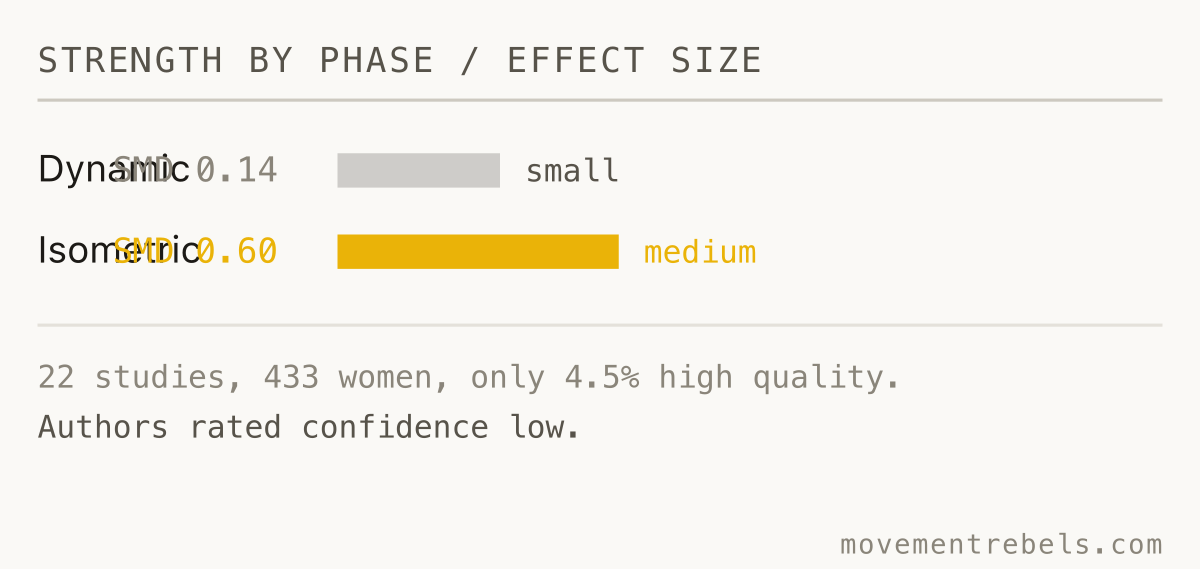
Those numbers matter. They do not say "don't train in the luteal phase." They say "the late follicular phase is a slightly better window for hitting maximal efforts." And they come with a significant caveat the researchers themselves flagged: methodological quality across the literature is low, average sample sizes are small, and fewer than half of studies used blood samples to actually verify cycle phase. Confidence in the evidence is rated low by the researchers who reviewed it.
A Frontiers umbrella review (a review of meta-analyses) published in 2023 went further and concluded that "current evidence shows no influence of women's menstrual cycle phase on acute strength performance or adaptations to resistance exercise training." Different conclusion, same underlying data quality problem.
What does the evidence robustly agree on? Two things. First, the physiological shifts are real: resting heart rate, core temperature, and aspects of cardiac autonomic function change across the cycle. Second, individual variation is large enough that group-level averages are a starting point, not a prescription. Some women feel meaningfully different between phases. Others notice almost nothing. Neither is wrong.
The two windows that shape your plan
For training purposes the cycle divides into two functional halves, not four distinct phases.
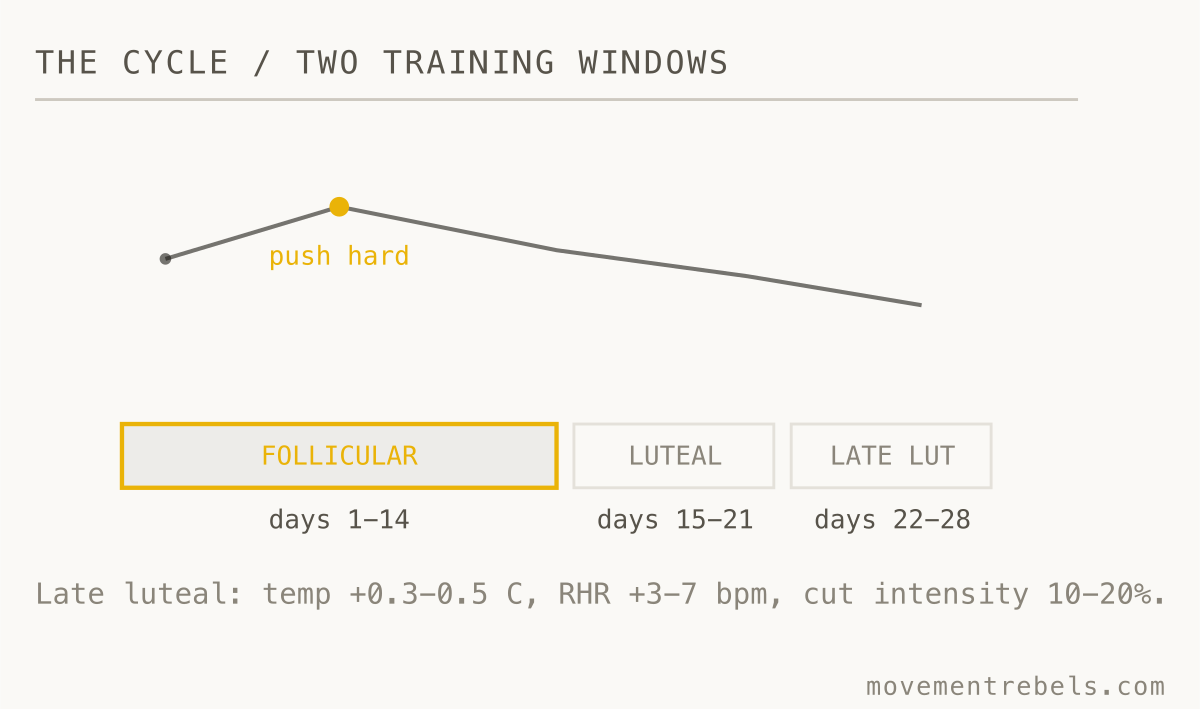
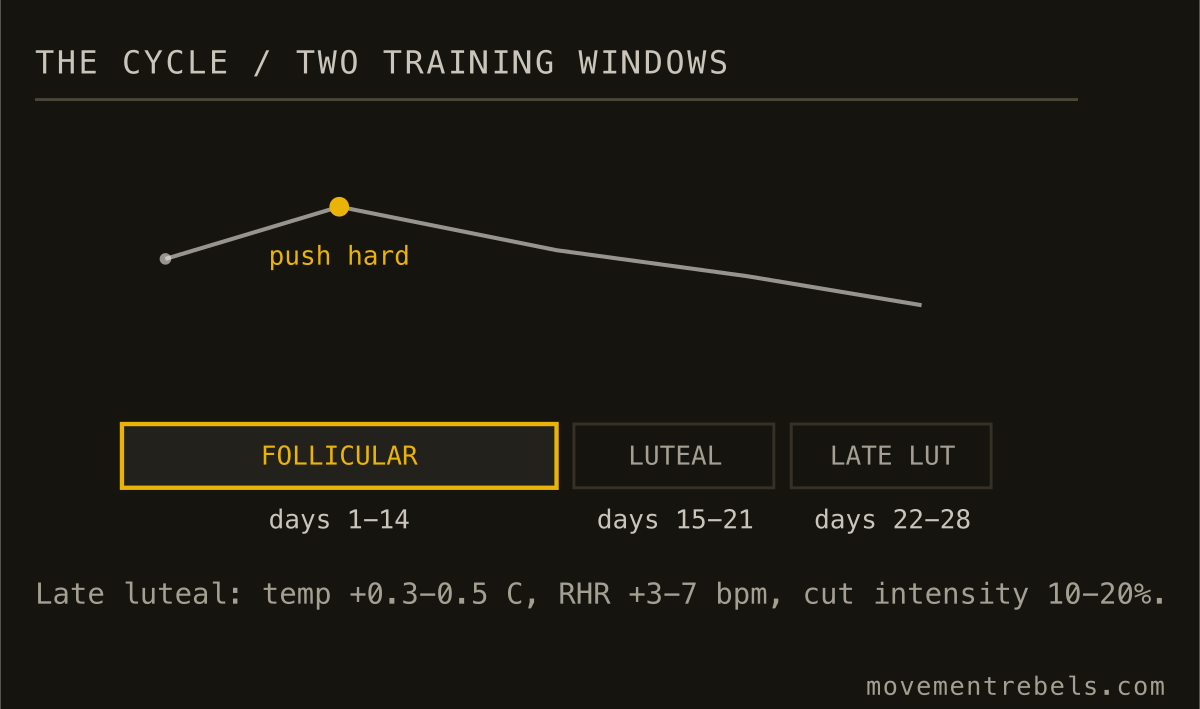
The follicular phase runs from day one of bleeding through ovulation, roughly days 1 to 14 in a 28-day cycle. Estrogen rises, body temperature sits at baseline, fluid balance is favorable, pain tolerance is elevated, and the nervous system is well-primed. This is the window to push hard: 1RM attempts, sprint intervals, VO2max blocks, technical lifts, benchmark efforts. Recovery between hard sessions is faster. You can stack intensity without the same accumulative cost.
The luteal phase runs from ovulation to the start of the next bleed, roughly days 15 to 28. Progesterone rises, core body temperature climbs 0.3 to 0.5 degrees Celsius, resting heart rate increases on average 2 to 5 bpm. Research on cardiac autonomic function broadly finds that HRV markers tend to drop in the luteal phase compared to follicular, reflecting shifts in autonomic balance. Heat tolerance drops. Carbohydrate metabolism shifts toward greater fat oxidation at rest. Sleep quality tends to deteriorate in the back half.
The first half of luteal (days 15 to 21) still tolerates hard work. The adjustment lives in late luteal, the seven to ten days before the bleed.
The bleed itself varies. Some athletes train through day one without issue. Others need reduced intensity for a day or two. Treat that as athlete-reported and individual, not assumed.
The asterisk nobody prints: hormonal contraception
If you use oral contraceptives or other hormonal contraception, the phase-based model largely does not apply to you. The pill flattens the estrogen and progesterone curves by design. Research broadly finds that women on hormonal contraception do not benefit from cycle-based periodization in the same way as naturally cycling athletes, and do not show the cardiorespiratory shifts tied to follicular and mid-cycle hormone peaks.
This is not a problem with your training. It means you have a different hormonal baseline: stable across the month rather than oscillating. The practical implication is that the follicular-push, luteal-moderate framework is designed for naturally cycling athletes. If you use hormonal contraception, train by readiness and load, not by phase. HRV and resting heart rate are still valid readiness signals. The calendar is not.
Most cycle-based training content omits this. It is a significant omission for a large portion of the audience.
What to do in each window
Follicular: push the hard stuff. This is the window for top-set strength work, sprint intervals, CrossFit benchmark attempts, VO2max sessions, and anything requiring maximal output or fine motor skill. If you are targeting a competition or a PR attempt, align it with mid-to-late follicular when possible. Recovery between hard sessions is faster here, so stacking two heavy days with one easy day between them is more sustainable than in late luteal.
Log every session in detail during this window. The coach needs the rep quality, perceived effort, and performance data from this phase to understand your actual capacity. That pattern across multiple cycles is more useful than any single data point.
Luteal, first half: moderate to hard work still lands well. Reduce volume slightly if you feel it, but this is not a write-off week. Keep structure, keep the main lifts, keep one threshold session.
Luteal, second half: this is where the adjustment matters. Practical changes that hold across most athletes:
- Cut top-end intensity by 10 to 20%. Drop one threshold session per week. Shift a VO2max interval session to a tempo run or zone 2 block. A heart rate zone calculator gives you the bpm ceiling for that easier work so a late-luteal session does not drift back up into the intensity you meant to drop.
- Strength stays. Move from heavy triples at 85 to 90% toward sets of 8 to 10 at 70 to 75%. Progress continues. You simply avoid grinding near-maximum efforts when HRV is suppressed and core temperature is elevated.
- Heat tolerance is measurably reduced in late luteal. If you train in a warm gym or race warm events, treat this the same way you would deload planning: acknowledge the signal and reduce the thermal stress accordingly.
- Sleep deteriorates in late luteal for many athletes. This compounds training stress. A 20-minute NSDR session on flat afternoons costs nothing and has genuine recovery return.

What your wearable already shows you
You do not need a dedicated cycle-tracking app to see this on your data. Two metrics expose it clearly.
Resting heart rate typically climbs 2 to 5 bpm in the luteal phase. If your Garmin or Apple Watch RHR has been elevated for a week and you are not sick, not sleep-deprived, and not in a heavy training block, you are almost certainly in late luteal.
HRV trends down through luteal, hits a low in the late-luteal window, and rebounds in early follicular. The shape mirrors the follicular/luteal divide almost exactly. If you track HRV, reading those trends is covered in detail in the guide on HRV-guided training.
Garmin's training status and body battery will downgrade you in late luteal on identical load because the elevated baseline stress reads correctly as reduced readiness. That is not a wearable bug. It is the watch reading the physiology.
Fueling shifts that matter
Carbohydrate metabolism shifts in luteal: the body relies more on fat oxidation at lower intensities, and glycogen availability becomes more critical for hard efforts. Do not attempt high-intensity intervals fasted in late luteal. The session quality drops sharply and the recovery cost rises.
Hunger increases in late luteal. This is biologically appropriate: the body anticipates the metabolic cost of the menstrual phase. Eating an additional 100 to 300 kcal per day in late luteal is not a failure of discipline. It is a correct response to an increased energy requirement. If you are tracking macros for body recomposition, chronic undereating in late luteal is one of the most reliable ways to produce poor quality sessions that look like programming problems but are actually fueling problems. A daily protein target calculator sets the floor that should hold steady across both phases even when total calories flex.
Iron loss during heavy bleeds matters for endurance athletes. Ferritin should be checked annually, particularly for athletes noticing progressive HR drift on easy runs, unusual perceived effort at baseline paces, or unexplained plateau in aerobic performance. These are patterns the coach surfaces when the performance markers align with the known risk window, but bloodwork is the only verification. The coach is not a substitute for a lab test.
How Movement Rebels handles this
The coach knowledge base covers cycle-phase programming alongside masters athlete considerations, sport-specific preparation, and injury return. When you log your cycle start in your profile, plan generation shifts the hard sessions toward your follicular window and reconfigures late luteal toward zone 2 and skill work. The morning brief in the coach chat mentions phase when it is relevant and stays quiet when it is not.
You can override at any point. If your cycle is irregular, if you are on hormonal contraception and the calendar-based adjustment does not apply, or if your lived experience simply does not match the textbook pattern, tell the coach in chat. It updates the athlete memory and stops auto-adjusting based on phase. Personalization outranks the population average every time.
Movement Rebels reads Garmin natively. On the iOS app it reads Apple Health natively, which means resting heart rate, HRV, sleep, and any workouts logged to Apple Health all feed into the coach's picture. When the morning brief says "RHR up 5 bpm over your 30-day baseline, HRV down, keeping intensity moderate today," that is the phase tracking working from actual data without you having to log anything manually.
Cycle phase is one input among many in the same app that tracks your strength PRs, your sleep patterns, your zone 2 runs, and your body composition. One timeline, one coach, one set of data that compounds across months. It does not require a separate app bolted on at the side.
Pricing
7-day free trial of the full coach. No card. After the trial, Pro+ is $20/month for unlimited coaching, full library, all integrations.
One app instead of five.
Strength, endurance, recovery, fueling, planning, and your AI coach. All under a 7-day free trial. No card.
Start 7-day trialWhy Women and Men Fuel Differently: Macro Targets, Timing, and Iron
How women and men differ in fueling: carbohydrate and protein targets, menstrual cycle effects, iron needs, and the energy availab
HRV-Guided Training: Read the Signal, Skip the Noise
One low HRV night tells you almost nothing. The 7-day-vs-28-day trend tells you nearly everything. Here is what the evidence actua
When to Deload: Reading the Signals Right
The 4-week deload rule is a template, not a law. Here are the actual physiological signals that tell you when your body is asking
Sleep and Training Performance: The Lever Nobody Respects
Sleep outperforms every supplement, wearable, and recovery tool you own. Here's the honest evidence, what actually trashes it, and