WHOOP AI Coach: What the Scores Tell a Coach, and What They Don't
WHOOP is a good sensor. It is also one of the most successfully marketed wearables in the industry, and those two facts are worth separating before you build a training system around it. The Recovery percentage and Strain number feel authoritative. The research on whether they actually predict anything is thinner than the app implies. That is not a reason to ignore the device. It is a reason to use it more carefully, with a clearer picture of which numbers travel through to a coaching layer and which ones do not.
What WHOOP measures, and what that is actually worth
WHOOP reads photoplethysmography (PPG) from your wrist, primarily during sleep, and from that signal derives heart rate, resting heart rate (RHR), and RMSSD-based heart rate variability (HRV). Research has confirmed that WHOOP's HR measurement tracks ECG closely during sleep, with bias and limits of agreement well within the day-to-day coefficient of variation for heart rate. HRV tells a more complicated story: the same research found that WHOOP's HRV bias and limits of agreement approached or exceeded the coefficient of variation during slow-wave sleep, meaning subtle night-to-night HRV changes carry more noise than the heart rate signal does. A 2025 Physiological Reports study compared several consumer devices against ECG and found WHOOP's RHR concordance at a CCC of 0.91 and HRV concordance at 0.94, placing it below Oura but above Polar for both metrics. For HRV specifically, Garmin also ranked below WHOOP in that study. For RHR, Garmin was excluded from the analysis entirely due to methodological differences in how it calculates the metric, so no direct RHR comparison between WHOOP and Garmin is available from that data.
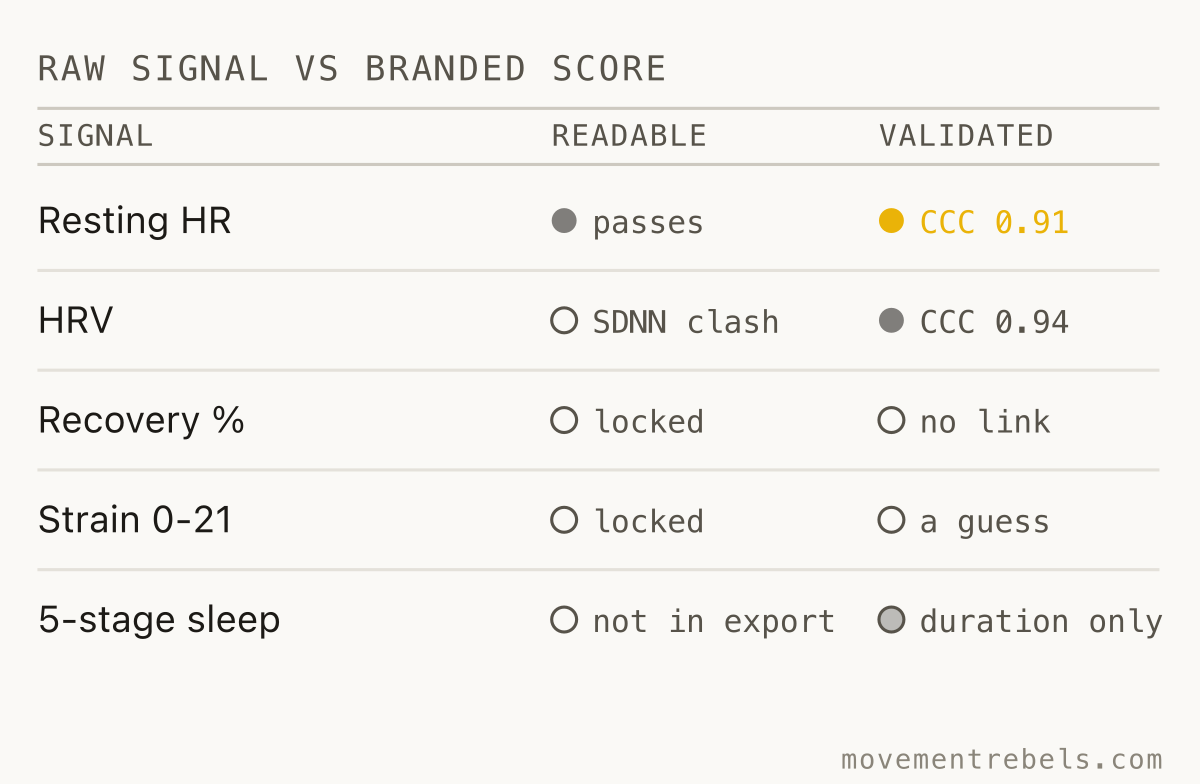
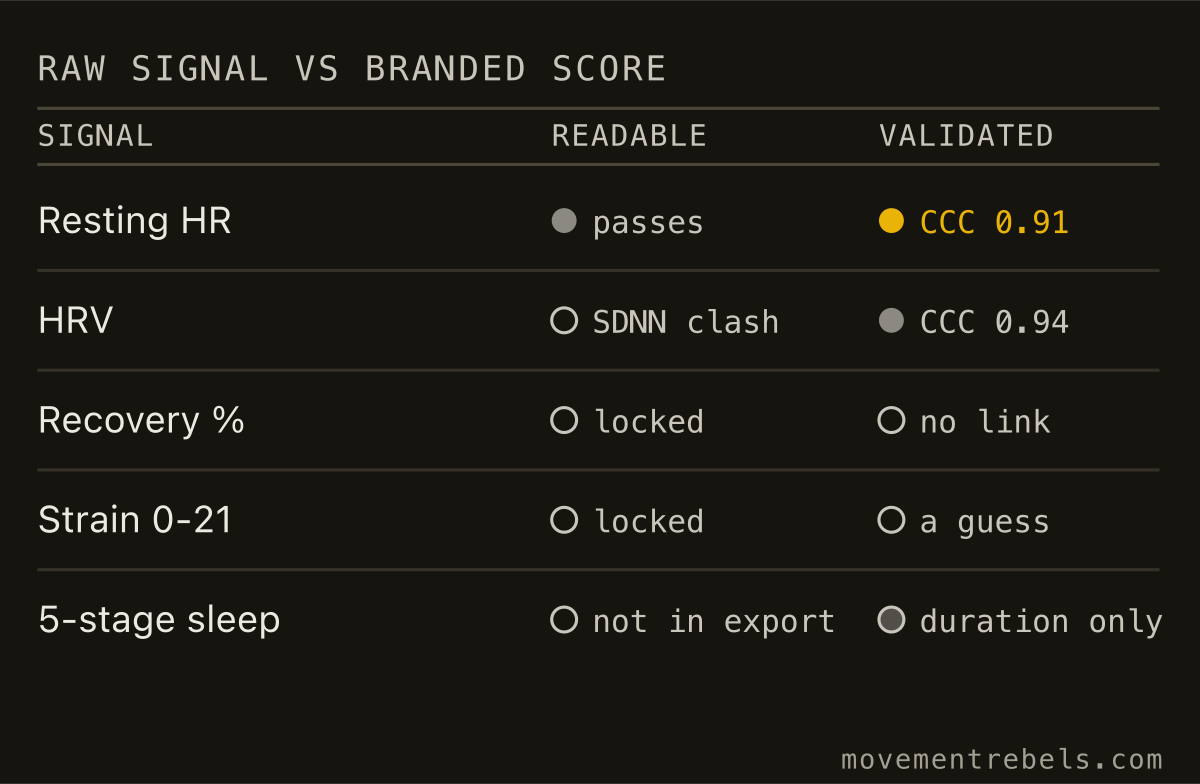
So the raw signal is reasonably good, particularly for heart rate. The Recovery score (0-100%) and Strain score (0-21) are something else entirely. They are WHOOP's proprietary composite algorithms, built on those raw inputs and whatever else sits inside a black box. The open equivalent of Strain is a Training Stress Score calculator to quantify session load, which uses the same power-and-heart-rate inputs without locking the number behind one brand. The research picture on WHOOP's composite scores is mixed. Studies looking at how well Strain and Recovery correlate with validated physiological and psychological stress measures during hard training blocks have found inconsistent results, with composite scores generally performing less predictably than raw HRV and RHR. Coaches and researchers broadly recommend reading the composite scores as directional context, not as actionable instructions on their own.
The honest position: WHOOP is a reliable RHR and sleep monitor with an engaging scoring interface built on top. The underlying physiological data has value. The composite scores have directional value at best and are not independently validated.
What data actually reaches Movement Rebels through Apple Health
This is the part that matters practically, and it is more constrained than most WHOOP coverage suggests.
WHOOP exports to Apple Health on iOS, but the export does not include its proprietary Recovery score or Strain score. Those numbers exist only inside the WHOOP app. What WHOOP writes to Apple Health is a narrower set of raw metrics: resting heart rate (one daily value), respiratory rate (sleep average), sleep records (marked as asleep or awake, not the full five-stage breakdown), workouts (type, duration, active calories), and SpO2. HRV is explicitly not exported because WHOOP calculates RMSSD while Apple Health stores SDNN, and the two values are not interchangeable.
Movement Rebels has a native iOS app that reads Apple Health via HealthKit. Once you enable the integration, the coach sees:
- Resting heart rate and its 7- and 30-day trend
- Respiratory rate baseline and shifts from that baseline
- Sleep duration and sleep continuity (the granular staging is not available from WHOOP's export)
- Workouts logged by WHOOP, with type and duration
What the coach does not see: the Recovery percentage, the Strain score, the five-stage sleep architecture, or WHOOP's own HRV value.
This is not a Movement Rebels limitation. It is a WHOOP export constraint, and the same constraint applies to any third-party coaching tool reading WHOOP data through Apple Health. A direct WHOOP connector that brings the Recovery score, Strain, and HRV through is on the Movement Rebels roadmap as the user base grows. Until it lands, the Apple Health path above is what the coach reads automatically, and you can type any WHOOP number straight into the chat in the meantime.
What the coach does with the data it can see
The constrained picture is still useful for a coach that knows how to read trends rather than reacting to single-day numbers.
RHR trend is the cleaner signal of the two. Your individual morning RHR over a rolling 7-28 day window tells a coach more than any single Recovery percentage, because it strips out the session-to-session noise. A gradual RHR climb of 3-5 beats per minute across two weeks is a reliable warning that training load is exceeding recovery, even before you feel it. That trend lives in Apple Health and the coach reads it. The same heart rate data drives a heart rate zone calculator for your training, so you can set the bands you actually train in from your resting and max HR. For a deeper look at how this signal works and how to use it in training decisions, see Resting Heart Rate Trends: The 28-Day Line.
Respiratory rate baseline shifts matter too, and WHOOP measures them consistently. An uptick of 1.5+ breaths per minute above your norm, especially combined with rising RHR, is often an early marker of illness or significant under-recovery, sometimes 24-48 hours ahead of subjective symptoms.
Sleep duration and consistency from the workout log give the coach load context. If WHOOP logs a 90-minute Zone 2 ride Tuesday, a second session Thursday, and sleep is showing under six hours both prior nights, the coach does not need a Strain score to make a sensible recommendation about Friday.
Concrete examples of how the coach behaves with this data:
- RHR 4+ beats above your 14-day average, two consecutive mornings, respiratory rate up 1+ breath per minute: the coach replaces the planned threshold session with an aerobic hour and notes the pattern. Hard-it-out days during early illness markers are one of the highest-return things to avoid. The mechanism is covered in Overtraining Signs.
- Workouts logged by WHOOP showing five consecutive hard sessions, sleep under 6.5 hours most nights, RHR climbing: the coach inserts a deload before you ask. See When to Deload for the trigger logic.
- Sleep data shows late bedtimes drifting through the week (Monday 22:30, Friday 01:15): the coach surfaces this in your morning brief. Sleep consistency, not just duration, is one of the cleaner predictors of HRV baseline. The evidence base for sleep and training performance is in Sleep and Training Performance.
You can also bring WHOOP context directly into the coach chat. If your Recovery shows 34% red and Strain yesterday hit 19, type that in. The coach incorporates qualitative and quantitative information you share, regardless of whether it flowed in automatically.
For HRV-guided training more broadly, the HRV-Guided Training guide covers how to read the signal, how much noise to expect day-to-day, and when HRV trends are worth acting on versus when they are not.

What WHOOP does not do, and why that gap matters
WHOOP does not write progressive training. WHOOP Coach (the in-app GPT wrapper) can answer questions and give a vibe, but it does not know you are ten weeks out from a half-marathon, does not balance your strength days against your endurance days, and does not write a Tuesday threshold session calibrated to where your fitness actually sits this week. It is a glossary and a suggestions layer, not a periodized program.
That is the structural gap the wearable space has not solved, and it is the reason most WHOOP users eventually reach for a second tool. The options are a human coach (useful, expensive, often unavailable for the back-and-forth that daily readiness data demands), a static training plan from a book or app (ignores your readiness data entirely), or a coaching layer that reads the data and writes the program.
How Movement Rebels fills the gap
Movement Rebels is that coaching layer. One app for strength, endurance, hybrid, planning, coaching, fueling, recovery tracking, and wearable integration.
The coach writes a periodized weekly plan calibrated to your goals, your current fitness block, and the readiness data flowing in from Apple Health. When your RHR is trending up, the plan adapts. When sleep data shows a rough week, the Thursday intervals shift. When your logged workouts show a load pattern building faster than your recovery window, the deload appears before the question arises.
The Garmin integration goes further: the coach pushes structured sessions directly to your watch with pacing targets and heart rate caps set as on-device alerts, so the session itself is calibrated, not just described. If you use both a Garmin for structured training and WHOOP for overnight recovery tracking, both integrate. Garmin handles the workout delivery side; WHOOP contributes the recovery signal through Apple Health.
Full sport coverage in one subscription: strength (hypertrophy, powerlifting, Olympic lifting, calisthenics), endurance (running, cycling, triathlon, Hyrox, ultra), and hybrid blocks. The coach also holds context across domains: your female cycle if you track it, your masters-athlete load tolerances, your injury history, and whatever fuelling context you have written into Notes for your coach. Recovery tools live inside the same app (breathwork, NSDR, cold exposure), and the coach sees when you use them.
One honest limitation: Movement Rebels has a feed, crews, follows and high fives, but no segments or segment leaderboards, and a far smaller network than Strava. If you keep Strava for that, the integration is live (your sessions logged in Movement Rebels are written to your Strava description automatically), so your friends' feed still sees your sessions. Strava activity data does not flow into the coach as an AI input; the connection is write-only from Movement Rebels to Strava.
If you use Oura instead of WHOOP, the picture is similar: Oura exports sleep stages, heart rate, and resting heart rate to Apple Health, so those flow through to Movement Rebels automatically. Oura's nightly HRV and readiness score stay in the Oura app, the same way WHOOP's scores do, and reach a coach only through Oura's own API. The difference is covered in Oura Ring AI Coaching.
Pricing
Movement Rebels is a 7-day free trial with full access, no card required up front. After that, Pro+ is $20/month for unlimited coaching, the full WOD library, full Rebel Fuel, and every recovery tool in the app.
One app instead of five.
Strength, endurance, recovery, fueling, planning, and your AI coach. All under a 7-day free trial. No card.
Start 7-day trialOura Ring AI Coaching: Great at Recovery, Blind to the Barbell
Oura Ring is the best sleep and HRV tracker you can wear. It cannot program a week of training. The honest picture: what the ring
HRV-Guided Training: Read the Signal, Skip the Noise
One low HRV night tells you almost nothing. The 7-day-vs-28-day trend tells you nearly everything. Here is what the evidence actua
WHOOP vs Oura vs Garmin: Which One Earns Its Place?
WHOOP, Oura, and Garmin measure different things and sell different promises. The no-spin breakdown: what each measures, what it s
Adaptive Training Plans: How the Plan Adjusts to You
Adaptive training is real science with honest limitations. What peer-reviewed research says about autoregulation and HRV-guided pl