Oura Ring AI Coaching: Great at Recovery, Blind to the Barbell
The Oura Ring is one of the most accurate consumer devices for measuring what happens while you sleep. A 2025 independent validation study published in Physiological Reports found that Oura Gen 3 and Gen 4 showed the strongest concordance with gold-standard ECG for both HRV and resting heart rate across 536 nights, outperforming WHOOP, Garmin, and Polar. The ring knows a lot.
The problem Oura users run into is not the data quality. It is that none of that data changes the plan. Your readiness score dips to 58, your HRV is down for the third straight morning, your temperature is trending up by 0.3 degrees, and the app suggests you take it easy. It cannot tell you what "take it easy" means in the context of a half-marathon eight weeks out. It cannot swap Thursday's threshold run for a Zone 2 recovery session and update your calendar. It cannot read your protein log and notice you have been 600 kcal under for four days, which is probably why recovery is poor.
That gap is what an AI coach is for. The honest framing: Oura is a diagnostic instrument. It is not a coach. Pair it with something that coaches.
What the ring actually measures, and what it does not
Oura tracks sleep stages, nighttime HRV (RMSSD), resting heart rate, respiratory rate, and skin temperature deviation from your personal seven-night baseline. The readiness score is a composite of those signals weighted against your recent activity load. It is one of the more honest single numbers in wearables, partly because the ring-form-factor and the overnight-only window filter out the motion artifact and positional noise that plagues wrist-based HRV.
What the ring does not track: anything that happens with a barbell, a pace, a power meter, or a swim split. It has no GPS. It has no accelerometer accurate enough for structured workout detection. Its step count is a rough proxy, not a training log. And its readiness score, however well-calculated, is a description of your current state. It says nothing about what you should do with that state.
That last point is where most Oura guides skip to a product recommendation. The honest version is that the ring's readiness composite is a useful input into a training decision, but HRV-guided training research consistently shows the signal matters most when it is interpreted in context: your training history, your target event, the week's planned load, and your fueling. A readiness score without that context is a number, not a prescription.
How Oura data reaches Movement Rebels
Oura pushes a defined set of metrics to Apple Health on iOS: heart rate samples in one-minute intervals, average nighttime respiratory rate, sleep duration and stage data, steps, active energy, and workout summaries for detected or manually logged activities. Movement Rebels runs a native iOS app with native HealthKit integration. Every morning, the ring's overnight data lands inside MR automatically.
There is one important thing to be precise about here. Oura's readiness score does not travel through Apple Health, and neither does its nightly HRV value or the raw temperature deviation. What arrives in Apple Health is the rest of the signal: heart rate, resting heart rate, respiratory rate, sleep duration, and sleep stages. Movement Rebels reads those directly and builds its own recovery picture from them, rather than leaning on Oura's composite score. The HRV and readiness numbers that Oura is known for reach a coaching layer only through Oura's own API, which is the next integration on the roadmap.
For Android users, Movement Rebels runs as a PWA at app.movementrebels.com while the native Android app rolls out. The automatic Apple Health pipeline is iOS-only, so on Android you bring your Oura numbers into the coach chat directly, or pair a Garmin for the native Connect integration.
A direct Oura API integration, which would add the nightly HRV, the readiness composite, and the temperature trend that Apple Health does not carry, is the next integration on the roadmap. The Apple Health path today already drives the adaptive plan and the morning brief off your resting heart rate, sleep, and respiratory trends.
The illness-detection edge: why temperature matters more than the score
The most underrated feature of the Oura Ring for athletes is not the readiness score. It is the nightly temperature deviation. Your seven-night baseline is personalized, which means a deviation of 0.2-0.3 degrees is meaningful for you specifically, not against a population average.
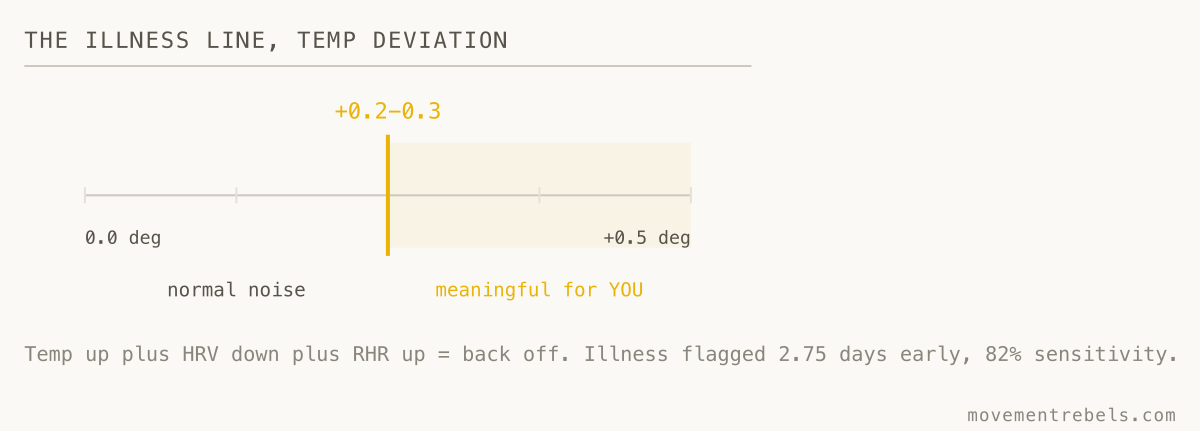
A UCSF-led study published in Scientific Reports found that Oura's combined physiological data (temperature, heart rate, HRV, respiratory rate) could identify COVID-19 an average of 2.75 days before participants sought testing, with 82% sensitivity. The same multi-metric pattern shows up in any acute illness: temperature spikes, resting HR climbs, HRV falls, respiratory rate elevates. Of those, resting heart rate and respiratory rate come through Apple Health to the coach. The temperature and HRV shifts are what Oura surfaces in its own app, and a one-line note in chat brings them into the picture.
For athletes, this matters practically: the most common training mistake at the onset of a mild illness is not backing off soon enough. A three-day HRV downtrend plus an elevated temperature deviation is a different clinical picture than a single poor sleep score after a late night. The Movement Rebels coach distinguishes between the two in the morning brief and responds differently: light adjustment for a stress blip, a sharper volume cut and a flag for possible early illness when temperature is trending alongside HRV.
Readiness that changes the plan, not just the score
This is the thing Oura users have wanted and have never had from the ring itself: the score changes the plan, automatically, without you having to interpret it.
A resting heart rate two beats above your 30-day baseline for three mornings, short sleep on two of those nights, and your Oura readiness sitting in the red: the morning brief reads something like, "Three-day HRV downtrend. Pulling Thursday's threshold run, keeping the easy 40-minute Zone 2 session, pushing the long run to Sunday. Eat your carbs back." The plan updates in the calendar. You did not have to decide. To pin the numbers behind that easy session, you can find your Zone 2 heart rate range from your max or resting HR.
The same logic works in the other direction. A readiness score above 90 after a recovery week, and the coach offers to bring forward a hard intervals session because the body is ready for it. Adaptive training plans built on live physiological data are what separate periodization that works from periodization that is theoretically sound but practically rigid.
The research broadly supports this direction. A narrative review in Sensors (MDPI, 2026) found that daily morning HRV is more sensitive to training load changes than measurements taken later in the day, making it the better timing window for readiness decisions. The broader body of research on HRV-guided training generally finds that adjusting load based on daily physiological signals improves adaptation outcomes compared to fixed prescriptions, though results vary by sport and protocol. The ring measures the signal at the right time of day. The coach has to act on it.
What Oura cannot see: where MR fills the gaps
A ring on your finger cannot see the barbell, the plate, or the water bottle. The training stack around most Oura users is fragmented: the ring for recovery, a separate app for strength logging, another for running, another for food. None of them talk to each other. The coach that adapts your Thursday session based on your HRV never sees that you have been under-fueling.
Movement Rebels keeps it in one place. The strength logger covers hypertrophy, powerlifting, Olympic lifts, calisthenics, and strongman, with the full exercise codex and form cues next to every prescription. Endurance lives in the same shell: running, cycling, swimming, triathlon, ultra, and Hyrox. Structured workouts push directly to your Garmin watch through the native integration if you wear one alongside the ring. Pushing today's session to your watch takes one tap.
Rebel Fuel handles the fueling layer. Snap a photo of your plate and the meal-AI estimates macros, or log a manual entry in seconds. The coach does not read your Rebel Fuel log. When Oura's recovery metrics are poor and your food log shows four consecutive days 600 kcal below target, the coach connects those two facts in the morning brief. That is not something Oura can do. It is not something a generic macro tracker can do. It requires a coach that sees both.
Recovery tools sit inside the app too: breathwork timers, NSDR sessions for midday resets, cold exposure tracking, fasting timers. Your biohack history sits on the same timeline as your training and your sleep data, so you can actually see whether the breathwork and the cold protocol are moving your HRV. For a deeper look at what your resting heart rate trend is telling you over weeks, MR tracks that across the full training block.
A real Oura-driven week, without the manual interpretation
Say you are a recreational triathlete eight weeks out from a half. Monday's overnight data comes in with resting HR two beats above average and respiratory rate ticking up, while your Oura app flags an 18% HRV drop and a temperature deviation of plus 0.4. The coach reads the heart-rate and breathing signals that come through Apple Health, you flag the Oura readiness drop in one line of chat, and it swaps Monday's threshold bike for a 30-minute Zone 2 spin plus an NSDR session. It pushes a hydration and electrolyte nudge and pulls a meal idea from Rebel Fuel that hits your protein target without overshooting calories on a light training day.
Tuesday morning the data normalizes. The plan stays put. Wednesday's brick workout runs as scheduled, the structured ride pushed to the Garmin, the off-the-bike run logged in the app. Thursday the resting heart rate ticks up again after a short sleep. The Saturday long run gets trimmed by 20%, and the Sunday recovery ride becomes a walk.
None of that required you to open graphs and make decisions about your own training. The ring provided the data. The coach made the calls. Managing data from multiple sources without getting lost in it is the practical problem Oura users face daily. The ring is excellent at producing data. What is needed is a layer that decides what to do with it.
Where Oura still wins over every alternative
If your priority is sleep depth and overnight recovery accuracy, Oura is still the best tool for it. The ring-form-factor means less motion artifact overnight. The finger placement gives a clean peripheral temperature signal that wrist devices struggle to match. The nighttime HRV window, when the autonomic nervous system is in its quietest state, produces more consistent readings than daytime spot checks.
The pairing that works best for most athletes: Oura for the overnight ground truth on recovery, Garmin on the wrist for structured workouts and GPS sport, and Movement Rebels as the layer that connects both data streams into one adaptive plan, with the fueling, the strength work, and the recovery tools in the same place.
One honest trade-off: MR has a feed, crews, follows and high fives, but no segments and a much smaller network than Strava. If the social side matters, keep using Strava. The MR-to-Strava integration writes your sessions back to Strava with a rich coach summary, so the activity still lands in your friends' feed.
How Movement Rebels handles this
The iOS app reads Oura data via native HealthKit integration. No manual export. No third-party connector. Sleep, resting heart rate, and respiratory rate arrive each morning, and the coaching layer acts on them. Oura's nightly HRV and readiness score stay in the Oura app until the direct API integration lands.
Compare it to the Apple Health AI coach model, which works for any device that writes to HealthKit, or the Garmin AI coach integration for athletes who want structured workouts pushed to the watch. Oura users often pair all three.
Pricing
Movement Rebels is one app for the full picture: strength, endurance, hybrid, planning, coaching, fueling, recovery, tracking. A 7-day free trial covers the entire surface, no card required. After the trial, Pro+ is $20/month for unlimited coaching.
One app instead of five.
Strength, endurance, recovery, fueling, planning, and your AI coach. All under a 7-day free trial. No card.
Start 7-day trialApple Health as an AI Coach Data Layer: What It Passes Through
Movement Rebels reads Apple Health natively on iOS. But WHOOP doesn't export HRV, Oura's readiness score stays locked, and the coa
HRV-Guided Training: Read the Signal, Skip the Noise
One low HRV night tells you almost nothing. The 7-day-vs-28-day trend tells you nearly everything. Here is what the evidence actua
Sleep and Training Performance: The Lever Nobody Respects
Sleep outperforms every supplement, wearable, and recovery tool you own. Here's the honest evidence, what actually trashes it, and
WHOOP vs Oura vs Garmin: Which One Earns Its Place?
WHOOP, Oura, and Garmin measure different things and sell different promises. The no-spin breakdown: what each measures, what it s