5K and 10K Training: A Weekly Plan to Race Faster
Most runners trying to break a 5K or 10K time make the same error: they run every session at the same uncomfortable middle pace. Too hard to build aerobic volume, too easy to drive adaptation. You leave this guide with a weekly structure that separates those efforts on purpose, sample workouts with paces you can hit tomorrow, and a plan for the race itself.
What limits a 5K and 10K
The 5K and 10K sit in a narrow physiological band. Both are run close to or above your lactate threshold, and both lean hard on VO2max, the ceiling on how much oxygen your body can use per minute.
- A 5K for a trained recreational runner typically takes somewhere in the range of 20 to 35 minutes depending on sex and fitness level. You spend most of it at or above threshold pace, with VO2max as the limiter. The race punishes a weak top end.
- A 10K for the same runner typically falls in the 42 to 65 minute range. It sits right at threshold. The race punishes a weak threshold and poor pacing far more than a weak top end.
So the two distances share an engine but tax it differently. The 5K wants more VO2max work. The 10K wants more threshold work. Both want a deep aerobic base underneath, because the base is what lets you recover between hard sessions and hold pace in the back half.
Two numbers matter for the rest of this guide:
- Threshold pace. Roughly the pace you could hold for about an hour all out. For most recreational runners it sits somewhere around 10K race pace, but for faster runners it is noticeably quicker than 10K race pace. In heart rate terms, it generally falls in the range of 88 to 92% of max heart rate for trained runners. Lower efforts around 85 to 88% HRmax are closer to the first lactate threshold, which is a useful aerobic stimulus but not the same training target.
- VO2max pace. Roughly your current 3K to 5K race pace, run at 95 to 100% of max heart rate. You can only hold it for a few minutes at a time, which is why this work is done in intervals.
Drop a recent race result into a VDOT calculator to set your training paces and you get both numbers in one place, ready to program the sessions below.
The weekly structure
Three quality sessions and the rest easy. That ratio holds whether you run 4 days a week or 6. The mistake is not the number of hard days, it is letting the easy days creep into a grey zone where they stop being easy and stop counting as quality.
A clean week for someone running 5 days:
- Monday: rest or 20 to 30 min easy
- Tuesday: VO2max session (the hard one)
- Wednesday: easy run, 30 to 45 min, conversational
- Thursday: threshold or tempo session
- Friday: rest or easy
- Saturday: long run, easy effort
- Sunday: easy run or full rest
The two key sessions sit 48 hours apart so you arrive at each one fresh. Everything between them is genuinely easy, run at a pace where you could hold a conversation. That easy work is your aerobic base, and it is the part people skip because it feels too gentle to be doing anything. It is doing the most. Lock the easy days into the right intensity using heart rate or perceived effort, covered in zone 2 training. A heart rate zone calculator for easy and threshold work turns your max and resting HR into the five zones this plan references.
Aim for roughly 80% of your weekly minutes easy and 20% hard. If you run 4 hours a week, that is about 48 minutes of quality across the two key sessions and the rest easy.
The VO2max session
This is the one that hurts and the one that raises your ceiling. Short, fast repetitions at 95 to 100% effort with enough recovery to repeat the quality. If you want a starting number to track against, you can estimate your VO2 max from a Cooper test before the block begins. The dose, work to rest ratios, and how to progress the reps are laid out in how to run VO2 max intervals.
Start here and progress over the block:
- 3 to 5 x 3 min at VO2max pace (current 5K race pace or a touch faster), with 2 to 3 min easy jog between. Total hard time: 9 to 15 min.
- Progress toward 5 to 6 x 3 min, or longer reps like 4 to 5 x 4 min with 3 min recovery.
The work interval should feel like an 8 or 9 out of 10. By the last rep you are counting down the seconds. If you can negative-split the reps and finish the session thinking you could do two more, you ran them too slow. If you fall apart by rep three, you started too fast.
Keep total hard volume between 12 and 20 minutes. More than that and the pace drops below VO2max, which turns the session into a slow threshold run and misses the point. A 10 to 15 min easy warm-up and 10 min cool-down go around it, every time.
For a 5K focus, bias these reps shorter and faster (90 sec to 3 min). For a 10K focus, you can run them slightly longer (3 to 5 min) since the 10K rewards holding a high but submaximal effort.
The threshold session
This is the workhorse for the 10K and the session that lets you hold race pace without drowning in lactate. The effort is "comfortably hard," a 7 out of 10, in the 88 to 92% of max heart rate range for trained runners. You could speak in short sentences but would not want to.
Three formats, pick based on the day:
- Continuous tempo: 20 to 40 min at threshold pace in one block. Honest and simple. The longer end is for 10K specificity.
- Cruise intervals: 4 to 6 x 5 to 8 min at threshold with 1 min easy jog between. The short breaks let you hold a slightly faster pace at the same effort and accumulate more time at threshold. Total 25 to 40 min of work.
- Long intervals: 2 to 3 x 10 to 15 min at threshold with 2 to 3 min easy between.
The discipline here is restraint. Threshold is not a time trial. If you finish a tempo and feel wrecked, you ran it at 10K race effort, not threshold effort, and you will pay for it on the next quality day. The full breakdown of formats, paces, and how to progress them lives in the tempo run guide.

The long run
For 5K and 10K training the long run is aerobic insurance, not the main event. It builds the base that lets the two hard sessions work and trains your body to hold pace when tired.
- Run it at easy effort, the same conversational pace as your other easy days.
- Length: 60 to 90 min, or 25 to 30% of your weekly volume, whichever is shorter. A 5K runner does not need a 2-hour long run.
- It is fine to add 4 to 6 x 20 sec strides at the end (controlled fast, not sprinting) to keep your legs sharp. Do not turn it into a hard session.
If your week is already carrying two demanding key sessions, keep the long run boring. The cost of making it hard is a compromised Tuesday and Thursday.
How many weeks, and how to build them
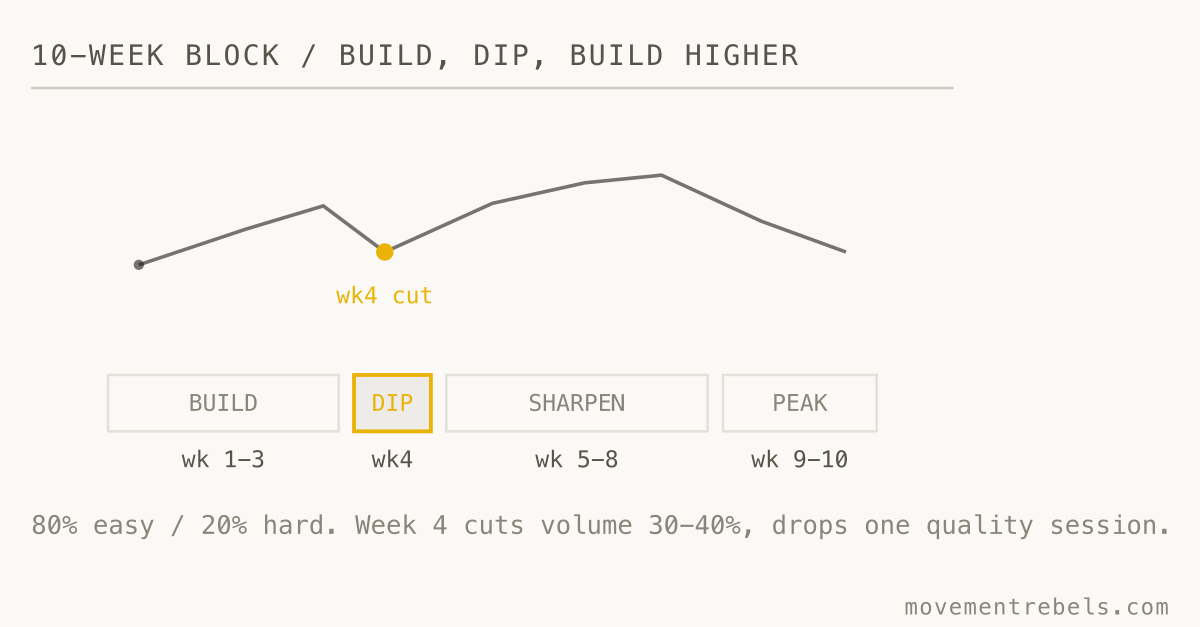
Plan a block of 8 to 12 weeks for a clear improvement. Less than 8 and you are racing on fitness you already had. More than 14 without a goal race and motivation drifts.
A simple structure:
- Weeks 1 to 3: build. Establish the weekly rhythm, keep VO2max reps on the shorter end, build easy volume.
- Week 4: down week. Cut volume 30 to 40%, drop one quality session. Recover so the next block lands.
- Weeks 5 to 8: sharpen. Lengthen the VO2max and threshold work, hold easy volume steady.
- Weeks 9 to 10: peak and taper. Volume drops, intensity stays. Keep the legs fresh and fast.
That down week in week 4 is not optional. Fitness is built when you absorb training, not when you pile it on. The signs that you have pushed past the point of absorbing, and what to do, are in recognizing overtraining and when to deload. For the longer view on how blocks stack across a season, see periodization for recreational athletes.
If you track training load, watch the trend across the block rather than any single day. A steady rise through weeks 1 to 3, a dip in week 4, then a higher rise through weeks 5 to 8 is the shape you want. Training stress score explains how to read that curve.
Pacing the race itself
A good plan ruined by a bad first kilometre is the most common way runners miss a time they trained for. The fix is even pacing, often a slightly negative split. Set a realistic goal first by using a recent effort to predict your 5K and 10K race time, then build your splits around that number.
For the 5K:
- Run the first kilometre at goal pace or 2 to 3 sec slower, not faster. Adrenaline will make goal pace feel easy. It is a trap.
- Settle into goal pace through the middle. This is where the race is decided, not the start.
- From 4K, spend whatever is left. If you have anything in reserve at 4K you paced the first half too cautiously, but that error is rarer than going out too hot.
For the 10K:
- The first 2K should feel almost too controlled. You are sitting at threshold, and threshold for 40-plus minutes is a different animal than for 5 minutes.
- Hold goal pace through 7K. Watch your heart rate drift; a small rise is normal, a sharp climb means you are overcooked.
- Push from 8K. The last 2K is where disciplined early pacing pays out.
Practice race pace in training so it is a known feeling, not a guess. A few reps at goal pace in the final two weeks calibrate the body better than any watch.
The mistakes that cost you the race
- Racing every session. The single biggest one. If your easy runs are run hard, you arrive at the key sessions tired and run those slow too. Everything collapses into one mediocre pace. Easy means easy.
- No true rest days. A 30 min "recovery" run at threshold effort is not recovery. If you are sore or flat, rest fully or jog at a pace that feels almost lazy.
- Skipping the warm-up before quality. Cold legs cannot hit VO2max pace, so the first two reps are wasted and the session quality drops. 10 to 15 min easy plus a few strides, no exceptions.
- Too much hard volume. More VO2max reps past 20 min of work do not add fitness, they add fatigue and slow the pace below the target zone.
- No down week. Riding three weeks of building straight into a fourth without a cut is how a strong block turns into a flat one. Plan the dip.
- Ignoring sleep. The adaptation from these sessions happens when you sleep, not when you run. Chronic short sleep undoes the work. See sleep and training.
How Movement Rebels fits
The structure above is the easy part to write and the hard part to hold week after week as life moves your sessions around. The Movement Rebels coach reads your Garmin and Apple Health data, builds the week around the runs you did and how recovered you are, and adjusts the next sessions when a hard day landed flat or you missed a run. It keeps the easy days easy and the hard days hard, which is the whole game.
Train the three efforts, respect the easy days, plan the down week, and pace the race like you trained it. The fitness follows.
One app instead of five.
Strength, endurance, recovery, fueling, planning, and your AI coach. All under a 7-day free trial. No card.
Start 7-day trialTempo Runs: Threshold Done Right
Tempo run physiology, honest pacing ranges, three session variants, and why the popular HR zone is wider than coaches admit. Build
Zone 2 Training: When It Works, When It's a Waste
Zone 2 is real, old, and oversold. Here's the honest version: when low-intensity volume is your highest-leverage work, when it isn
Training Stress Score (TSS): Useful Number, Wrong Anchor
TSS quantifies session load well. The mistake is treating it as a recovery metric. Here's what it measures, where it breaks, and h
Periodization for Recreational Athletes: Which Model, and How Much You Need
Linear, block, undulating: the honest evidence on which periodization model recreational athletes actually need, and what the rese