Training on GLP-1 Medication: Protect Muscle, Fuel Your Sessions
This guide is not about whether you should be on a GLP-1. Your prescriber made that call with you. What this guide is about: once you are on semaglutide or tirzepatide and training, the specific risks you are walking into and what the peer-reviewed evidence says to do about them.
The central problem is not the drug. It is the combination of a steep energy deficit, appetite suppression that makes eating feel effortless to skip, and the training volume that demands fuel you are not taking in. Under those conditions, a meaningful share of the weight you lose comes from lean mass rather than fat. The proportion depends on which drug you are taking: tirzepatide trials show roughly 25-26% of weight lost is lean tissue; semaglutide trials show approximately 30-40%, and a 2025 meta-analysis across GLP-1 therapies put the average around 31%. For a recreational cyclist with decent legs, or a runner who has spent years building their aerobic base, that is not a cosmetic concern. That is a performance and long-term health concern. Before you start, it helps to know your maintenance number, so run a TDEE calculator for training and rest days to see what the GLP-1 deficit is actually subtracting from.
The fix exists and is well-supported. It requires deliberate resistance training and deliberate protein intake, because the drug will not do either of those for you.
This is not medical advice. Follow your prescriber's guidance on dosing, timing, and monitoring. Flag any unusual fatigue, cramping, or nausea during training to your care team before adjusting your program.
The Lean-Mass Loss Problem Is Real, and the Numbers Are Concrete
Clinical trials give us a fairly clear picture. In the SURMOUNT-1 body-composition substudy, tirzepatide produced about 21% body-weight loss over 72 weeks, and DXA scans showed lean mass fell roughly 10.9% while fat mass fell 33.9%. Put another way, about 25% of the weight lost was lean tissue and 75% was fat.
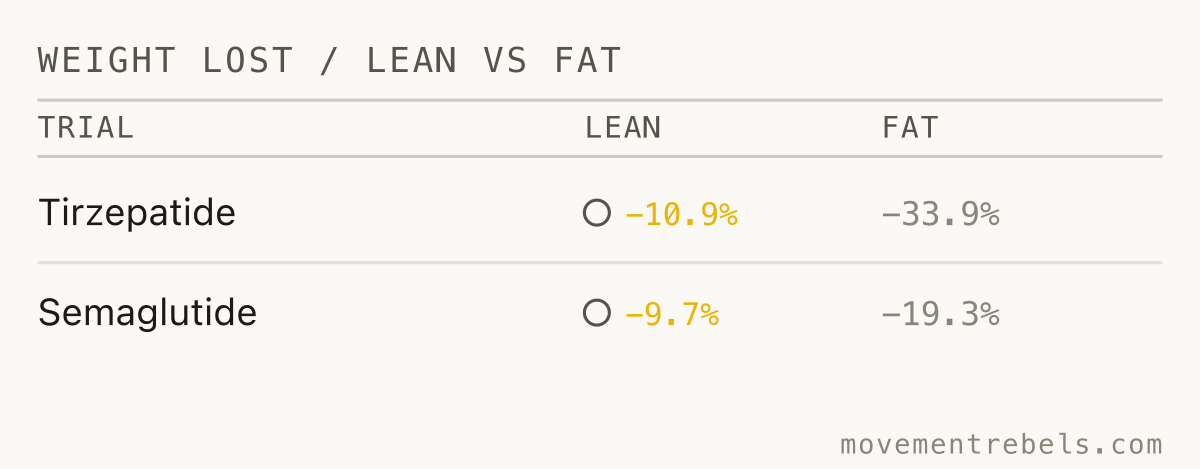
Semaglutide shows a different profile. STEP-1 DXA data show absolute lean loss of approximately 6.9 kg against roughly 10.4 kg of fat lost, meaning around 30-40% of total weight lost was lean tissue. A PMC review on muscle loss and GLP-1 receptor agonists puts semaglutide's lean-loss proportion at approximately 30% of total weight lost, and characterizes this as "physiological rather than pathological" in the context of large weight loss overall. That is still a materially worse lean-mass outcome than tirzepatide's 25-26%, and worth knowing before assuming the two drugs carry the same risk profile.
The review also notes that the risk of disproportionate lean tissue loss rises sharply with advanced age, rapid or large total weight loss, low dietary protein, sedentary behavior, and chronic disease.
Active athletes sit on a spectrum here. If you are training five days a week, you already have some protection. But "some protection" is not the same as "no risk," and the appetite suppression that makes GLP-1s effective is the exact mechanism that puts muscle at risk when training demands are high.
The broader range across trials is 15-50% of total weight loss coming from lean tissue. Ongoing research is actively testing resistance exercise plus protein supplementation as protective interventions, with muscle cross-sectional area as primary endpoints. The rationale is the same logic your training should follow now.
For athletes also managing body recomposition goals alongside a GLP-1 prescription, the guide on macros for body recomposition covers the underlying energy-balance and protein-distribution logic in more depth.
Why Resistance Training Is the Lever, Not Just Cardio
The literature on this point is consistent enough to call it settled: aerobic exercise alone does not attenuate lean body mass loss during weight-loss diets as effectively as resistance training does. Running more kilometers will not protect your legs when you are in a sustained caloric deficit. Lifting will.
The signal to preserve muscle mass is mechanical tension on muscle fibers against load. When you are in a deficit, the body will cannibalize protein from wherever it can find it unless you are repeatedly sending the message that those fibers are in use and needed. Resistance training sends that message. Appetite suppression plus a 700-calorie daily deficit plus cardio-only training does not. If you are not sure how steep your current deficit is, a calorie deficit calculator with a safe-rate check shows whether your weekly loss rate sits inside the range that protects lean tissue.
The practical prescription from the literature is two to three resistance sessions per week targeting major muscle groups, with progressive load. That means increasing weight, reps, or volume over time, not staying at the same comfortable level for months. Compound movements, squats, deadlifts, rows, presses, pull-ups, and lunges, cover the most muscle per session. Isolation work can supplement but should not replace them.
If you are an endurance athlete whose identity is mostly aerobic, the hybrid athlete training guide covers how to stack resistance sessions alongside aerobic volume without one suppressing adaptation in the other.
Research on GLP-1 agonists and exercise generally points to 150 minutes per week of moderate aerobic work plus 60-90 minutes per week of resistance training as a sustainable maintenance framework, building toward 2-3 resistance sessions weekly. If you are already training more than this, do not cut aerobic volume. Add the resistance sessions.
The Protein Number, and Why Distribution Matters More Than Most People Think
For resistance-trained individuals in a caloric deficit, the evidence broadly supports protein intakes well above standard dietary guidelines to maximize lean mass retention. The ISSN position stand on protein and exercise (PMC5477153) sets the hypocaloric range for resistance-trained subjects specifically at 2.3-3.1 g/kg/day. That is a ceiling applicable to people actively lifting in a deficit, not a general recommendation for all athletes or recreational exercisers.
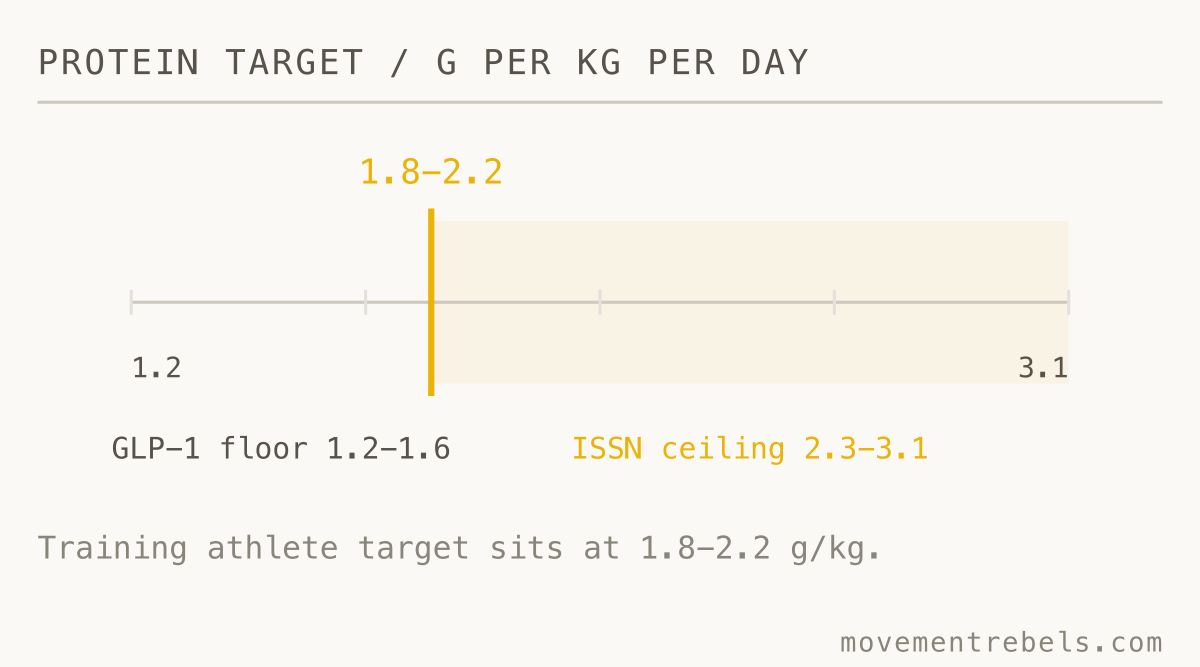
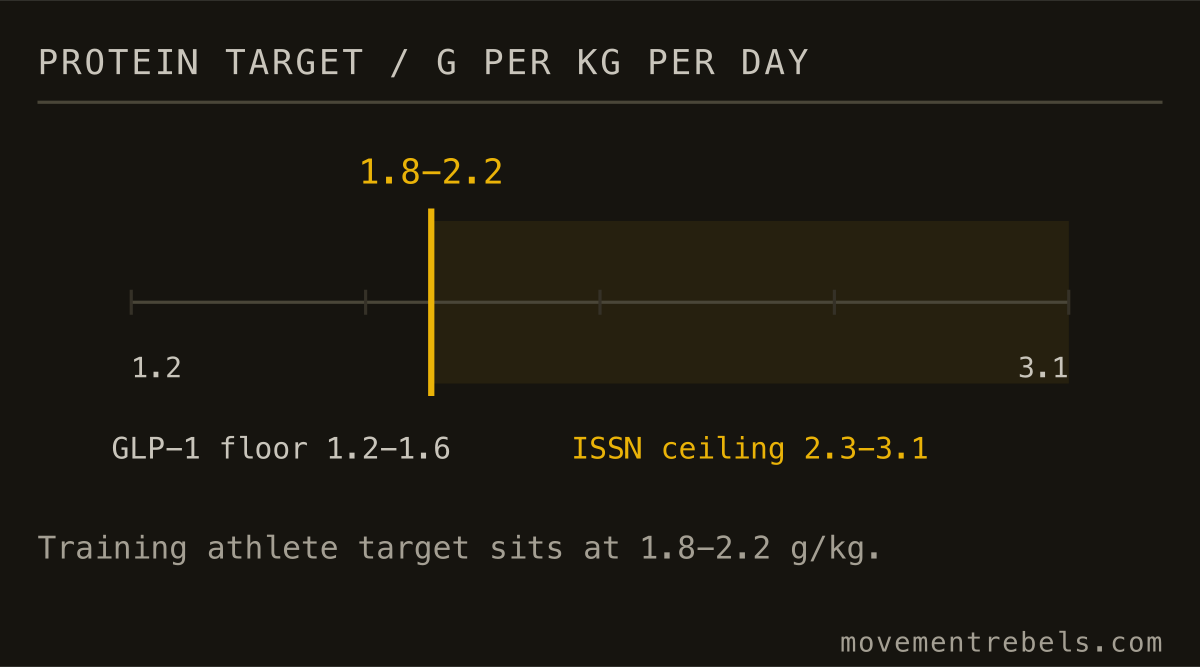
For athletes doing meaningful training volume on a GLP-1, the evidence supports aiming toward the higher end of 1.8-2.2 g/kg/day as a practical target. The PMC muscle-loss review recommends 1.2-1.6 g/kg of adjusted body weight as a floor for people on GLP-1s generally, with athletes needing more.
The distribution piece is what most guides skim. Muscle protein synthesis is a discrete biological event, not a running average. Eating 40 g of protein at dinner and 10 g across the rest of the day does not produce the same anabolic response as distributing 30-40 g across four feedings. Each feeding needs to cross the leucine threshold (roughly 2.5-3 g of leucine) to maximally stimulate synthesis. On a GLP-1, where appetite suppression makes three large meals feel like they require willpower, four smaller protein-dense feedings can be easier to execute than trying to hit targets in two or three sittings.
Prioritize protein sources with complete amino acid profiles: meat, fish, eggs, dairy, or high-quality plant proteins in combination. A whey or casein supplement is a practical tool for athletes who cannot hit targets through food alone, especially post-training when appetite is lowest. A daily protein intake calculator turns the g/kg range above into a concrete daily gram target you can actually plan meals around.
See the fueling around long training sessions guide for the timing and composition logic that applies to endurance sessions specifically.
Fueling Workouts When Your Appetite Is Suppressed
This is where athletes on GLP-1s run into trouble that pure weight-loss programs never think about. GLP-1 drugs also slow gastric emptying. That means the carbohydrate you eat before a session takes longer to reach your bloodstream, and the window for pre-session fueling compresses.
Practical implications for session fueling:
Pre-session (60-90 minutes before): Eat a small, carbohydrate-containing meal or snack even if you are not hungry. Your liver's stored glycogen and the muscle glycogen you will burn during hard efforts need to be topped up. The absence of hunger is not the same as the absence of need. A banana with 20-30 g of a protein source works. Large volumes of fat or fiber before training will compound the gastric-emptying slowdown.
Intra-session (sessions over 60-75 minutes): GLP-1's appetite suppression does not pause during exercise. For sessions over an hour at moderate to high intensity, you still need carbohydrate. Sports drinks, gels, or chews in the 30-60 g/hr range depending on intensity and duration. Standalone GLP-1 therapy has a low inherent hypoglycemia risk, but underfueling long efforts can cause energy crashes in any athlete in a caloric deficit, and risk rises if you are also on other glucose-lowering medications. If you feel dizzy, weak, or unusually flat 40-60 minutes into a session, report it to your prescriber.
Post-session: This is the window where the suppressed-appetite problem is most damaging. You have just created a protein synthesis window, but the drug is telling your brain you are not hungry. Override that signal intentionally. A 30-40 g protein source within 30-60 minutes of finishing, combined with carbohydrate to begin glycogen replenishment, is the target. Liquid sources (protein shake, milk, or a smoothie) are often easier to execute when appetite is low than solid food.

Who Carries the Highest Risk
Not every person on a GLP-1 medication faces equal muscle-loss exposure. The PMC review identifies the highest-risk profile as: older athletes (sarcopenia risk rises with age), people losing weight rapidly (more than 0.5-1% of body weight per week), athletes with already-low body weight or muscle mass, and anyone significantly undereating protein relative to their training load.
For masters athletes (40+) already managing anabolic resistance and slower recovery, a GLP-1 in a steep deficit without resistance training is a particularly high-risk combination. The lean mass that took years to build through consistent strength work can erode meaningfully in two to three months of neglecting it. The masters athlete training guide covers the protein-distribution and strength-session frequency logic that applies here.
If you have access to periodic body composition measurement (DXA or bioimpedance), it is worth tracking fat-free mass alongside total body weight during GLP-1 therapy. Body weight alone does not tell you whether the loss is coming from the right tissue. A lean body mass calculator gives you a starting baseline to track against, and an FFMI calculator normalizes that mass for height so you can watch muscle retention rather than the scale.
The Recovery Overlap
One underappreciated effect of a sustained caloric deficit combined with GLP-1 use is on training recovery. With less total energy available, recovery quality can decline. HRV may trend lower. Resting heart rate may creep up. Sleep quality can shift. These are signals worth monitoring, not ignoring.
The connection between energy availability and recovery capacity is central to the risk profile known as RED-S (Relative Energy Deficiency in Sport). Athletes on GLP-1s are not inherently at RED-S risk, but those running a steep deficit alongside high training loads are closer to that territory than they might realize. See the guide on RED-S and low energy availability for the warning signs.
If you use Garmin or Apple Health, your HRV trend and resting heart rate data are visible in Movement Rebels and feed directly into how the coach reads your readiness for hard sessions. A sustained suppression in those metrics during a GLP-1 cut is a signal to discuss load management with your prescriber, not just push through. See HRV-guided training for how to read that trend without chasing daily noise.
How Movement Rebels Handles This
Movement Rebels does not detect whether you are on a GLP-1. What it does is build training programs and coaching responses around the data you actually produce: your training load, your recovery metrics from Garmin or Apple Health, your logged nutrition, and your body composition data if you track it.
For athletes managing a GLP-1 cut, the coach is most useful when you tell it what you are doing. A note in your athlete profile that you are in a caloric deficit, your approximate weekly protein target, and your resistance training frequency gives the coach the context to weight your weekly plan toward maintenance of strength and muscle mass rather than volume accumulation. The weekly brief reads your prior week's sessions, recovery metrics, and logged data to adjust the coming week. It will flag suppressed readiness before a hard session if your HRV trend warrants it.
Garmin integration means that if you push a structured workout to your watch, your actual execution (heart rate, pace, power, duration) feeds back into the coach's understanding of your current capacity. That feedback loop matters more, not less, when your training energy is variable due to appetite suppression and deficit-induced fatigue.
Pricing
Movement Rebels offers a 7-day full-access free trial, no card required. After the trial, Pro+ is $20/month and includes unlimited AI coaching, personalized weekly training plans, nutrition tracking, and full wearable integration with Garmin and Apple Health.
One app instead of five.
Strength, endurance, recovery, fueling, planning, and your AI coach. All under a 7-day free trial. No card.
Start 7-day trialGLP-1 and Training: Preserving Muscle Through Intensity, Volume, and Protein Timing
Preserve muscle on GLP-1 by adjusting training intensity and volume. A coach's guide to resistance protocols, cardio zones, and pr
Masters Athlete Training After 40: What Holds You Back
The research is clear: most VO2max decline after 40 comes from training volume reduction, not aging. Here's what actually changes,
Macros for Body Recomposition: The Numbers That Work
Simultaneous fat loss and muscle gain is real but slow. Here's the honest protein math, the deficit window, how training status ch
Body Recomposition Tracking: Why The Scale Lies
The scale is the worst tool for tracking recomposition. Here's the honest five-signal stack that actually shows progress, what the