RED-S and Low Energy Availability: Not a Female-Only Problem
The old framing was the Female Athlete Triad: disordered eating, menstrual dysfunction, and low bone density, a constellation seen in elite women and treated as a women's problem. Then the research caught up. In 2014 the International Olympic Committee retired the Triad label and replaced it with Relative Energy Deficiency in Sport (RED-S), a broader syndrome covering both sexes, multiple body systems, and a wider range of severity than the classic triad implied. The IOC's 2023 consensus statement on RED-S built on that shift with substantial new evidence, and it is unambiguous: male athletes get RED-S too, the consequences are real, and the field has been slow to recognize it.
This matters more than it sounds. A male athlete training eight to fifteen hours a week on inadequate calories is not failing to "cut weight properly." He is chronically under-fueling a stressed system. The outcomes include suppressed testosterone, increased stress fractures, impaired immune function, flattened power output, and mood disruption. None of those go away by training harder.
This guide is not a diagnostic tool. If you suspect RED-S, the right move is a sports physician and a registered dietitian, ideally one experienced with athletes. What this guide can do is explain the mechanism, describe the warning signs in plain terms, and make the case for why fueling relative to load matters as much as any training variable.
What Low Energy Availability Actually Means
Energy availability (EA) is not the same as energy balance. It is the energy left for normal physiological functions after subtracting what exercise burns, expressed relative to lean body mass. The standard formula: (energy intake minus exercise energy expenditure) divided by lean body mass in kilograms, measured in kilocalories per kilogram per day.
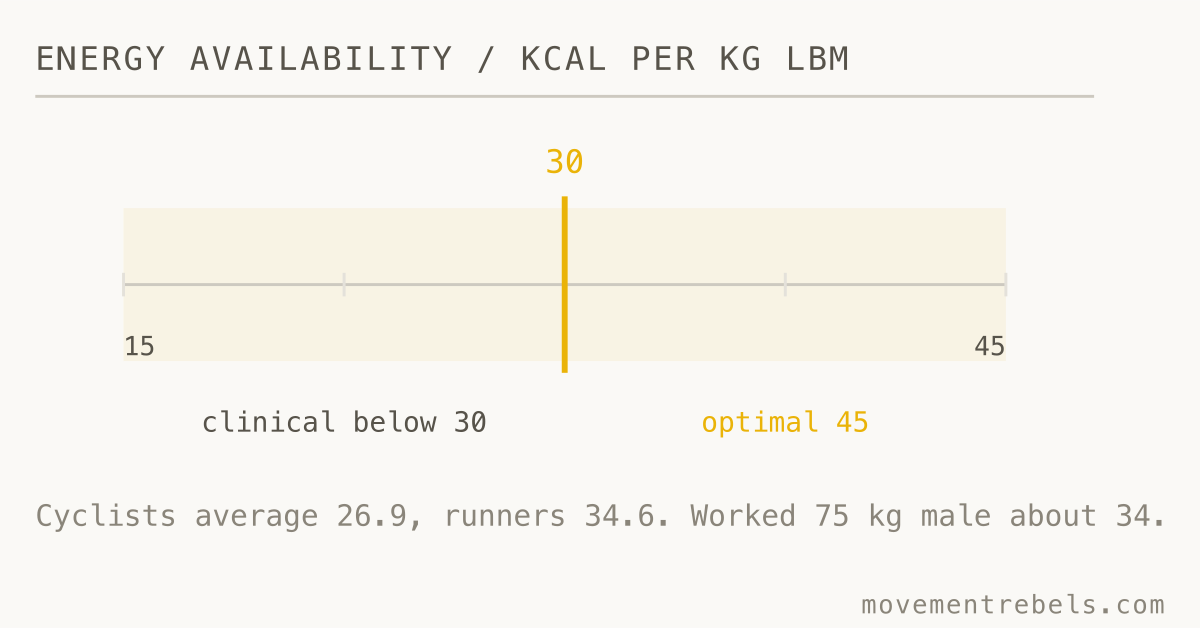
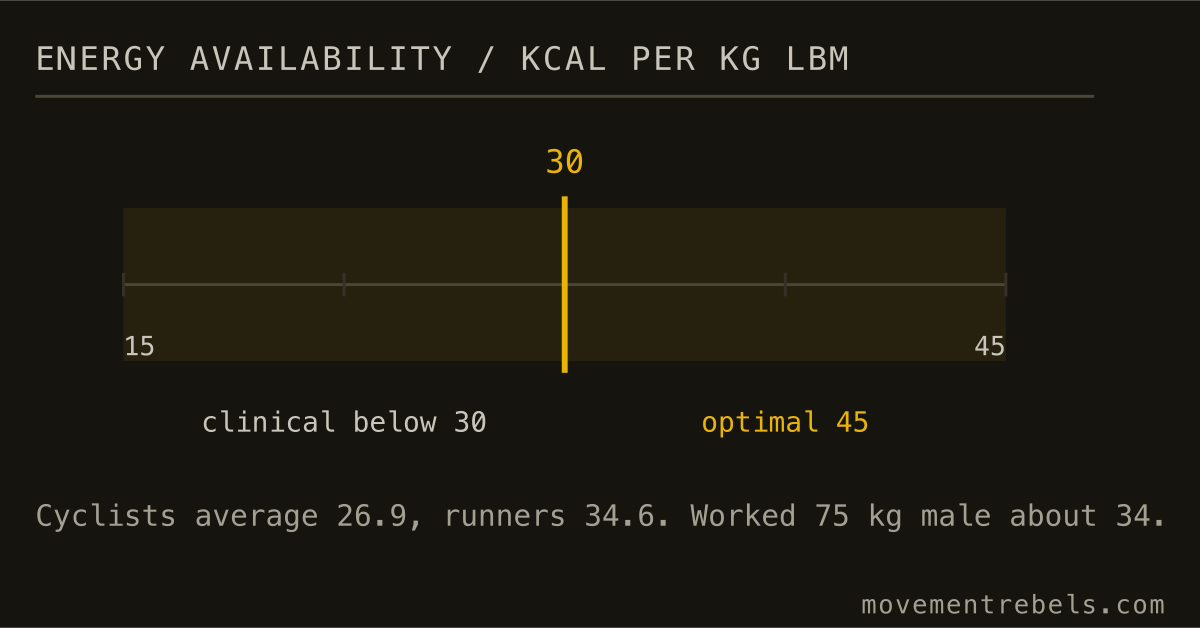
The threshold that consistently shows up in the research is around 30 kcal/kg lean body mass per day. Below that, the body starts rationing: reproductive hormones drop, bone turnover shifts catabolic, metabolic rate suppresses, and the immune system deprioritizes. The body is conserving resources it no longer trusts will arrive.
The "45 kcal/kg lean body mass" figure is the generally accepted optimal floor for health maintenance. Anything between 30 and 45 is a risk zone; below 30 is where clinical consequences appear.
For a 75 kg male athlete with 65 kg of lean mass training ten hours a week, the math can get tight quickly. A 3,000 kcal intake against 800 kcal of daily exercise energy expenditure leaves 2,200 kcal for the rest, which works out to roughly 34 kcal/kg lean mass. That sounds fine until a heavy week adds two extra sessions and expenditure climbs. Many athletes never adjust intake upward when training load spikes. That gap is where RED-S lives. Start by running a TDEE calculator to find maintenance calories so you can see the real size of the gap between what you burn and what you eat.
Why Male Athletes Get Missed
The research on RED-S in men has lagged significantly behind the female literature, largely because the most visible marker in women, loss of menstrual function, has no direct male equivalent. There is no single flag that goes to zero and forces a clinical conversation.
What male athletes get instead is a subtler cluster: libido decline, loss of morning erections, unexplained strength plateau, mood flatness, poor sleep quality, and recurrent minor illness. Any one of those is easy to attribute to overtraining, stress, or age. Together they point toward a hormonal axis that is being rationed.
The research broadly shows that chronic under-fueling disrupts the hypothalamic-pituitary-gonadal (HPG) axis, producing reduced testosterone and luteinizing hormone. This is not primary hypogonadism, it does not mean the testes are failing. It means the brain has downregulated the reproductive axis as part of a larger resource-conservation response. Fix the energy deficiency, and the axis typically recovers. Leave it running for months or years, and the downstream consequences, including bone loss, accumulate.
How Common Is This in Male Athletes
More common than most people assume. Studies of competitively trained male endurance athletes consistently find that a substantial proportion, often the majority of participants, fall below the 30 kcal/kg lean body mass threshold or are operating in the risk zone just above it. Cyclists tend to show lower energy availability than runners in the same cohorts.
These patterns appear in recreational and competitive athletes, not just elite professionals. Training volume and under-eating are colliding in the middle of the amateur athlete population at a rate that is not yet reflected in clinical awareness or coaching practice.
The Performance Consequences Come Before the Lab Values
This is the part that should concern any athlete who thinks they will notice RED-S via a dramatic health event. A controlled intervention study that induced a 25% energy deficit in 12 trained male endurance athletes, each serving as their own control over 14 days, found that explosive power declined significantly, with countermovement jump height dropping measurably, before hormonal changes became apparent. The performance penalty leads the hormonal signal.
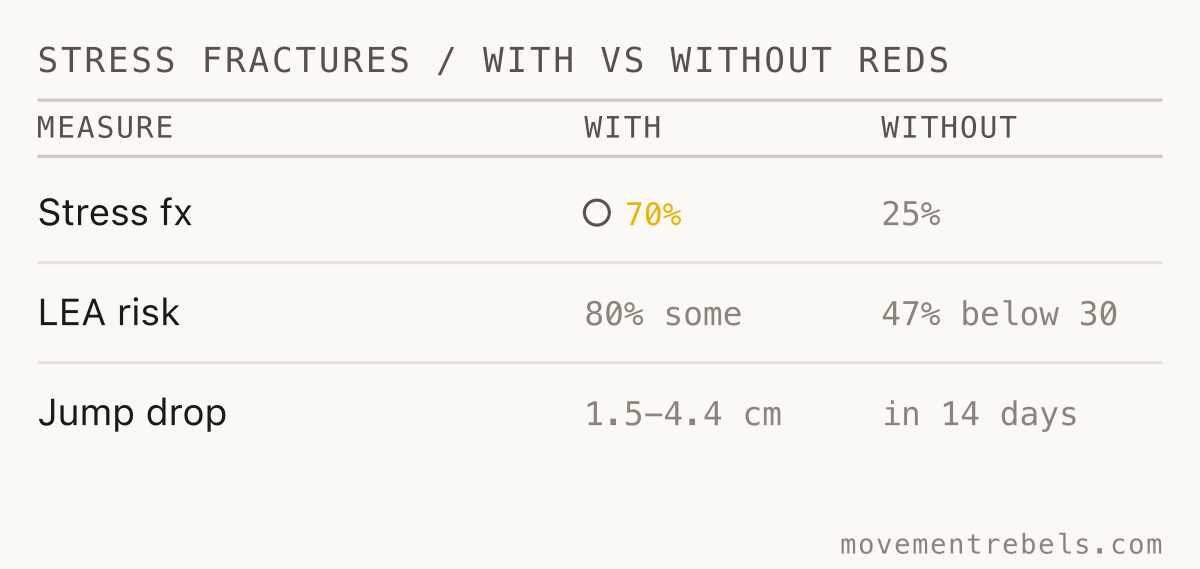
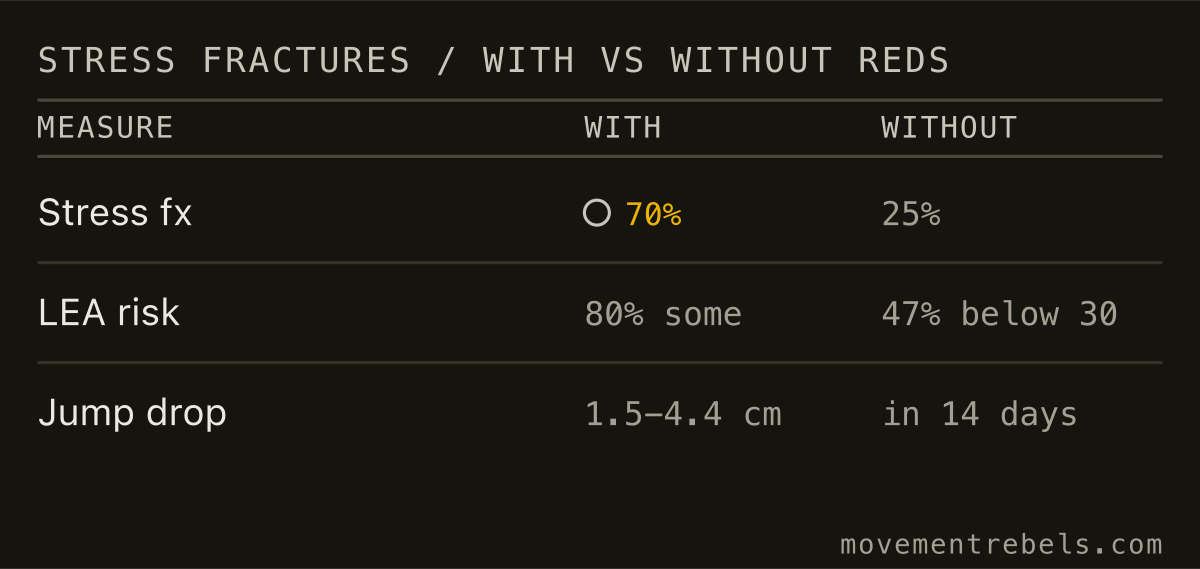
Hemoglobin dropped. Well-being scores fell. Cognitive restriction around food increased. All of this happened in 14 days at a level of deficit that many athletes sustain for months while attributing the flat sessions to "overtraining" or "a rough block."
The broader consequences that develop over longer deficits are well-documented in the IOC consensus and subsequent research:
- Bone health. Studies broadly find that athletes with RED-S have substantially higher rates of stress fractures than those without. Bone formation markers are suppressed; resorption markers are elevated. Endurance athletes are far more affected than strength athletes.
- Immune function. Chronic under-fueling suppresses immune response, increasing illness frequency and the duration of each episode.
- Muscle protein synthesis. Inadequate energy blunts anabolic signaling independent of protein intake. You can hit a 1.8 g/kg protein target and still fail to recover adequately if total calories are insufficient. A protein calculator sets the daily gram floor that has to sit on top of adequate total energy, not in place of it.
- Metabolic rate. The body lowers resting metabolic rate as a conservation measure. This is why heavy training blocks without adequate fueling lead to fatigue that sleep does not fully resolve.
Warning Signs Worth Taking Seriously
None of these are diagnostic on their own. They are reasons to review fueling, consult a professional, and stop attributing every symptom to insufficient willpower or insufficient training.
In male athletes, watch for:
- Persistent fatigue despite adequate sleep, particularly after easier training days
- Power or strength plateau or decline over a multi-week block when load has not increased
- Recurrent minor illness, more than two to three respiratory infections per training year
- Libido decline or loss of morning erections
- Mood change: low motivation, irritability, or emotional flatness that tracks with training volume
- Stress fractures or bone stress injuries, especially multiple in the same season
- Unexpected weight loss during a phase when you were not trying to lean out
- Low resting heart rate with low performance, not the adaptation version you want, but the resting-low-with-flat-outputs version
For female athletes, menstrual cycle changes remain a critical signal. Missed periods, irregular cycles, or cycle shortening during a training buildup are medical symptoms that warrant a full workup, not something to normalize as a sign of hard training. The training around the menstrual cycle guide covers how cycle phase interacts with training response.

The Diet Culture Complication
There is an uncomfortable overlap between RED-S and deliberate body-composition goals. Endurance athletes chasing power-to-weight ratios, cyclists managing climbing weight, CrossFit athletes leaning into aesthetic competition standards: all of these contexts create structural incentive to under-eat. If you are intentionally cutting, a safe calorie deficit check keeps the loss rate inside a range that does not tip into the chronic deficit this guide warns about. Sometimes that incentive is internally generated. Sometimes it comes from coaches, sport culture, or comparison with images of elite athletes whose weight is not always a healthy outcome of their training.
The IOC's 2023 consensus explicitly addresses this. RED-S is not synonymous with eating disorders, but it does exist on a continuum with disordered eating, and the two conditions amplify each other. The supplement industry benefits from an athlete who attributes poor performance to inadequate micronutrients or insufficient recovery products rather than to under-eating. The honest intervention is usually adding food, not adding a supplement stack.
If eating restriction feels compulsive, food is anxiety-producing, or body image is a persistent source of distress, that deserves professional support beyond a dietitian. Eating disorder treatment that understands athletic performance is worth finding.
What to Eat, and When
This guide is not a nutrition prescription. A sports dietitian who can assess your load, body composition, and biomarkers is the right next step if you suspect RED-S. The broad principles, consistent with the IOC consensus and the fueling around long sessions guide:
Fuel for the training you are doing, not for the training you did last month. When load increases, intake needs to follow within days, not weeks. Carbohydrate is the primary fuel for moderate to high-intensity work, and carbohydrate undereating is its own sub-category of concern even when total calories look adequate. The gut training and carb tolerance guide covers how to build the carb tolerance that high-volume sessions demand.
Peri-session fueling matters. A long run or ride in a fasted or under-fueled state is a deliberate training adaptation for a specific context, not a default. The train fasted or fuel first guide covers when that choice is appropriate and when it is working against you.
Do not use supplements as a proxy for food. Protein powder, amino acids, and recovery blends do not compensate for a chronic caloric deficit. The evidence-backed supplements guide covers which supplements have actual research behind them and which are marketing.
The Difference Between Overtraining and Under-Fueling
These two conditions overlap symptomatically, which is why they get confused. Both produce fatigue, mood decline, performance plateau, and elevated resting heart rate trends. The practical distinction:
Overtraining is a load problem: too much stress, not enough recovery. The fix is load reduction.
Under-fueling is an energy problem: too little fuel for the training being done. The fix is fueling up, and critically, fueling up before reducing load.
The error to avoid is treating under-fueled RED-S by cutting training volume without addressing intake. Volume reduction relieves the immediate energy debt but does not restore the hormonal axis, bone health, or immune function. Those recover when energy availability is adequate, not when training stops.
If the overtraining signs look familiar but nothing is improving despite reducing load, get fueling and biomarkers checked. The two conditions can coexist, and treatment for one without the other does not resolve either.
How HRV and Wearable Data Can Flag the Pattern
Chronic under-fueling produces characteristic trends in physiological data that wearables capture over time. Resting heart rate climbs over days to weeks. HRV trends downward, not the single-day dip that follows a hard session, but a 7-14 day suppression that does not respond to easy days or rest.
Garmin's own Body Battery and stress tracking will reflect this if you are wearing the device consistently: chronic depletion that does not recover overnight even when sleep duration is adequate.
Apple Health on iOS captures HRV trend from any device that writes to it, including those that export recovery metrics through the Health app. A multi-week declining trend without a clear training-load explanation is worth investigating through a fueling lens.
The HRV-guided training guide covers how to read the trend signal rather than reacting to daily noise. The resting heart rate trends guide covers the resting HR arc that typically accompanies chronic under-fueling.
These data points do not diagnose RED-S. They give you an objective signal to bring to a sports physician or dietitian and say: "here is what my physiological data has been doing over the last six weeks, and here is what my training and fueling have looked like." That is a much more productive clinical conversation than "I feel flat."
How Movement Rebels Handles This
Fueling and load belong in the same view, not in separate silos. Rebel Fuel gives you a weekly intake record to hold against your training load, and telling the coach you are in a deficit lets it read a rising resting heart rate and a falling HRV trend as fueling signals rather than noise. A persistent gap between load and fueling over multiple consecutive days is the pattern to look for.
Structured sessions push to your Garmin watch, and the post-session file comes back through the native integration. The coach reads actual work completed, not just planned work, which matters because a hard week that ran long or added an unplanned session is often the week where athletes forget to eat more.
If the load increased and your fueling has not moved in three days, that is the context to bring to your check-in, and it can factor into the next session recommendation. The approach is the same one covered in the data-driven athlete guide: your training data is not useful in isolation. The coach reads it alongside the context that makes it meaningful: how you slept, how you felt, and what you tell it about your fueling.
For athletes who are also working through recovery from overtraining, the training stress vs life stress guide is relevant context. Life stress and training stress both drain the same recovery resources, and fueling needs to account for both.
Movement Rebels does not replace a sports physician or registered dietitian. If the signs in this guide look familiar and they have persisted for more than a few weeks, see a professional. What the coach can do is help you bring better data to that appointment, catch the fueling-load imbalance before it becomes a clinical presentation, and adjust your training plan to reduce load while you rebuild energy availability.
Pricing
Movement Rebels includes training, fueling, wearable integration, and AI coaching in one app. A 7-day free trial covers the full surface with no card required. After the trial, Pro+ is $20/month for unlimited coaching.
One app instead of five.
Strength, endurance, recovery, fueling, planning, and your AI coach. All under a 7-day free trial. No card.
Start 7-day trialWhy Women and Men Fuel Differently: Macro Targets, Timing, and Iron
How women and men differ in fueling: carbohydrate and protein targets, menstrual cycle effects, iron needs, and the energy availab
Carbohydrate Timing for Athletes: Fueling Around Long Sessions
How many grams of carbohydrate and when: 1 to 4 g/kg before training, 30 to 90 g per hour through long sessions, and the 4 hour re
Overtraining Signs: The Ones Worth Watching
True overtraining syndrome is rarer than you think, has no reliable biomarker, and is almost never what recreational athletes have
HRV-Guided Training: Read the Signal, Skip the Noise
One low HRV night tells you almost nothing. The 7-day-vs-28-day trend tells you nearly everything. Here is what the evidence actua