Train Fasted or Fuel First? Morning Workout Nutrition
Fasted training raises fat oxidation during that session. That is the whole reliable effect. It does not improve performance, add power output, or make you faster. Most people who roll out of bed to run on empty are collecting a real metabolic stimulus and a real performance cost at the same time, then confusing the two.
The industry has spent a decade selling fasted cardio two ways: as a fat-loss cheat code (mostly wrong) or as a metabolic flexibility hack for serious athletes (partly right, and misapplied by most people who try it). The honest version is quieter. Fasted training is a tool with one narrow use case, beside the point for most morning sessions and worth reaching for in a small slice of them.
What Fasted Exercise Actually Does
Train after an overnight fast and insulin sits low, glucagon runs high, and your body shifts substrate preference toward fat. Free fatty acids climb. The research broadly confirms roughly double the circulating free fatty acids in the fasted state compared to the fed state, and genes for fatty acid transport and beta-oxidation in the muscle fibers get upregulated alongside it.
The signaling is real. Low muscle glycogen activates AMPK and p38MAPK, which switch on PGC-1 alpha, the transcription factor that drives mitochondrial adaptation, and the glycogen threshold hypothesis maps a specific glycogen window where those signals fire hardest. Above the window, blunted. Below it, the adaptations show up.
The adaptation record across studies is consistent. Most research shows enhanced cell signaling, gene expression changes, and increased oxidative enzyme activity from fasted and low-glycogen training protocols, so the stimulus for substrate flexibility is legitimate. Then people confuse signal with outcome.
What Fasted Exercise Does Not Do
Here is the part that gets buried. Molecular adaptation and performance adaptation are two different things.
Most evidence shows only a minority of studies on train-low protocols demonstrate performance improvements, while the majority show no change, and systematic reviews of the topic consistently find that pre-exercise feeding enhances prolonged aerobic performance while fasted exercise shows no significant benefit for performance. Feeding helped. Skipping it did not.
The evidence also notes that pre-exercise feeding blunts some signaling related to mitochondrial adaptation, so there is a trade-off here, and it is a real one: eat and perform better, or fast and get the stronger training signal. The industry says you get both. You are choosing.
At intensity the case against fasting gets stronger, because carbohydrate is the primary fuel there and compromised carbohydrate oxidation at high effort is the mechanism that costs you. The consensus across sports nutrition research is clear: endurance athletes should avoid high-intensity training while fasting. Running intervals, threshold work, VO2 max sessions, heavy lifting. All worse on empty. The fasting stimulus does not pay for the quality you lose.
Then the fat-loss claim. Short-term fat oxidation during a fasted session is real, but total daily fat oxidation is not materially different once you zoom out to the full 24-hour picture, and the evidence broadly shows no significant difference in body composition changes between fasted and fed aerobic exercise groups over time. Energy balance across the day wins.
The "Substrate Flexibility" Argument: Where It Holds
Substrate flexibility. That is the strongest case, not fat loss and not performance: teaching the body to switch fuel sources efficiently depending on what is available and what the session demands. Elite endurance athletes who periodically train at low carbohydrate availability build stronger fat-burning machinery, and it pays off in the long events where glycogen eventually runs low.
That is the "train low, compete high" framework: selected easy and moderate sessions run on reduced glycogen availability to fire the adaptation signals, while every quality session, race, and high-intensity block gets fueled properly. Fasted morning runs fit here when the session is easy and short. Not when you are expecting good splits.
The key word is "periodized." Fueling around long training sessions covers how chronic under-fueling is a far more common problem than over-fueling, and how the daily carbohydrate picture matters more than the state of any single session. Training low chronically is not training low strategically. Chronic under-fueling erodes training quality, raises injury risk, and in its more severe form feeds the relative energy deficiency patterns described in RED-S and low energy availability. A fasted session you chose is a tool. A fasted session you fell into because there was no time for breakfast is under-fueling with a better story.
The Decision Heuristic: What Session Are You Doing?
The research converges on one framework. Ignore the hype. Use this:
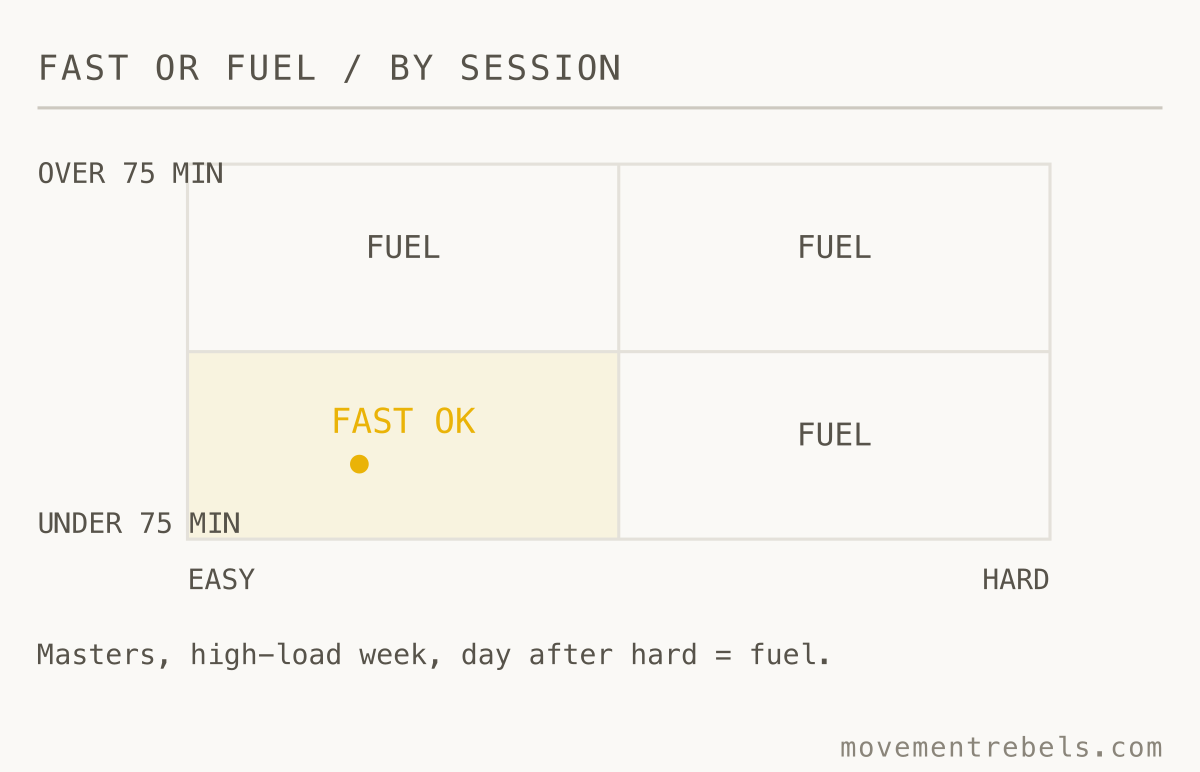
Fast before the session if:
- The session is easy, below lactate threshold, mostly aerobic. Zone 1 or low Zone 2 running, easy cycling, light movement work.
- Duration is under 60 to 75 minutes. Past that, even moderate intensity pulls glycogen down meaningfully.
- You are an experienced athlete with a metabolic base under you. Beginners who spend their first sessions glycogen-depleted suffer and adapt slowly.
- You are periodizing nutrition alongside training intensity inside a structured plan, and periodization for recreational athletes shows how carbohydrate availability fits into a training block.
Fuel before the session if:
- The session carries any real intensity: intervals, threshold, tempo, strength, HIIT, circuits.
- It runs past 75 minutes, at any intensity.
- You are deep in a high-load training week. With fatigue already stacked, the marginal metabolic signal from fasting does not cover the quality you give up, and HRV-guided training carries the readiness signal that should shape the call.
- You are a masters athlete. Evidence on fasted training in athletes over 40 is thin, and the protein catabolism risk weighs heavier when muscle mass is harder to rebuild. See masters athlete training for the nuance.
- Yesterday was hard. Two glycogen-depleted sessions back to back is a hole, not a strategy.
Not sure where the session falls? Fuel it. A quality session fueled poorly costs you more than an easy session fueled when it did not need to be.
Pre-Workout Nutrition When You Fuel
Timing and composition matter when you eat. The standard is a full meal two to four hours out, built from 1 to 1.5g of carbohydrate per kg of bodyweight, 20g of protein, low fat and fiber so the gut clears before effort. For a 70kg athlete that is 70 to 105g of carbs. Rice and eggs. Oats with banana and protein, or toast with a shake. Our guide to protein timing around your sessions covers how the pre and post doses fit together.
Early risers who cannot get a two-hour buffer take a smaller shot 30 to 60 minutes out. Carb-forward and low-fiber. Banana, white toast with honey, a small bowl of oats, half a serving of a simple shake. You are topping up liver glycogen and dampening cortisol, not sitting down to breakfast, and the gut training guide covers how regular early-morning fueling trains the gut to handle pre-session food better over time.
What does not work: a handful of almonds or a protein bar on the way to the gym, because fat and protein slow gastric emptying and neither tops up muscle glycogen meaningfully in 30 minutes. Fuel with carbs. Give them time to absorb.
Caffeine Is a Separate Question
Caffeine explains part of this. Most people who train fasted also train caffeinated, and caffeine at 3-6mg/kg of bodyweight has consistent evidence for performance across effort types. The clarity and the drop in perceived effort are real, and they come from the caffeine. The missing pre-workout meal often is not the active ingredient people think it is. Train fasted and the coffee may be doing the work. See caffeine for endurance athletes for the dosing and timing framework.
Who Actually Benefits From Fasted Training
Profiles where fasted training earns the deliberate application:
The time-crunched endurance athlete who trains 5 to 8 hours a week and puts one or two easy morning sessions in it. Spend those on substrate flexibility and you pay nothing in quality, because the quality sessions sit at times of day when eating is possible. Cheap metabolic breadth.
The cyclist or runner building aerobic base through high easy-volume weeks. Zone 2 cycling at 60-70% of max heart rate draws modestly on glycogen, so a 45-minute fasted morning spin is a clean application of the stimulus. Past 60 minutes, bring a fueling plan. The zone 2 training guide and the fueling around long sessions guide cover how these sessions fit into a week.
Nobody in their first year of training. Beginners need quality sessions, consistent fueling, and enough stimulus to build a base, and the substrate flexibility signal needs a developed aerobic system before it does anything useful with it. Get the base first.
What the Industry Gets Wrong
The supplement economy runs on this topic. Fat-burning morning formulas, ketone esters, MCT oil in coffee, all sold as "enhancing" fasted training. No supplement changes the physiology underneath. Low insulin drives fat oxidation, and that happens as reliably on water and black coffee as on a stack of capsules.
Fasted cardio marketing conflates "higher fat oxidation during this session" with "losing more body fat overall." The evidence does not support the link. Your body is not a stopwatch tallying each session's substrate use and subtracting it from fat mass, and energy balance and total training load across the week are the dominant variables. A quality interval session fueled properly does more for body composition than a shuffling fasted run where intensity collapses after 20 minutes.
How Movement Rebels Handles This
The fueling decision arrives with the session prescription. When the coach writes an easy Zone 2 run for Tuesday morning, it names the session type and says whether to fuel first, based on the week's load pattern, instead of leaving the fueling call in a separate note. Hard Monday, easy recovery run Tuesday. The coach tells you Tuesday is a candidate for a fasted window if you want the metabolic signal, or fueled if recovery is the priority.
Garmin Connect is live, so the completed session syncs back on its own, and Apple Health is live on the iOS app, feeding HRV, resting heart rate, sleep data, and workout data into the coach's readiness picture. Monday's HRV down, sleep poor? The fasted-Tuesday framing shifts, and it shifts off the data coming from your devices, not off a generic template.
Rebel Fuel logs what you eat and when. Under-fuel on early-session days often enough and the coach sees the pattern, not one lonely session. It flags chronic under-fueling before training quality erodes, and it suggests a pre-session carbohydrate target calibrated to the actual session type and your bodyweight, instead of a generic "eat a banana" cue.
Readiness comes from HRV-guided training, session structure from the coach, fueling guidance from Rebel Fuel. Same app. Same data.
Pricing
One app for the whole picture: strength, endurance, hybrid, planning, coaching, fueling, recovery, tracking. The 7-day free trial covers all of it. No card. After the trial, Pro+ is $20/month for unlimited coaching.
One app instead of five.
Strength, endurance, recovery, fueling, planning, and your AI coach. All under a 7-day free trial. No card.
Start 7-day trialThe Post-Workout Protein Window Is a Myth
The 30-minute post-workout protein window is mostly a myth. Your real window is closer to a day. Here is what the research shows,
Carbohydrate Timing for Athletes: Fueling Around Long Sessions
How many grams of carbohydrate and when: 1 to 4 g/kg before training, 30 to 90 g per hour through long sessions, and the 4 hour re
Zone 2 Training: When It Works, When It's a Waste
Zone 2 is real, old, and oversold. Here's the honest version: when low-intensity volume is your highest-leverage work, when it isn
HRV-Guided Training: Read the Signal, Skip the Noise
One low HRV night tells you almost nothing. The 7-day-vs-28-day trend tells you nearly everything. Here is what the evidence actua