Connect Training Data to ChatGPT or Claude: Why the Workflow Breaks
Here is the scenario. You export last week's Garmin training load, paste the CSV into ChatGPT, and ask what you should do tomorrow. The reply sounds coherent. Then you remember: it doesn't know your last 12 weeks, it doesn't know you skipped Tuesday because your knee flared, it doesn't know your strength numbers are stalling, and it has absolutely no memory of the conversation you had with it yesterday. You are back to the same empty context window you started with.
People have tried to solve this by automating the exports, building custom GPTs, and piping wearable data into Claude via APIs. The machinery can work. But it is solving the wrong problem. The real issue isn't the data format. It's that you have to ask at all.
The pull-model trap
ChatGPT and Claude are pull systems. They respond when you initiate. That structure has a flaw that no custom GPT or export automation can fix: you are least likely to ask when a coaching intervention is most needed.
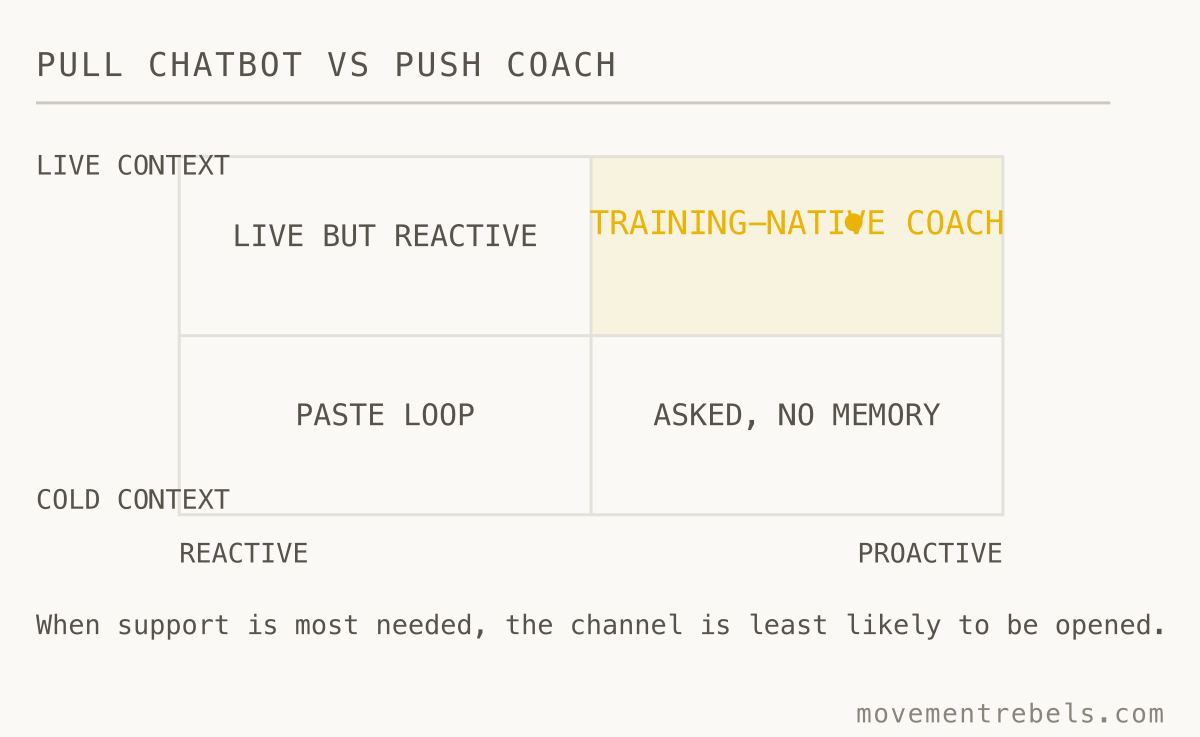
Early research testing LLMs as coaches has identified this exact pattern. The systems work reasonably well on planning and education but tend to fail in the moments that matter most: when motivation is low or fatigue is accumulating, users rarely seek guidance. An LLM cannot proactively notice that HRV has dropped for three consecutive mornings and push a recovery prompt. It waits to be asked.
That is not a quirk of the LLM. It is structural. A general-purpose chatbot is a question-answering tool. Coaching is a push discipline. The two are not the same thing.
Three jobs the athlete has to do instead
When you route your training data through a general LLM, you absorb responsibilities the model cannot carry.
You become the data pipeline. Every session starts cold. Paste the TSS summary, then the HRV chart, then describe how the legs felt, then add the strength numbers. Five minutes of formatting before a single useful exchange. For the load number itself, a Training Stress Score calculator for your sessions gives you the figure directly instead of asking a chatbot to infer it. Skip one data point and the advice drifts wrong, and the model won't tell you it drifted, it will just answer anyway.
You become the memory layer. The model has no idea you raced a half-ironman eight weeks ago, that you train fasted three mornings a week, or that your left shoulder has a long history you've mentioned a dozen times in prior sessions. You can write a long preamble every time. Most people don't, so advice trends toward the generic over time.
You become the safety filter. AI systems without a persistent athlete model and automatic data intake have no reliable way to flag dangerous load accumulation or recommendations that conflict with a known injury history. Without ground-truth data flowing in automatically, a general LLM will confidently recommend a 90-minute threshold session the day after a heavy long run. You catch it, or you don't.
The copy-paste loop is not a coaching workflow. It is a riddle you set for the LLM, and the answer quality is bounded by how well you wrote the riddle.
What the research actually says
Studies testing general LLMs as coaches are still early and methodologically thin. The evidence broadly shows low rigor across most published evaluations: small samples, short follow-up windows, and limited use of real user-generated data. Take any headline finding with appropriate skepticism.
The honest read: general LLMs are good at producing plausible-sounding plans. Research has found that recreational athletes often rate AI-generated training plans highly, and expert coaches in pilot studies have sometimes found them difficult to distinguish from human-created plans at first glance. Plausibility is achievable.
Personalization to live data is a different matter. The research consistently finds that LLMs used as coaches "lacked access to the runner's physical state during training sessions," with all feedback remaining retrospective. Knowing what happened after the fact is a long way from adjusting intensity in real time or proactively shifting next week's load based on a pattern you haven't mentioned yet.
If you are struggling with information overload from your wearables, adding a general-purpose LLM to the loop typically makes it worse, not better. You now have one more conversation to maintain.
The better architecture: bring the reasoning to the data
The right inversion is putting the LLM inside the app that already holds your data, rather than pulling data out into a chat window. When the LLM has structured, current, automatic context on every turn, you get to ask "should I deload this week?" without typing a single number.
That is the design choice behind Movement Rebels. The coach inside the app uses the same class of models (Claude, Gemini, routed by task) but the models see data they were never given access to in a copy-paste workflow.
How Movement Rebels connects your training data
The live integrations, what actually flows in automatically:
Garmin Connect is a native OAuth integration. Completed activities land in the app automatically: TSS, training load, HRV, body battery, sleep. The coach reads the file, not your description of the file. Structured workouts push the other way: the coach generates tomorrow's session and sends it to your watch. You tap start. See the full picture in the Garmin AI coach guide and the guide on pushing workouts directly to your Garmin watch.
Apple Health via HealthKit is live on the native iOS app. The coach reads HRV, resting heart rate, sleep duration, and workouts that exist in Apple Health. This is also the path for devices that export to Apple Health. Oura Ring exports sleep, HRV, and resting HR to Apple Health, so those metrics flow into MR automatically. WHOOP does not export its recovery or strain scores to Apple Health, so MR cannot read WHOOP scores. The honest path for WHOOP users is to bring that context to the coach in conversation. See the Apple Health AI coach guide for exactly what HealthKit surfaces.
Strava connects read and write. Activities sync in automatically from Strava. In the other direction, after each session the coach writes a structured summary back to your Strava activity description, so your Strava feed stays current. To be clear: MR does not analyze Strava as an AI data input. Strava-sourced activities appear in your history; the analysis layer sits on top of the data MR holds directly.
Strength and body data come from the in-app exercise codex, including PRs, baseline tests, and progression on every named lift. Body composition trends, biohack history (breathwork, cold exposure, fasting), and fuel logs from Rebel Fuel all feed the same context the coach draws from.
Athlete Memory persists across conversations. Mention a knee issue in March and the coach still knows about it in August when you ask about your run plan. This is the piece that custom GPTs partially approximate but cannot replicate from live data automatically, because there is no live data stream for a general LLM to watch.

The push difference
The practitioner-level shift is that a training-native AI works as a push system. It does not wait for you to ask. When your HRV drops for three mornings running, the coach flags it before your next planned hard session. When your fuel log shows a 600 kcal deficit three days in a row and you have a threshold run tomorrow, the coach notes the pairing. When your resting heart rate trends upward over a two-week window, it shows up in the morning brief before you've opened the app to check.
You can still ask anything in the chat. But the leverage is in what surfaces without being asked.
The HRV-guided training model is the clearest example: reading the signal only works if the signal is being read continuously, not just on the mornings you remember to check.
One honest note on Strava
If you use Strava for its reach, the friends' feed, the segments, keep using it. Movement Rebels has crews, a feed and high fives of its own, at a much smaller scale, and no segments. MR replaces Strava's training value: planning, logging, AI coaching, recovery read, fueling. The read-write integration means your activities still post to Strava with a session summary the coach writes. The social side stays entirely intact. The Strava AI coach guide covers exactly how the read and write flows work.
What a general LLM is actually good for in training
This is worth being honest about. If you have a specific, bounded question, "what are the current recommendations for protein timing around strength sessions?", a general LLM gives you a useful, fast answer. For a bounded number like turning your heart rate figures into usable bands, a purpose-built tool to calculate your heart rate training zones does it faster and more reliably than pasting numbers into a chat window. If you want to stress-test a plan you already have, Claude or ChatGPT is a reasonable sounding board. For masters athletes managing age-related recovery or athletes returning from injury, one-off context conversations with a general LLM can fill gaps.
What they cannot do is hold your live data, notice patterns before you do, adjust your plan in response to what your body is actually doing, and push you the relevant output without being prompted. Those are the things that make a coach a coach rather than a reference book.
How to set this up
If you've been pasting into ChatGPT or Claude, switching to a connected coaching layer takes about ten minutes.
- Sign up at app.movementrebels.com or download the native iOS app.
- Connect Garmin through the native OAuth flow (30 seconds). If you use Oura, it exports to Apple Health automatically and MR picks it up via HealthKit on iOS.
- Connect Strava if you want the read-write loop and the Strava summaries.
- Spend five minutes in onboarding: sport, goal, history, constraints. That context becomes the base layer of Athlete Memory.
- Open the coach and ask whatever you would have asked ChatGPT. Notice the answer references your actual data, not your summary of it.
Pricing
Seven-day free trial, full access to the coach, plan generation, snap meal, and every tool in the app. No card required. After the trial, Pro+ is $20/month for unlimited coaching, adaptive planning, and all integrations.
One app instead of five.
Strength, endurance, recovery, fueling, planning, and your AI coach. All under a 7-day free trial. No card.
Start 7-day trialHow the AI Coach Learns From Your Data: Periodization, Adaptation, and Feedback Loops
Adaptive is the most abused word in fitness apps. Here is what learning from your data means in practice: three feedback loops, re
Concept2 and Your AI Coach: Turn Erg Data Into Training
Connect your Concept2 Logbook and every RowErg, SkiErg, and BikeErg session syncs into Movement Rebels with split, watts, and stro
Garmin AI Coach: What Your Watch Knows vs. What a Coach Needs to Know
Garmin's built-in coaching balances run and ride load using its own metrics. An AI coach reading the same data programs everything
Apple Health as an AI Coach Data Layer: What It Passes Through
Movement Rebels reads Apple Health natively on iOS. But WHOOP doesn't export HRV, Oura's readiness score stays locked, and the coa