HIIT After 50: Intervals for the Aging Athlete
Here is the thing the "listen to your body after 50" crowd gets wrong: your body still responds to intensity. Research consistently shows that HIIT produces large, meaningful improvements in VO2max in older adults, including people well into their 60s and 70s. These are not marginal gains. They are the kind of cardiovascular adaptations you see in younger athletes who are new to structured training. The ceiling on cardiovascular adaptation does not collapse at 50. What changes is the cost per hard session and how many of them you can stack before things break.
The popular version of HIIT advice for older athletes runs in two equally unhelpful directions. One camp says do it exactly like a 30-year-old, just maybe take a gentler week every so often. The other says high intensity is dangerous past 50 and you should stick to brisk walks. Both positions ignore what the physiology actually shows. You can do real intervals. You need more recovery between them and a progression plan that respects what changes with age. That is the whole argument.
A practical note before the how-to: if you are new to high-intensity exercise and have been sedentary, or if you have a history of cardiovascular disease, hypertension, or joint problems, get medical clearance before starting a HIIT program. The research shows HIIT is safe for most older adults, including many with managed chronic conditions, but "most" is not "all." That conversation with your doctor takes twenty minutes and removes the main reason to hold back.
What VO2max decline actually looks like after 50
VO2max falls roughly 1% per year from around age 25 onwards in the general population, a rate documented across large cross-sectional and longitudinal datasets. By 50 that compounds into a meaningful gap. By 65 the average sedentary adult has lost 30-40% of the peak capacity they had at 25.
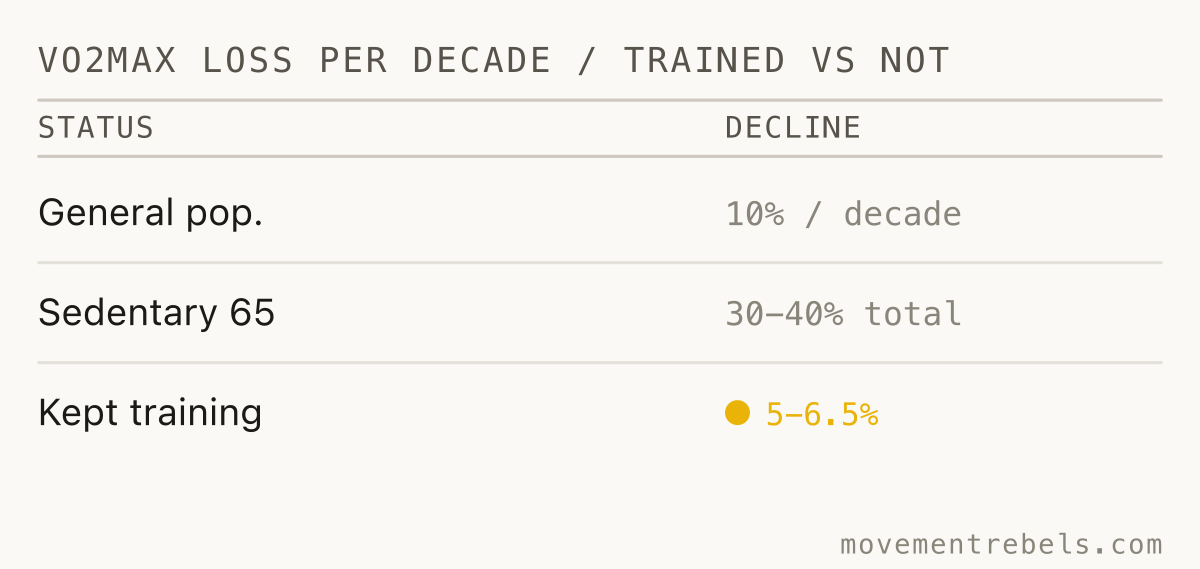
Masters athletes look dramatically different. The landmark study on aging masters endurance athletes already referenced in the masters athlete training guide found that changes in training volume explained 54% of the variance in VO2max decline in male athletes (39% in female athletes), not age alone. Athletes who kept training lost only 5-6.5% per decade. The question, then, is not whether you can maintain a high aerobic ceiling past 50. You can. The question is what kind of training gets you the highest adaptation per unit of recovery cost.
The answer is a mix of Zone 2 volume and genuine high-intensity intervals. Not one or the other. The aerobic base from Zone 2 work supports the quality of your interval sessions. The interval sessions produce the VO2max stimulus that Zone 2 alone cannot. You need both. To put a number on where you are starting from, a VO2 max calculator from the Cooper test gives you a baseline to track as the intervals do their work.
What HIIT does that moderate exercise does not
There is a ceiling effect on what moderate-intensity continuous training can do for VO2max once you have a reasonable base. To push the ceiling higher, you need to work at intensities that challenge your cardiac output: roughly 85-95% of maximum heart rate during work intervals. A heart rate zone calculator sets those upper-zone targets so you know the actual bpm range a hard interval needs to hit.
The ICFSR Global Consensus on exercise for older adults explicitly recommends high-intensity exercise for older populations. The consensus document notes that older adults remain very capable of undertaking high-intensity progressive resistance training even at very advanced ages, and separately supports HIIT for cardiorespiratory fitness across older age groups. The physiological case for going hard does not expire at 50.
What HIIT does mechanistically: it drives stroke volume adaptation (your heart pumps more blood per beat), increases mitochondrial density in working muscle, and improves arteriovenous oxygen difference. Moderate intensity hits some of these. High intensity hits all of them more forcefully per minute of work. The practical translation is that a well-designed 35-minute HIIT session can produce a VO2max stimulus comparable to 90 minutes at a moderate pace. For athletes over 50 who are managing work, family, and recovery capacity alongside training, that time efficiency is not a minor point.
What actually changes: the recovery cost per session
The intensity adaptation itself does not age out. The recovery window does.
Research on masters club runners doing interval sessions shows that neuromuscular markers, including voluntary activation, twitch force, and isometric force, can still show signs of fatigue in a subset of athletes at the 24-hour mark. Most masters runners recover fully within that window. A minority may not. In a younger athlete, full overnight recovery is the strong norm. In a masters athlete, stacking a second hard session the next day carries more risk of incomplete recovery, particularly for those who sleep poorly or carry high life stress. That is where overuse injuries come from, not from the intervals themselves.
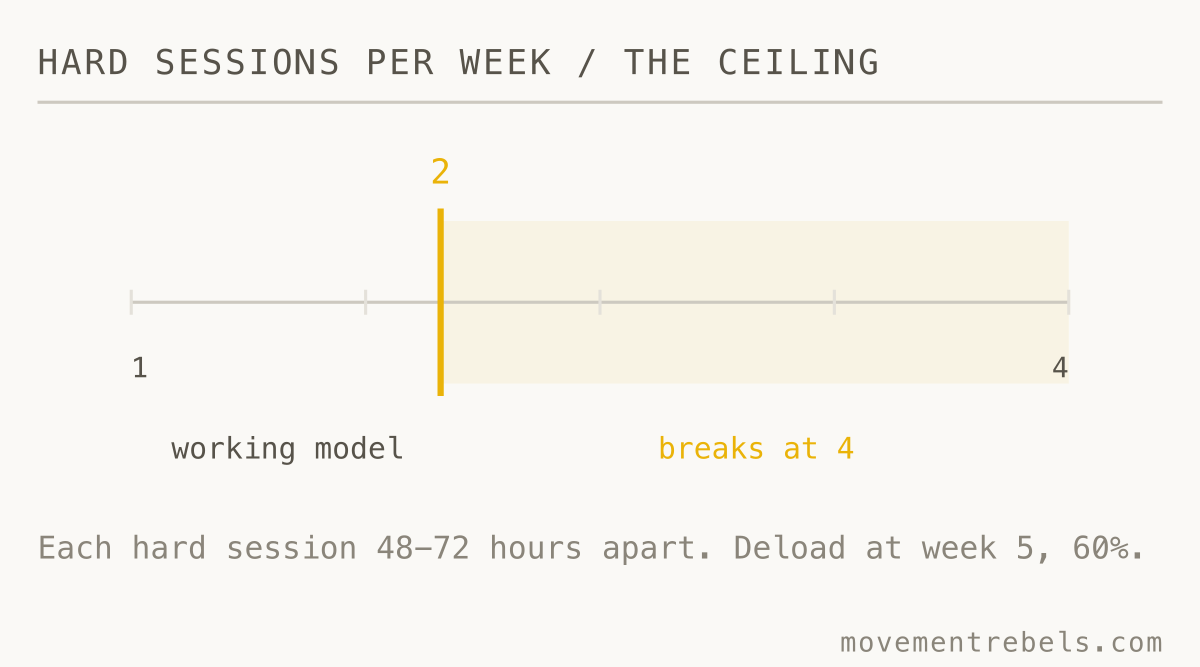
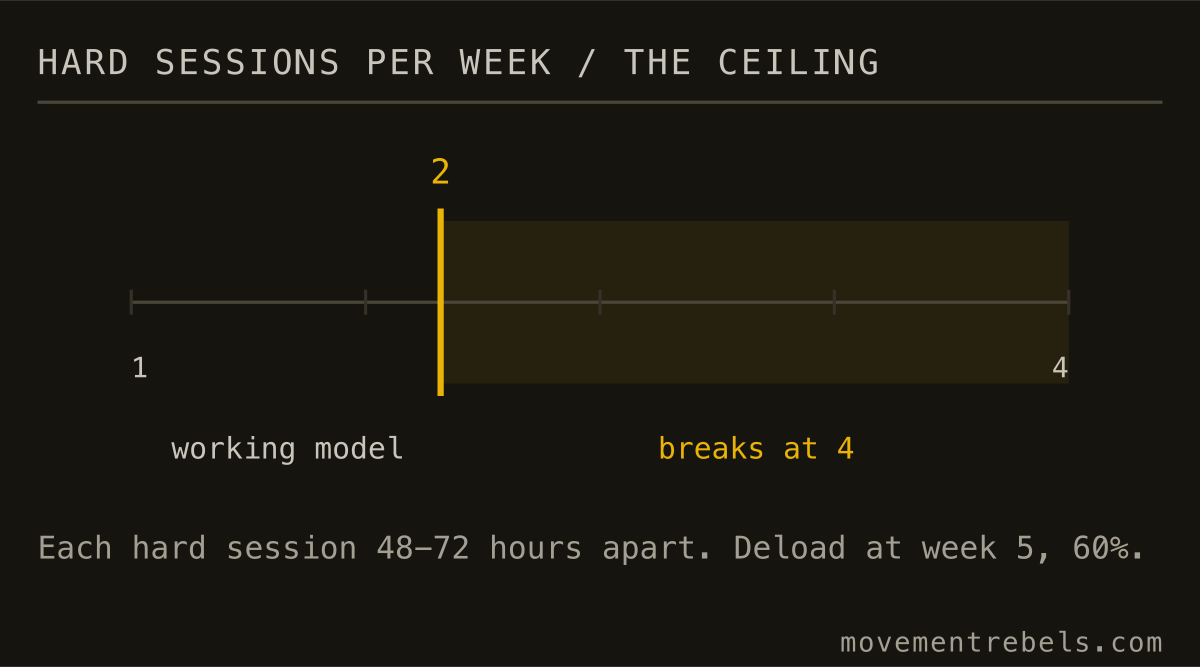
The working model for athletes over 50: two genuine high-quality sessions per week, each separated by at least 48 to 72 hours. Three hard sessions per week is the ceiling for athletes with strong aerobic bases who sleep well and manage life stress. Four is where things reliably break.
This is a different constraint from younger athletes, but it is not a dramatic one. What it means practically is that the filler days between hard sessions have to be truly easy. Medium-intensity days that feel moderate but sit above Zone 2 keep the nervous system in a state of unresolved fatigue. The recovery never lands. The next interval session starts from a depleted baseline. Over weeks, quality degrades, injury risk climbs, and the VO2max adaptation you were chasing stays just out of reach. See overtraining signs for the signals that distinguish normal training fatigue from a pattern that needs a reset.
How to structure intervals past 50
The classic HIIT formats designed for younger athletes often use 30-second all-out efforts with short rest. Those work, but they carry a higher neuromuscular cost than the aerobic benefit warrants for masters athletes. Slower VO2 kinetics after 50 mean that very short intervals spend a large fraction of the work period ramping up to the target zone rather than sustaining it.
The formats that deliver the most aerobic stimulus per unit of recovery cost for athletes over 50:
4x4 Norwegian intervals. Four minutes at 85-95% max HR, four minutes easy recovery, repeated four times. Total hard work: 16 minutes. This format has decades of evidence behind it and appears repeatedly in research on older adults as the most effective structure for VO2max stimulus. It gives your cardiovascular system enough time in the target zone to drive adaptation. You arrive at the target intensity early in each interval and sustain it, rather than finishing before you get there.
8x3 with full recovery. Three minutes hard, three minutes easy, eight rounds. Slightly shorter intervals but the same total high-intensity volume. Useful if 4-minute efforts feel technically compromised on the run because fatigue in longer intervals distorts form.
Hill repeats. Running uphill adds load without the joint impact of flat-ground speed. Six to eight 90-second hard efforts up a 6-8% grade, walking down for recovery. Naturally self-limiting: the incline slows you enough to avoid the pace-induced form breakdown that flat speed can produce. The hill training guide covers the technical side.
What to keep modest in number. Sprint intervals under 30 seconds, Tabata-style (20 seconds on, 10 seconds off), and AMRAP circuits are fine tools for younger athletes. For masters athletes they carry disproportionate neuromuscular cost, high tendon load, and limited time in the aerobic target zone. They are not off-limits, but they are not the highest-value format for the aerobic objective.

Progression: slower ramp, longer blocks
One of the underappreciated differences in masters HIIT programming is how slowly to add intensity across a training block. A 28-year-old can add a hard session every two weeks and absorb it. An athlete at 52 usually needs three to four weeks at a given load before the adaptation has consolidated enough to add more.
The adaptive training plan guide covers the general principles of progressive overload, but the masters-specific rule is: add one variable at a time and wait for it to land. If you increase session intensity (from 85% to 90% HR), keep frequency and duration flat for three weeks. If you add a third weekly hard session, keep the intensity and duration of each session the same for four weeks before changing anything else.
Deload weeks need to come sooner. A younger athlete can push a five or six-week block before a deload. At 50, the recovery cost of each week accumulates faster. A four-week block with a fifth week at 60% of normal intensity is a sensible default. That deload week is not lost training. It is when the adaptation from the previous four weeks lands. Skip it and the adaptation ceiling compounds at a lower level than it should.
The when to deload guide covers signal-based approaches. For masters HIIT athletes, the most reliable indicator is a seven to ten-day trend in morning HRV. A sustained depression of 10% or more below your rolling baseline, without an obvious acute cause like poor sleep or illness, usually means the deload needs to come earlier than planned.
Reading the data: what wearables tell you
Heart rate monitor precision matters more for masters HIIT than for any other training format. The work intervals need to hit 85-95% max HR to drive the cardiovascular adaptation. Too low and you are doing hard tempo work, which has value but not the same VO2max stimulus. Too high for too long and the session cost spikes without proportional adaptation gain.
Age-predicted maximum heart rate formulas (220 minus age) are unreliable at the individual level. A 58-year-old with a true max HR of 175 and a formula-predicted max of 162 will spend every intended hard interval stuck in a zone that is effectively moderate, wondering why the intervals feel easy and why fitness is not responding. Do a maximum heart rate test before setting interval targets, or use a recent race effort to anchor the estimate. The VO2 max intervals guide covers this calibration in detail.
HRV trend over seven to ten days is your clearest signal for whether the system is absorbing training or accumulating without recovery. A single low-HRV morning is noise. A seven-day trend below baseline is information. HRV-guided training explains how to act on the trend rather than the daily point estimate. For masters athletes, this signal becomes more reliable and more important than it was at 30.
Resting heart rate elevation of five or more beats above your personal baseline for more than two consecutive days is the other flag. Both metrics together, trending in the wrong direction, are a clear signal to replace the planned interval session with Zone 2 or rest. Resting heart rate trends covers how to read the pattern.
The supplement and gear ecosystem around aging and HIIT
Worth naming honestly: there is a large commercial ecosystem built around the idea that masters athletes need specialized products to do high-intensity training safely. Collagen peptides for joints, NMN for mitochondria, "recovery formula" protein blends, compression recovery boots, and the rest.
Some of these have real evidence behind them. Most do not, or have effect sizes too small to justify the cost. Protein timing matters: most sports nutrition guidelines put the daily protein target for exercising adults at 1.4-2.0g per kilogram of bodyweight, distributed across meals, with a dose of 0.25-0.40g/kg in the post-exercise window. For a 75 kg athlete that means roughly 19-30g after the session and total daily intake in the 105-150g range. In older adults, where muscle protein synthesis response per gram of protein is somewhat blunted, hitting the higher end of those ranges is sensible. That is real. The evidence for most proprietary supplements targeted at masters athletes is considerably thinner. See evidence-backed supplements for what is actually supported by the research and what is largely marketing.
What does have strong evidence: adequate sleep (7-9 hours, consistently), protein distribution, and fuel quality around hard sessions. The fueling around long sessions guide covers the carbohydrate side. Under-fueled interval sessions compound into chronic under-recovery faster in older athletes than in younger ones. Get the basics right before adding products.
How Movement Rebels handles this
The coach reads your completed activity files through Garmin's native integration and through Apple Health on the iOS app, which captures heart rate, HRV, sleep, and workouts from any device that writes to Apple Health.
For a masters athlete doing HIIT, this means: the weekly plan defaults to two hard interval sessions with 48-72 hour gaps enforced between them, aerobic base work filling the rest, and a deload block scheduled every four weeks. Heart rate zones are set from your actual max HR, not a formula, and interval targets are personalized to your zones rather than generic percentages.
When you start a session, it pushes to your Garmin watch with the work and rest intervals pre-loaded. If you drift above the target zone during a recovery interval, the watch buzzes. After the session, the coach reads the file and checks time-in-zone for the work periods. If your intervals were at 82% average when the target was 88-92%, it notes the gap and asks: heat? Hills? Starting too fast and dying? The prescription adjusts.
The seven to ten-day HRV trend from Apple Health or your Garmin informs whether the upcoming hard session goes ahead as planned or shifts to a Zone 2 day. The coach is reading the trend, not a single morning value. A bad night does not cancel your intervals. A five-day HRV depression does.
When the structured workout description syncs back to Strava after the session, it reflects what was prescribed. Strava data does not feed the coach's AI analysis; the coach reads activity data through Garmin and Apple Health directly.
Pricing
One app for the full picture: AI coach, strength, endurance, hybrid planning, recovery tracking, fueling, and wearable integration. A 7-day free trial covers the entire surface with no card required.
After the trial, Pro+ is $20/month for unlimited coaching.
One app instead of five.
Strength, endurance, recovery, fueling, planning, and your AI coach. All under a 7-day free trial. No card.
Start 7-day trialTraining Consistency When Life Is Busy: How to Keep Moving Without a Perfect Schedule
How to stay consistent when work and family eat the week: your maintenance dose, protecting intensity over volume, and a triage or
Masters Athlete Training After 40: What Holds You Back
The research is clear: most VO2max decline after 40 comes from training volume reduction, not aging. Here's what actually changes,
HRV-Guided Training: Read the Signal, Skip the Noise
One low HRV night tells you almost nothing. The 7-day-vs-28-day trend tells you nearly everything. Here is what the evidence actua
When to Deload: Reading the Signals Right
The 4-week deload rule is a template, not a law. Here are the actual physiological signals that tell you when your body is asking